
Foundation Water Problems in the Phoenix Metro Area
Phoenix-area homes can experience foundation problems even in a dry desert climate. Expansive and collapsible soils, intense monsoon storms, irrigation, and poor drainage can create uneven moisture conditions around foundations. Understanding how these factors affect your property can help you recognize warning signs, identify possible causes, and determine what steps to take next.
Phoenix Metro Foundation Water Problems at a Glance
The Phoenix metro area presents a unique combination of desert soils, seasonal storms, and human-controlled water sources. Some soils expand or collapse when wetted, while caliche layers can restrict drainage. Monsoon runoff, landscape irrigation, and changing soil moisture can contribute to foundation movement, cracking, and water accumulation around homes. Conditions vary across Phoenix, Scottsdale, Mesa, Chandler, Gilbert, and surrounding communities.
Why Foundation Water Problems Occur in the Phoenix Metro
Although Phoenix is known for its hot, dry climate, water and changing soil moisture can still affect residential foundations. Intense monsoon storms, landscape irrigation, variable desert soils, and local drainage conditions can create problems that homeowners may not expect.
The following factors help explain why foundation movement, cracking, and water accumulation can occur throughout the Phoenix metropolitan area.
Expansive and Collapsible Desert Soils
Soils across the Phoenix metro vary considerably. Some contain expansive clay that swells when wet and shrinks as it dries. Other soils may be collapsible, meaning their structure can compress when suddenly saturated, potentially causing settlement.
Both conditions can contribute to uneven foundation movement, but they behave differently. Expansive soils may push upward against a foundation, while collapsible soils can settle when wetted.
Not every Phoenix property has these soil conditions. The risk depends on the soil beneath and around the home, its moisture history, and local site conditions.
Monsoon Storms and Sudden Runoff
Phoenix receives relatively little annual rainfall compared with many U.S. cities, but summer monsoon storms can produce intense rainfall over short periods.
Water may accumulate around homes when rainfall exceeds the capacity of the soil or drainage system to absorb and carry it away. Streets, patios, driveways, and other hard surfaces can also concentrate runoff toward lower areas.
In neighborhoods near desert washes or mountain slopes, runoff may arrive from areas beyond the property itself. Even brief storms can create significant drainage problems when water has no clear path away from a foundation.
Irrigation, Caliche, and Soil Moisture Changes
Landscape irrigation can be an important source of moisture around Phoenix homes, particularly during long periods without rainfall.
Sprinklers, drip irrigation, leaking pipes, and overwatering may repeatedly wet soil near a foundation. When moisture is concentrated in one area, susceptible soils may expand or settle unevenly.
Some properties also contain caliche, a hardened calcium-carbonate-rich soil layer that can restrict downward water movement. Where this occurs, water may collect above the layer or move sideways rather than draining deeper into the ground.
Maintaining appropriate irrigation and directing excess water away from the home can help reduce avoidable moisture changes.
Groundwater, Land Subsidence, and Local Drainage
Groundwater and drainage conditions vary throughout the Phoenix metropolitan area. Most homeowners should first consider visible surface drainage, irrigation, and soil moisture conditions when investigating water around their foundations.
However, parts of the broader region have also experienced land subsidence associated with historical groundwater withdrawal. In certain areas, this regional ground movement has contributed to earth fissures.
These geological hazards are different from ordinary foundation settlement or drainage-related cracking. Their presence cannot be determined from a crack alone and may require specialized evaluation.
Homeowners should consider their property’s location, surrounding terrain, drainage patterns, and available geological hazard maps when assessing potential risks.
Find Foundation Water Conditions in Your Area
Foundation water conditions are not identical across the Phoenix metropolitan area. Differences in soil composition, terrain, drainage patterns, irrigation, and proximity to desert washes can influence how water moves around a home.
Use the regional guide below to explore the part of the Phoenix metro closest to you. These areas represent broad geographic patterns rather than property-level soil or hazard boundaries. Conditions can vary significantly between nearby neighborhoods.
Choose the area closest to your home to explore the foundation water conditions that may be most relevant to your property.
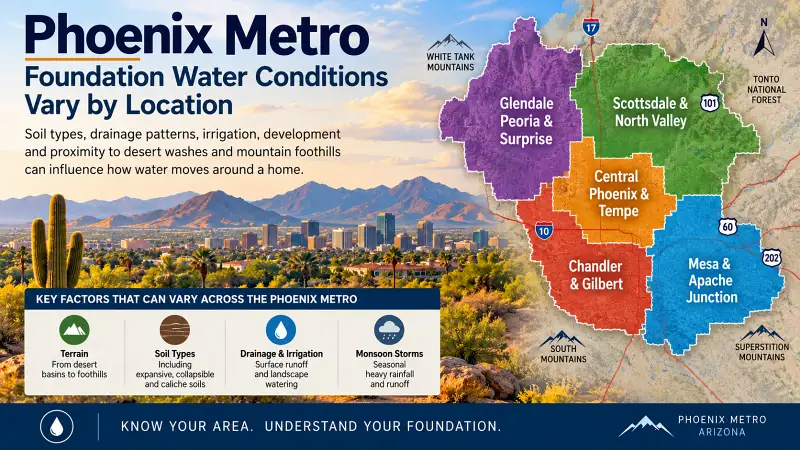
Note:
These regions describe broad foundation-water patterns across the Phoenix metro, not the conditions beneath a specific home. Expansive or collapsible soils, caliche, irrigation, grading, and drainage can vary within the same neighborhood. Local symptoms, moisture patterns, and the timing of foundation movement are often more useful than location alone when trying to understand a problem.
Central Phoenix & Tempe Foundation Water Conditions
Central Phoenix and Tempe include established residential neighborhoods, older landscaping, and areas that have experienced decades of urban development. Foundation water conditions can be influenced by natural soil characteristics as well as irrigation, grading, paved surfaces, and changes made around properties over time.
Even homes on the same street may experience different moisture conditions. Irrigation patterns, underground plumbing, lot elevation, drainage improvements, and soil composition can all affect how water reaches and moves through the ground surrounding a foundation.
What Homeowners May Notice
Homeowners in Central Phoenix and Tempe may notice:
- Cracks developing in interior walls, exterior stucco, or concrete slabs
- Doors or windows that begin sticking or no longer close properly
- Uneven concrete around patios, walkways, or driveways
- Water pooling near the home after monsoon storms or irrigation
- Damp soil or unusually green landscaping near a foundation
- Changes in existing cracks following prolonged dry periods or heavy watering
What Can Contribute to the Problem
Several conditions may contribute to foundation water problems in Central Phoenix and Tempe:
- Landscape irrigation: Repeated watering or leaking irrigation lines can concentrate moisture near a foundation.
- Expansive or collapsible soils: Where present, moisture changes can cause susceptible soils to swell or settle.
- Older drainage patterns: Landscaping, patios, additions, or changes in grading may redirect water toward the home.
- Paved surfaces: Driveways, sidewalks, and patios can concentrate runoff during intense storms.
- Plumbing leaks: Underground supply or drain lines may introduce moisture beneath or beside a foundation.
- Restricted soil drainage: Caliche or compacted soil layers, where present, may affect how quickly water moves downward.
Often, several factors interact rather than one condition causing the entire problem.
What Homeowners Can Do
Before considering repairs, homeowners can take several practical steps:
- Observe where water collects during or shortly after irrigation and monsoon storms.
- Check sprinkler heads, drip irrigation lines, and nearby plumbing for possible leaks.
- Look for landscape beds, patios, or walkways that direct water toward the foundation.
- Check whether drainage paths have been blocked by landscaping or recent improvements.
- Photograph foundation cracks or changes in concrete and record whether they are progressing.
- Compare conditions around different sides of the home, particularly where watering patterns vary.
Avoid making major drainage changes or attempting foundation repairs before understanding the likely source of the problem. If cracks are widening, floors are becoming noticeably uneven, or other signs of movement are progressing, seek a qualified evaluation.
Who Should You Talk to About a Foundation Water Problem
The appropriate professional depends on what you are observing and the likely source of the problem.
- Drainage or grading contractor: For recurring surface water, runoff directed toward the home, or drainage improvements.
- Irrigation specialist: For leaking sprinkler systems, excessive watering, or irrigation-related moisture problems.
- Licensed plumber: For suspected underground plumbing or water-line leaks.
- Structural engineer: For significant or progressive cracking, uneven floors, or suspected foundation movement.
- Geotechnical engineer: When soil behavior, settlement, or subsurface conditions require specialized investigation.
If the cause is uncertain, an independent evaluation may help clarify the problem before selecting a repair method. Foundation cracks and moisture symptoms can have multiple causes, and the most appropriate solution depends on identifying the underlying conditions.
Not Sure Who to Contact?
Tell us a little about what you’re seeing and we’ll help you identify the type of professional who may be appropriate.
Note:
Foundation cracks, uneven concrete, and persistent damp soil can have different causes. In Central Phoenix and Tempe, irrigation and plumbing leaks may create moisture problems even when there has been little rainfall. Pay attention to when symptoms appear, whether they change after watering or storms, and whether the affected area is getting worse. These observations can help a qualified professional determine what needs further investigation.
Related Resources – Learn More
Scottsdale & North Valley Foundation Water Conditions
Scottsdale, Paradise Valley, and communities across the northern Phoenix metro include a mix of established neighborhoods, newer developments, desert foothills, and properties near natural drainage corridors. In some areas, sloping terrain and nearby mountains can influence how stormwater moves across the landscape.
During intense monsoon storms, runoff may travel through washes, down slopes, or across developed properties before reaching lower ground. Grading, retaining walls, landscaping, and construction can alter these drainage patterns. As a result, two nearby homes may experience very different foundation water conditions depending on their elevation, soil, and drainage paths.
What Homeowners May Notice
Depending on the property’s terrain and drainage, homeowners in Scottsdale and the North Valley may notice several warning signs, particularly during or after intense monsoon storms.
- Water flowing across a yard or toward the foundation during intense monsoon storms.
- Soil erosion near slopes, retaining walls, or landscape features.
- Sediment or debris accumulating along drainage paths after storms.
- Cracks in exterior stucco, foundation concrete, patios, or retaining walls.
- Water collecting against the uphill side of a home or other structure.
- Changes in walkways, landscape walls, or other improvements where soil has shifted or washed away.
Symptoms vary by property. A home on relatively level ground may face different concerns than one built near a hillside or desert wash.
What Can Contribute to the Problem
Foundation water problems in Scottsdale and the North Valley often involve a combination of natural terrain and changes made during development. Several conditions can influence how water reaches a home and how the surrounding ground responds.
- Mountain and foothill runoff: Intense rainfall can send water downslope toward developed areas, even when rainfall at the home is limited.
- Natural washes: Desert drainage corridors can carry rapidly moving runoff during storms and may affect nearby properties.
- Altered grading: Construction, landscaping, and neighboring improvements can change where stormwater flows.
- Soil erosion: Concentrated runoff may remove supporting soil around slopes, walkways, and other improvements.
- Retaining walls and hillside drainage: Poorly managed water behind retaining walls or along slopes can contribute to localized drainage and stability concerns.
- Variable soil and fill conditions: Natural deposits, compacted ground, and construction fill may respond differently to moisture.
These factors may interact. For example, runoff from an uphill property may follow a drainage path altered by landscaping or construction, concentrating water near a foundation that previously remained relatively dry.
What Homeowners Can Do
Understanding where water comes from and how it moves across the property is a useful first step. Homeowners can look for visible drainage patterns and changes around their homes before deciding whether professional evaluation is needed.
- Observe where stormwater enters the property and where it travels during rainfall.
- Check for erosion, sediment deposits, or newly exposed soil near slopes and landscape walls.
- Keep existing drainage channels and approved drainage outlets clear of debris without redirecting natural washes.
- Look for grading or landscaping changes that may be directing runoff toward the foundation.
- Inspect retaining walls for new cracks, tilting, bulging, or signs of drainage problems.
- Document recurring water accumulation, soil movement, and changes following major storms.
- Seek professional guidance before modifying hillside drainage, retaining walls, or established stormwater pathways.
The goal is to identify potential drainage concerns without creating new ones. Redirecting runoff on a sloped property can sometimes affect neighboring homes or established drainage systems, so larger changes deserve careful planning.
Who Should You Talk to About a Foundation Water Problem
The appropriate professional depends on whether the concern involves surface runoff, erosion, soil stability, or possible foundation movement.
- Drainage or grading contractor: For localized runoff, drainage improvements, or water collecting near a foundation.
- Civil engineer: For complex stormwater drainage, drainage corridors, or changes that could affect neighboring properties.
- Geotechnical engineer: For suspected soil instability, erosion-related settlement, or concerns involving hillside ground conditions.
- Structural engineer: For progressive foundation cracking, retaining wall movement, or suspected structural damage.
For homes near steep slopes or natural washes, identifying how water moves across the surrounding terrain may be just as important as inspecting the foundation itself.
Not Sure Who to Contact?
Tell us a little about what you’re seeing and we’ll help you identify the type of professional who may be appropriate.
Note:
Not every Scottsdale or North Valley home is located near foothills or natural washes. Many properties have relatively level terrain and experience the same irrigation and drainage concerns found elsewhere in Phoenix. The property’s actual slope, drainage pathways, and surrounding terrain matter more than its city or neighborhood name.
Related Resources – Learn More
Mesa & Apache Junction Foundation Water Conditions
Mesa and Apache Junction extend across the eastern Phoenix metropolitan area, from established neighborhoods and relatively level developed land toward the foothills of the Superstition Mountains. Terrain, natural washes, and changing soil deposits can influence how stormwater moves through these communities.
During intense monsoon storms, runoff from higher elevations may travel through washes and drainage channels toward lower areas. Properties closer to mountain fronts may encounter different runoff and erosion conditions than homes farther west in Mesa. However, grading, irrigation, and local soil characteristics remain important throughout the area.
What Homeowners May Notice
Homeowners may observe different symptoms depending on whether their property is in a developed neighborhood, near a natural wash, or closer to the foothills.
- Water moving rapidly across yards, streets, or driveways during monsoon storms.
- Sand, gravel, or sediment deposited along drainage paths after heavy rainfall.
- Soil erosion around patios, walkways, landscape walls, or exposed foundation edges.
- Water collecting near a slab foundation where grading or landscaping restricts drainage.
- Cracks in concrete slabs, exterior stucco, or surrounding hardscaping.
- Uneven walkways or changes in the ground surface following repeated wetting or runoff.
The timing of these symptoms matters. Problems appearing immediately after a storm may suggest a different moisture source than conditions that develop gradually during extended irrigation or dry periods.
What Can Contribute to the Problem
The eastern metro includes a transition from developed basin areas toward mountain-front terrain. Several natural and property-specific factors can affect foundation water conditions.
- Mountain-front runoff: Heavy rainfall over the Superstition Mountains and surrounding higher terrain can generate runoff that travels toward lower elevations.
- Desert washes: Normally dry channels may carry substantial stormwater during intense rainfall, creating localized flooding or erosion hazards.
- Alluvial deposits: Sand, gravel, silt, and clay deposited by past water movement can produce variable infiltration, drainage, and settlement characteristics.
- Caliche and restrictive soil layers: Where present, hardened layers may limit downward infiltration and influence how water spreads through the surrounding ground.
- Altered drainage paths: Roads, subdivisions, walls, and landscaping can change how runoff reaches or passes a property.
- Irrigation and localized soil wetting: Leaks or concentrated watering may affect moisture-sensitive soils even when rainfall is limited.
These conditions do not affect every property equally. A home’s position relative to slopes, washes, and constructed drainage systems can be more informative than its city name.
What Homeowners Can Do
A useful first step is understanding whether water is coming from the property itself or arriving from surrounding terrain. Homeowners can look for clues before deciding what improvements may be appropriate.
- Observe how water travels across the property during storms, when it is safe to do so.
- Look for sediment deposits, erosion channels, or debris that indicate where runoff has traveled.
- Check whether landscaping, walls, or grading direct water toward the foundation.
- Inspect irrigation lines and watering patterns for excessive moisture near the home.
- Keep approved drainage outlets clear of debris without obstructing or redirecting natural washes.
- Document cracks, uneven concrete, or soil movement and note whether changes follow storms or irrigation.
- Review available floodplain information before making substantial drainage changes, particularly near washes or mountain-front areas.
Homeowners should never enter or cross flowing floodwater to inspect drainage during a storm. Where runoff involves a natural wash or drainage corridor, professional guidance may be necessary before modifying its path.
Who Should You Talk to About a Foundation Water Problem
The appropriate professional depends on whether the concern involves ordinary lot drainage, stormwater arriving from surrounding terrain, soil behavior, or possible structural movement.
- Drainage or grading contractor: For localized water accumulation, yard drainage, and grading concerns.
- Civil engineer: For complex stormwater pathways, wash-related drainage, or improvements that could affect neighboring properties.
- Geotechnical engineer: For suspected soil settlement, erosion-related ground instability, or unusual subsurface conditions.
- Structural engineer: For progressive foundation cracks, uneven floors, or suspected structural movement.
- Irrigation specialist or plumber: For suspected irrigation leaks, underground water-line problems, or persistent localized soil wetting.
For properties near desert washes or mountain fronts, understanding where stormwater originates and how it reaches the property may be essential before choosing a repair or drainage solution.
Not Sure Who to Contact?
Tell us a little about what you’re seeing and we’ll help you identify the type of professional who may be appropriate.
Note:
Mesa and Apache Junction share many regional soil and drainage characteristics, but properties near the Superstition Mountains and natural washes may face additional runoff and erosion concerns. A dry wash is not necessarily an inactive drainage channel. Heavy rainfall upstream can produce flowing water even when little rain has fallen directly over a home.
Related Resources – Learn More
Chandler & Gilbert Foundation Water Conditions
Chandler and Gilbert occupy much of the southeastern Phoenix metropolitan area, where residential neighborhoods, landscaped properties, and relatively level terrain are common. Although these communities share the region’s dry climate, irrigation, monsoon rainfall, and changing soil moisture can influence how the ground behaves around foundations.
The underlying soils are not uniform. Some locations contain moisture-sensitive soils, while grading, construction fill, and drainage improvements can create different conditions from one property to another. For homeowners, understanding where water accumulates and whether the surrounding soil is repeatedly becoming wet or dry can be an important part of evaluating foundation concerns.
What Homeowners May Notice
Foundation-related symptoms in Chandler and Gilbert may develop gradually or become more noticeable after changes in irrigation, heavy rainfall, or prolonged dry weather.
- Cracks appearing or changing in exterior stucco, interior drywall, or concrete slabs.
- Doors and windows that begin sticking or become difficult to close.
- Uneven patios, walkways, or driveway sections near the home.
- Water pooling beside the foundation after irrigation or monsoon storms.
- Persistent damp soil or unusually vigorous plant growth in one area of the yard.
- Small depressions or changes in ground elevation around landscaped areas.
- Foundation or concrete movement that appears to change with seasonal moisture conditions.
Not every crack or uneven surface indicates a serious foundation problem. Changes that are progressing, recurring, or accompanied by other symptoms deserve closer attention.
What Can Contribute to the Problem
In Chandler and Gilbert, foundation moisture concerns may result from several interacting conditions rather than a single source of water.
- Expansive or collapsible soils: Where present, susceptible soils may swell, shrink, or settle as moisture conditions change.
- Landscape irrigation: Frequent watering, leaking irrigation lines, or uneven watering patterns can create localized soil moisture differences.
- Monsoon rainfall: Intense storms may overwhelm local drainage and leave water accumulating near foundations.
- Grading and drainage: Relatively flat lots, blocked drainage paths, or landscaping changes may prevent water from moving away from the home.
- Construction fill and compaction: Disturbed or poorly compacted fill can behave differently from surrounding natural soils when wetted.
- Underground plumbing leaks: Leaking supply or drain lines may introduce moisture beneath or near a slab foundation.
These factors can overlap. For example, irrigation may repeatedly wet one side of a home while other areas remain relatively dry, creating uneven conditions in moisture-sensitive soils.
What Homeowners Can Do
Homeowners can begin by looking for differences in moisture around the property and identifying conditions that may be concentrating water near the foundation.
- Check irrigation schedules and look for sprinkler or drip-system leaks near the home.
- Observe whether soil remains damp long after watering has stopped.
- Look for low spots where monsoon runoff or irrigation water collects beside the foundation.
- Inspect patios, walkways, and landscaping for changes that may be directing water toward the home.
- Compare moisture conditions around different sides of the foundation.
- Photograph cracks or uneven concrete and record whether changes appear to be progressing.
- Consider a plumbing leak evaluation if persistent moisture cannot be explained by rainfall or irrigation.
- Seek professional evaluation when foundation movement appears significant or continues to worsen.
The objective is not to keep every part of the soil constantly wet or completely dry. The priority is to avoid unnecessary water accumulation and identify unusual moisture patterns before choosing a corrective action.
Who Should You Talk to About a Foundation Water Problem
The right professional depends on whether the concern involves irrigation, drainage, soil movement, plumbing, or possible structural damage.
- Irrigation specialist: For leaking irrigation systems, uneven watering, or persistent moisture near landscaped areas.
- Drainage or grading contractor: For standing water, poor surface drainage, or grading that directs runoff toward the foundation.
- Licensed plumber: For suspected underground supply-line or drain-line leaks.
- Geotechnical engineer: For suspected soil settlement, expansive or collapsible soils, or unusual ground movement.
- Structural engineer: For progressive cracking, uneven floors, or suspected foundation damage.
If the source of moisture is uncertain, identifying it before undertaking foundation repairs can help avoid treating a symptom while leaving the underlying problem unresolved.
Not Sure Who to Contact?
Tell us a little about what you’re seeing and we’ll help you identify the type of professional who may be appropriate.
Note:
Parts of the southeastern Phoenix region, including areas around Chandler Heights and Queen Creek, have documented earth-fissure hazards associated with regional land subsidence. These are distinct from ordinary foundation cracks or localized soil settlement. Their presence should not be assumed elsewhere in Chandler or Gilbert. Homeowners concerned about unusual ground movement can consult Arizona Geological Survey hazard maps and seek a qualified geological or geotechnical evaluation.
Related Resources – Learn More
Glendale, Peoria & Surprise Foundation Water Conditions
Glendale, Peoria, and Surprise extend across the western and northwestern Phoenix metropolitan area, where established neighborhoods, newer subdivisions, and desert landscapes create a variety of foundation water conditions. Much of the developed area occupies relatively level terrain, while communities farther west and north approach mountain foothills and natural desert drainage corridors.
Soil conditions, construction grading, irrigation, and monsoon runoff can all influence how moisture reaches a foundation. Near the White Tank Mountains and other foothill areas, stormwater may also travel through natural washes and across sloping ground. The conditions affecting an individual home depend on its location, surrounding terrain, and drainage improvements.
What Homeowners May Notice
Homeowners may notice different symptoms depending on whether their property is in an established neighborhood, a newer development, or an area closer to desert foothills.
- Water collecting near the foundation after monsoon storms or landscape irrigation.
- Cracks in exterior stucco, concrete slabs, patios, or walkways.
- Uneven concrete or small areas of settlement around the home.
- Water flowing across yards or driveways during intense rainfall.
- Sediment deposits or soil erosion near drainage channels, slopes, or landscaped areas.
- Persistent damp soil near irrigation lines or landscaped beds.
- Changes in doors, windows, or floors that may indicate possible foundation movement.
A symptom alone rarely identifies the cause. Whether it appears after storms, during irrigation, or gradually over time can provide important clues.
What Can Contribute to the Problem
Foundation water conditions across the western metro can reflect both natural desert ground conditions and changes introduced during residential development.
- Construction grading and fill: Excavation, compacted fill, and subdivision development can change how water drains and how soil responds to moisture.
- Expansive or collapsible soils: Where present, moisture-sensitive soils may swell or settle as wetting conditions change.
- Monsoon runoff: Intense storms can generate water faster than local drainage systems or soil surfaces can accommodate.
- Mountain-front drainage: Properties closer to the White Tank Mountains or other foothills may be affected by runoff traveling through washes or across alluvial-fan terrain.
- Landscape irrigation: Repeated watering or leaking irrigation lines can create uneven moisture conditions near a foundation.
- Blocked or altered drainage paths: Landscape walls, patios, neighboring construction, and poorly maintained drainage features can concentrate water in unwanted areas.
These conditions can interact. For example, a newer development may have engineered drainage systems, but subsequent landscaping changes or blocked outlets can still affect how water moves across individual lots.
What Homeowners Can Do
A practical starting point is to understand how the property was graded and whether water follows the intended drainage paths during storms or irrigation.
- Observe where water collects and how it moves away from the home after rainfall.
- Inspect landscape grading, patios, and walkways for low spots that trap water beside the foundation.
- Check irrigation systems for leaks, overspray, or excessive watering near the home.
- Keep existing drainage outlets and approved stormwater pathways clear of debris.
- Look for sediment deposits or erosion that may indicate concentrated runoff.
- Review drainage plans or available floodplain information when concerns involve nearby washes or foothill terrain.
- Photograph cracks, uneven concrete, or changes in surrounding soil and record whether they are progressing.
- Consult a qualified professional before redirecting significant runoff or modifying established drainage systems.
Maintaining the property’s intended drainage paths can be especially important in planned subdivisions where neighboring lots and shared drainage improvements may be connected.
Who Should You Talk to About a Foundation Water Problem
The appropriate professional depends on whether the concern involves lot drainage, irrigation, unusual soil behavior, stormwater pathways, or suspected structural movement.
- Drainage or grading contractor: For localized water accumulation, poor grading, or drainage improvements around the home.
- Irrigation specialist: For leaking irrigation systems or repeated wetting near landscaped areas.
- Civil engineer: For complex stormwater drainage, subdivision drainage systems, or runoff affecting multiple properties.
- Geotechnical engineer: For suspected soil settlement, problematic fill, or unusual ground conditions.
- Structural engineer: For progressive cracking, uneven floors, or suspected foundation movement.
For properties near washes or foothills, a drainage evaluation may need to consider water arriving from outside the lot. For suspected foundation movement, an engineer can help distinguish structural concerns from more localized drainage or landscaping problems.
Not Sure Who to Contact?
Tell us a little about what you’re seeing and we’ll help you identify the type of professional who may be appropriate.
Not sure which problem you’re dealing with?
Use our Drainage Problem or Foundation Problem Assessment to better understand the likely cause of your home’s symptoms and learn which type of professional may be most appropriate.
Warning Signs Denver Metro Homeowners Should Pay Attention To
Not every crack, damp area, or drainage problem indicates serious foundation damage. What matters more is whether a symptom is new, recurring, getting worse, or appearing alongside other changes around the home.
Phoenix-area homeowners may want to take a closer look when they notice:
| What You Notice | What It May Be Worth Checking |
|---|---|
| Water pooling beside the foundation | Grading, monsoon runoff, irrigation leaks, and blocked drainage paths |
| Persistent damp soil near the home | Irrigation patterns, underground plumbing leaks, or restricted drainage |
| Cracks developing in concrete slabs or exterior stucco | Whether cracks are changing and if soil movement may be occurring |
| Soil pulling away from the foundation | Drying, soil shrinkage, and changes in moisture-sensitive soils |
| Uneven patios, walkways, or driveways | Localized settlement, erosion, or soil movement beneath concrete |
| Sticking doors or windows accompanied by new cracks | Possible differential foundation movement that deserves closer evaluation |
| Erosion, sediment deposits, or soil washing away | Concentrated stormwater runoff, nearby washes, and altered drainage paths |
| Recurring water accumulation after monsoon storms | Where runoff originates, how it reaches the home, and how long water remains |
Patterns are generally more informative than a single symptom. A small crack that remains unchanged may tell a different story than one that grows while doors begin sticking or drainage problems appear outside.
Photographs with dates can help homeowners track changes rather than relying on memory. It can also be helpful to note whether symptoms appear after monsoon storms, irrigation, plumbing leaks, or extended dry periods.
Reducing Foundation Water Risk Around Your Home
Many foundation-water concerns begin with something relatively simple: too much water reaching one part of the foundation, water remaining there longer than it should, or moisture conditions changing unevenly around the home.
Phoenix homeowners cannot control monsoon storms or the soil beneath their properties, but they can pay attention to how irrigation, runoff, and drainage affect moisture around their foundations.
Practical steps include:
- Check irrigation systems regularly for leaks, broken emitters, and sprinkler heads that direct water toward the foundation.
- Avoid excessive watering that repeatedly saturates soil immediately beside the home.
- Watch how water moves across the yard during monsoon storms, observing from a safe location.
- Keep gutters, downspouts, and existing drainage outlets clear and functioning where installed.
- Look for low spots, settled soil, or landscaping that allows water to collect against the foundation.
- Pay attention to changes in drainage caused by patios, walkways, landscape walls, or neighboring construction.
- Inspect the ground around the home for erosion, sediment deposits, or signs of concentrated runoff.
- Monitor foundation cracks, uneven concrete, and other changes that may be associated with soil movement.
- Seek professional guidance before redirecting natural washes or making substantial drainage changes on sloped properties.
The goal is not to keep soil around a foundation completely dry or continuously wet. Managing excess water and avoiding large, uneven moisture changes are generally more useful than allowing one area to repeatedly become saturated while another remains dry.
Where expansive or collapsible soils are present, the appropriate moisture-management approach may depend on the property’s specific ground conditions. Homeowners should avoid major changes to irrigation or drainage without understanding how those changes could affect the foundation.
When a Foundation Water Problem May Need Professional Evaluation
Many foundation-water concerns can begin with simple observations and drainage corrections. Professional evaluation becomes more appropriate when the source of moisture is unclear, the problem keeps returning, or water-related symptoms are accompanied by signs of possible foundation movement.
For Phoenix-area homeowners, this may involve irrigation or plumbing leaks, recurring monsoon runoff, moisture-sensitive soils, or changes affecting a slab foundation.
Consider getting professional input when:
- Water repeatedly collects near the foundation despite correcting obvious irrigation or drainage problems.
- Soil remains unusually damp during dry weather without an identifiable water source.
- Foundation or slab cracks are new, widening, or changing over time.
- Cracking occurs alongside sticking doors, windows, or noticeable changes in floor levels.
- Concrete slabs, patios, or walkways show significant or progressive settlement or heaving.
- You suspect an underground plumbing leak or moisture accumulating beneath a slab foundation.
- Significant erosion, soil settlement, or unusual ground movement is occurring near the home.
- Stormwater from nearby washes, slopes, or neighboring properties repeatedly reaches the foundation.
- You cannot determine whether the problem involves drainage, irrigation, plumbing, soil conditions, or the foundation itself.
The right professional depends on the suspected cause. Drainage problems, irrigation leaks, underground plumbing concerns, soil movement, and structural damage require different types of expertise.
A qualified evaluation should help identify the likely source of the problem before a homeowner commits to foundation repairs or major drainage improvements. Understanding the cause is more important than choosing a repair based on symptoms alone.
Phoenix Metro Foundation Water Problems: Homeowner Checklist
Foundation water conditions in the Phoenix metro can change following intense monsoon storms, extended dry periods, or changes in landscape irrigation. A simple inspection after major rainfall or when unusual moisture conditions appear can help homeowners recognize developing problems before they become more difficult to understand.
Around the outside of your home:
☐ Check that the ground slopes away from your home.
☐ Look for pooling water after storms or irrigation.
☐ Check irrigation lines and sprinklers for leaks.
☐ Keep gutters and drainage outlets clear.
☐ Look for erosion or washed-away soil.
☐ Watch for soil pulling away from the foundation.
☐ Check patios and walkways for cracks or settling.
☐ Watch for runoff from neighboring properties.
Inside the home:
☐ Look for new wall or floor cracks.
☐ Check whether existing cracks are growing.
☐ Watch for sticking doors or windows.
☐ Notice uneven floors or gaps near baseboards.
☐ Look for unexplained damp areas.
After heavy rain or snowmelt:
☐ Check where stormwater traveled once it’s safe.
☐ Look for new erosion or standing water.
☐ Photograph cracks, moisture, or soil movement.
☐ Record the date and weather conditions.
☐ Compare changes with previous inspections.
You do not need to diagnose the problem yourself. The purpose of this checklist is to identify patterns: where water travels, when moisture appears, and whether cracks or other conditions are changing.
Photographs, dates, and notes about recent storms or irrigation changes can help a qualified professional understand what may be happening if further evaluation becomes necessary.
Take the Checklist With You
Download the Phoenix Foundation Water & Drainage Home Inspection Checklist
Walk around your property and record what you see. This printable worksheet will help you document irrigation and drainage conditions, foundation cracks, soil movement, monsoon runoff, recent weather, photos, and changes over time.
You can also use the completed checklist and your photos to help explain what you’ve observed if you decide to speak with a local professional.
Download the Free Phoenix Home Inspection Checklist
* Free PDF from Foundation Water Guide. No signup required.
Key Takeaways
- Expansive and collapsible soils can respond differently to moisture changes, potentially contributing to foundation movement.
- Monsoon storms, irrigation, and poor drainage can concentrate water around Phoenix-area foundations.
- Conditions vary across the metro, from developed basin neighborhoods to foothills, washes, and mountain-front drainage areas.
- Caliche, construction fill, and local soil conditions can influence drainage and how the ground responds to moisture.
- Recurring water accumulation, changing cracks, or uneven settlement may warrant closer investigation and professional evaluation.
Official Phoenix Metro Resources
These official resources provide additional information about Arizona problem soils, caliche, groundwater conditions, and flood hazards that may affect Phoenix-area homeowners.
Common Phoenix Foundation Water Questions
Explore answers to common questions about desert soils, drainage, moisture changes, and foundation water problems that may affect Phoenix-area homeowners.
Frequently Asked Questions About Foundation Water Problems in the Phoenix Metro Area
Are expansive and collapsible soils a foundation concern in the Phoenix metro?
Yes. Some Phoenix-area soils contain expansive clay that swells when wet and shrinks as it dries. Other soils may be collapsible, meaning they can compress or settle when suddenly wetted. Both conditions can contribute to uneven foundation movement, but they behave differently. Soil conditions vary by property, so not every Phoenix home faces the same risk.
Can Phoenix's dry desert climate still cause foundation water problems?
Yes. Although Phoenix has a dry climate, intense monsoon storms can produce substantial runoff in a short period. Landscape irrigation, plumbing leaks, and poor drainage can also introduce moisture near foundations during otherwise dry weather. Sudden or uneven changes in soil moisture may be particularly important where moisture-sensitive soils are present.
How can caliche affect drainage around a Phoenix home?
Caliche is a hardened, calcium-carbonate-rich layer found in some Arizona soils. Dense caliche can restrict downward water movement, sometimes causing water to collect above the layer or move sideways through surrounding soil. This may contribute to localized drainage problems. However, not all Phoenix properties contain caliche, and its depth and characteristics can vary.
Why does soil pull away from my foundation during dry weather?
Some clay-rich soils shrink as they lose moisture, potentially creating visible gaps between the ground and a foundation. Extended dry periods and uneven irrigation can contribute to these changes. A gap alone does not establish that structural damage has occurred, but homeowners should watch for accompanying cracks, uneven floors, or other signs of movement.
Can landscape irrigation cause foundation problems in Chandler, Gilbert, or Phoenix?
Yes. Excessive irrigation, leaking drip lines, or broken sprinklers can repeatedly wet soil near a foundation. Where expansive or collapsible soils are present, concentrated moisture may contribute to swelling or settlement. Irrigation problems can also create persistent damp areas even when there has been little rainfall. Checking for leaks and managing excess water are useful first steps.
Who should evaluate a foundation water problem in the Phoenix area?
The appropriate professional depends on the suspected cause. A drainage contractor may help with grading or runoff, an irrigation specialist or plumber can investigate leaks, and a geotechnical engineer can evaluate unusual soil conditions. A structural engineer is appropriate when significant or progressive foundation movement is suspected. Identifying the likely cause before committing to repairs can help homeowners avoid unnecessary work.
Home › Foundation Water Problems by State › Arizona › Phoenix Metro Area