
Do I Need a Professional?
Understanding When Foundation Water Problems Require Expert Evaluation
Many homeowners notice moisture, dampness, or small cracks around a foundation and wonder whether the situation requires professional attention. The challenge is determining whether a condition appears stable and understandable or whether recurring moisture, structural movement, or multiple warning signs suggest a closer evaluation may be appropriate. In some homes, the issue may be temporary or seasonal. In others, repeated water exposure or structural changes may suggest that closer evaluation would be helpful.
Understanding the difference can make it easier to decide when observation is reasonable and when expert guidance may provide useful clarity. The goal is not to assume every moisture issue is severe, but to recognize when recurring water patterns or visible changes may deserve more than monitoring alone.
Understanding how interior water problems develop helps clarify why they recur and how they may progress if underlying causes are not addressed.
Do I Need a Professional to Evaluate Foundation Water Problems?
Not always. Some foundation moisture conditions are temporary, weather-related, or stable over time and may simply need observation and a better understanding of how water moves around the home.
However, situations involving recurring water entry, worsening dampness, changing cracks, or unclear drainage patterns may benefit from professional evaluation. A qualified inspection can help identify whether the issue relates to how water enters a foundation, exterior drainage conditions, groundwater pressure, or early structural movement.
Situations Homeowners Can Often Monitor
Some foundation water conditions remain stable once their cause is understood. In these situations, homeowners may choose to observe the problem over time, especially when symptoms are limited, infrequent, and do not appear to be worsening.
Moisture that appears only during extreme weather
Moisture that appears only during unusually heavy rain, snowmelt, or brief seasonal shifts may not always indicate an ongoing structural concern. If the area dries afterward and the pattern does not become more frequent, monitoring may be appropriate.
These situations are often easier to understand when viewed in the context of surface water vs. groundwater, since not all moisture around a foundation behaves the same way.
Small cracks that remain stable over time
Small cracks can appear in many homes and may remain unchanged for long periods. When a crack does not widen, shift, or appear alongside other warning signs, homeowners often monitor it rather than assume immediate repair is necessary.
If cracks are present, it can be helpful to compare them with the patterns explained on foundation cracks and the broader foundation damage page.
Temporary surface drainage conditions
Water can sometimes collect near a foundation after a major storm and then drain away without causing lasting problems. When the pattern is occasional rather than constant, homeowners may choose to monitor how quickly the area dries and whether the same issue returns repeatedly.
Pages such as poor grading around foundation and surface runoff and yard drainage can help explain why these short-term conditions occur.
Situations Where Professional Help Is Often Recommended
When water conditions become more persistent, more severe, or harder to explain, a professional evaluation may help identify the underlying cause. This is especially true when moisture appears repeatedly, the structure seems to be changing, or the source of water is unclear.
Repeated water intrusion inside the home
Water entering a basement or crawl space more than once often suggests that the issue is part of a broader pattern rather than a one-time event. Repeated seepage can point to drainage problems, groundwater pressure, or conditions that allow water to reach the structure more consistently.
Homeowners seeing this pattern may want to review water in basement, wet basement walls or crawl space water problems.
Drainage Conditions Outside the Home
Interior water issues are frequently influenced by exterior drainage problems. Water that collects near the foundation can increase pressure against walls and joints, leading to seepage or leaks inside the basement.
Changes in cracks or wall movement
Cracks that widen, shift, or appear alongside sticking doors, uneven floors, or visible wall movement may indicate that water is affecting the soil or structure more significantly. These situations are more likely to benefit from professional evaluation than isolated cosmetic cracking.
Related topics include wall bowing and settlement from water.
Persistent dampness or moisture buildup
Moisture that lingers for long periods, creates repeated musty odors, or does not fully dry out may indicate that the home is dealing with an ongoing water source rather than temporary humidity alone.
This type of pattern often overlaps with musty smell or damp basement and can sometimes be influenced by exterior conditions such as high groundwater table foundations.
Drainage patterns directing water toward the home
When gutters, downspouts, grading, or runoff patterns consistently direct water toward the foundation, professional guidance may help clarify whether the issue is simple drainage correction or part of a larger moisture problem.
Homeowners may find it useful to review downspout discharge issues and exterior water problems to better understand what is happening around the home.
What Professionals Evaluate During an Inspection
When a foundation or drainage specialist evaluates a home, the purpose is usually to understand how water is moving, where it is entering, and whether the structure is being affected. The inspection process is generally focused on identifying causes rather than reacting only to visible symptoms.
Professionals often look at how water behaves both outside and inside the home. Exterior drainage conditions, soil saturation, roof runoff, and grading patterns can all influence whether water collects near the foundation or moves safely away from the structure.
Inside the home, inspectors may review visible signs such as damp walls, staining, musty odors, or moisture appearing along floor joints. These interior clues help connect symptoms to the way water is interacting with the structure and surrounding soil.
Because foundation water problems can originate in several ways, inspections usually focus on understanding the broader water system around the home rather than assuming a single cause.
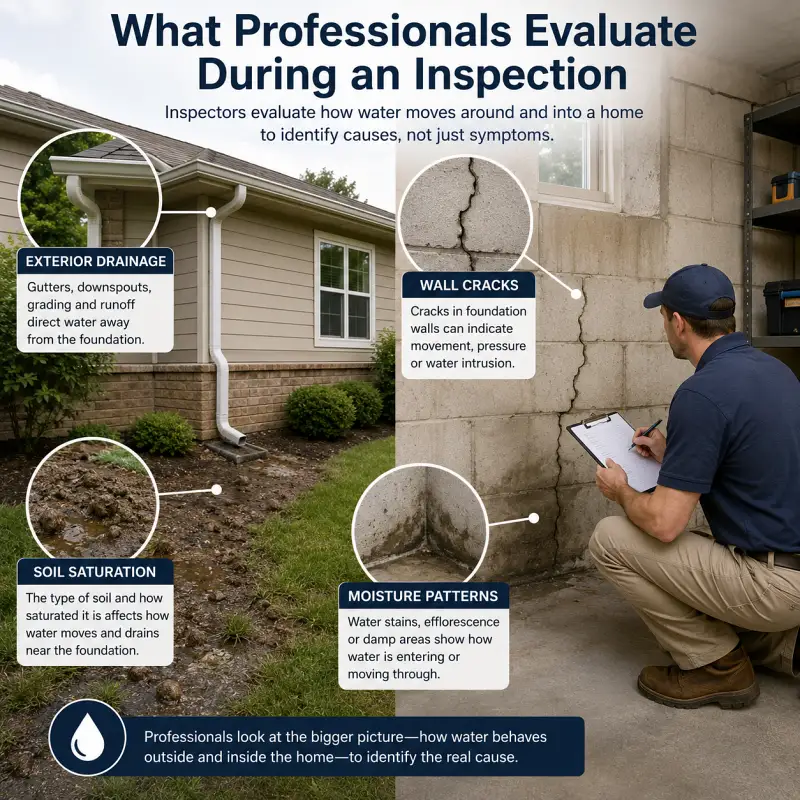
Exterior drainage and grading conditions
Professionals often begin by looking at how water moves around the outside of the home. They may evaluate grading, runoff patterns, downspout discharge, window wells, and low areas where water tends to collect near the structure.
This kind of review often relates closely to topics covered in foundation risk factors and foundation water problems.
Groundwater pressure around the foundation
In some homes, the issue is not only surface runoff but water pressure building below grade. Professionals may look for signs that groundwater, saturated soil, or hydrostatic pressure is influencing the basement or foundation walls.
For background, homeowners can review how water enters a foundation and surface water vs. groundwater.
Interior signs of moisture intrusion
An inspection may also include signs inside the home such as staining, damp walls, musty odors, floor joint seepage, crawl space moisture, or material deterioration. These clues help connect visible symptoms to possible water sources.
Homeowners who want to better understand this process can continue to how professionals diagnose water problems.
Persistent dampness or moisture buildup
Moisture that lingers for long periods, creates repeated musty odors, or does not fully dry out may indicate that the home is dealing with an ongoing water source rather than temporary humidity alone.
This type of pattern often overlaps with musty smell or damp basement and can sometimes be influenced by exterior conditions such as high groundwater table foundations.
Drainage patterns directing water toward the home
When gutters, downspouts, grading, or runoff patterns consistently direct water toward the foundation, professional guidance may help clarify whether the issue is simple drainage correction or part of a larger moisture problem.
Homeowners may find it useful to review downspout discharge issues and exterior water problems to better understand what is happening around the home.
When Monitoring May Be Reasonable vs When Evaluation May Be Helpful
| Situation | Monitoring May Be Reasonable | Professional Evaluation May Be Helpful |
|---|---|---|
| Moisture after an unusually heavy storm | ✓ | |
| Condition remains unchanged over time | ✓ | |
| Recurring water intrusion | ✓ | |
| Cracks that are widening or changing | ✓ | |
| Persistent dampness or musty odors | ✓ | |
| Water entering the basement repeatedly | ✓ | |
| Wall movement, bowing, or shifting | ✓ | |
| Multiple symptoms appearing together | ✓ |
“The most important factor is often not whether a crack or moisture issue exists, but whether conditions are changing over time. Expanding cracks, recurring moisture, and structural movement typically deserve closer evaluation than stable conditions that remain unchanged.”
— Foundation Water Guide Editorial Team
Key Takeaways
- Many foundation water problems can be monitored before they become serious.
- Worsening conditions deserve closer evaluation.
- Water movement often reveals the underlying cause.
- Identifying the cause is more important than treating the symptoms.
- Professional evaluations help homeowners make informed decisions.
Ready to Speak With a Professional?
If your foundation water problem has become difficult to diagnose, continues to worsen, or you’re looking for peace of mind, speaking with an experienced professional can help. Use the form to request an evaluation from a qualified contractor in your area.
When Professional Evaluation Makes Sense
- Cracks continue to widen or new cracks appear
- Water intrusion keeps returning after heavy rain
- Doors or windows become harder to open over time
- You notice recurring moisture around the foundation
- Multiple symptoms are occurring together
- You’re unsure whether the problem is drainage, plumbing or structural
An inspection can provide clarity and help you decide on the most appropriate next steps.
Where to Go Next
If you’re still deciding whether professional help is needed:
If you’re trying to identify the cause of the problem:
If you’re investigating symptoms around your home:
If you’re researching foundation water problems in your area:
Frequently Asked Questions About Is This Serious?
Homeowners often notice moisture around the foundation or signs of basement dampness and wonder whether the issue requires professional attention. Some conditions remain stable for long periods, while others may gradually worsen as drainage patterns, soil saturation, or water pressure around the home change.
The questions below address some common concerns homeowners have when deciding whether a foundation water problem needs further evaluation. If you want to explore additional topics homeowners frequently ask about basement moisture and drainage issues, you can review more foundation water problem questions that explain how these situations develop.
Do all foundation water problems require a professional inspection?
No. Some moisture conditions are temporary, seasonal, or stable over time and may simply need monitoring. Professional evaluation is generally more helpful when symptoms repeat, worsen, or become harder to explain.
When should a homeowner call a professional for foundation moisture?
Homeowners often consider professional evaluation when water repeatedly enters the home, cracks begin to change, dampness persists, or drainage patterns seem to direct water toward the foundation.
Can I monitor a crack before calling someone?
In some situations, yes. Small cracks that remain unchanged over time are often monitored. If a crack widens, shifts, or appears alongside other symptoms such as wall movement or water intrusion, further evaluation may be helpful.
What does a professional usually look at during an inspection?
A professional typically looks at drainage, grading, runoff patterns, groundwater pressure, visible moisture symptoms, and signs of structural change. The goal is usually to identify the source of the water and how it is affecting the home.
Is repeated basement water a sign that I need professional help?
Repeated water in a basement often suggests an ongoing moisture pattern rather than a one-time event. While the cause may vary, recurring water intrusion is one of the more common reasons homeowners seek professional evaluation.
Home › Do I Need A Professional?