
Soil Saturation and Expansive Clay: How Water Pressure Builds Around a Foundation
Soil conditions often influence foundation performance more than rainfall totals alone. While storms introduce water into the ground, the way surrounding soil absorbs and retains that moisture determines how long pressure remains against a structure.
Clay soils behave differently than sand or loam, holding water for extended periods and sometimes remaining saturated well after surface water disappears. This prolonged saturation can contribute to increased exterior pressure around a foundation.
Because soil composition varies by region, homes may respond very differently to similar weather conditions. Understanding how soil behaves helps clarify why some properties experience recurring moisture or movement concerns while others do not.
What Is Soil Saturation and Expansive Clay?
Soil saturation occurs when the ground holds more moisture than it can easily drain away. In some regions, certain clay-rich soils absorb water, expand, and place pressure against nearby foundations as moisture levels change.
As saturated soil expands and contracts over time, movement around the foundation can contribute to cracking, shifting, drainage problems, and moisture intrusion patterns. The severity often depends on soil composition, water management, and how consistently moisture collects near the home.
- Expansive clay soils can swell when they absorb excess moisture and shrink as they dry.
- Changing soil moisture levels can place pressure against foundations and basement walls.
- Poor drainage, roof runoff, and saturated soil conditions often contribute to soil expansion problems.
- Early warning signs may include wall cracks, sticking doors, uneven floors, or recurring basement moisture.
- Hydrostatic pressure can develop when saturated soil traps water around below-grade foundation areas.
Why Soil Type Often Matters More Than Rainfall
It’s common to assume that foundation water problems are caused primarily by heavy rain. While rainfall introduces moisture into the ground, the behavior of the surrounding soil often determines how that moisture affects a structure.
Two homes can experience the same storm totals and respond very differently. In one case, water drains efficiently away from the foundation. In another, moisture lingers in the soil for days, increasing pressure against below-grade walls, sometimes contributing to issues such as wet basement walls or water in the basement.
The difference frequently comes down to drainage capacity and water retention characteristics.
Some soils allow water to move through them quickly, reducing the amount of time moisture remains in contact with the foundation. Other soils absorb water slowly and release it gradually, remaining saturated long after rainfall has ended. When water cannot drain efficiently, pressure can build in the soil itself, particularly when combined with poor grading around the foundation or surface runoff and yard drainage issues.
For this reason, long-term soil saturation often plays a greater role in foundation stress than a single heavy storm. Understanding the type of soil surrounding a home provides clearer insight into recurring moisture patterns than rainfall totals alone.
How Clay Soil Holds Water
Clay soil behaves differently from many other soil types because of its extremely fine particle size. These particles pack tightly together, leaving very little space for water to move through. As a result, drainage tends to occur slowly compared to sandy or loosely structured soils. These differences are part of the reason water moves differently through different soil types.
Fine Particle Structure and Slow Drainage
Clay consists of microscopic mineral particles that bind closely together when wet. Because the gaps between particles are so small, water cannot pass through quickly. Instead of flowing downward and dispersing, moisture often lingers within the soil mass.
This slow drainage means that once clay becomes wet, it may remain damp for an extended period, even after rainfall has stopped.
This slow drainage can allow water to build up near the home. If you’re noticing pooling after extended rainfall, it may help to review water pooling near the foundation to understand what patterns to watch for.
Moisture Retention After Storms
After heavy rain, surface water may disappear within hours. However, the soil beneath the surface can remain saturated much longer. In clay-dominant soils, this retained moisture can create prolonged pressure against below-grade foundation walls.
Unlike fast-draining soils, clay does not quickly relieve this moisture load. The soil may stay heavy and dense for days, particularly in areas where surface runoff is limited or grading does not encourage outward drainage.
Clay Compared to Sand and Loam
Sandy soil contains larger particles with wider gaps between them. This allows water to drain more freely and reduces the duration of saturation around a foundation.
Loam soil (a balanced mixture of sand, silt, and clay) typically offers moderate drainage characteristics. Because it contains a blend of particle sizes, it neither drains as quickly as sand nor retains moisture as heavily as pure clay.
Clay, by contrast, holds water more tightly. This extended moisture retention is one of the reasons homes built in clay-heavy regions may experience different water-related stress patterns than those built in well-draining environments.
What Makes Clay “Expansive
Not all clay behaves the same way. Some clay soils contain minerals that react strongly to changes in moisture. These soils are often referred to as expansive clay, meaning they increase in volume when wet and shrink as they dry.
This expansion and contraction cycle can influence how pressure develops around and beneath a foundation.
Swelling When Wet
When expansive clay absorbs water, the microscopic particles separate slightly and the soil increases in volume. Even small increases in moisture content can cause noticeable expansion.
As the soil swells, it exerts pressure outward against foundation walls and upward beneath concrete slabs. This pressure does not require flooding, it develops gradually as the soil becomes saturated.
Over time, repeated swelling cycles can contribute to movement or stress along foundation surfaces.
As this pressure builds over time, it can begin to affect how the structure responds. If you’re noticing uneven floors or subtle shifting, it may help to review foundation settlement from water to understand how these changes develop.
Shrinking During Dry Periods
During extended dry weather, expansive clay releases moisture and contracts. As it shrinks, small gaps can form between the soil and the foundation. Learn more about soil shrinkage during drought and how prolonged dry conditions can affect the ground around a home.
These gaps may allow water to flow more easily toward the structure during the next rainfall event, restarting the saturation cycle. The repeated wet-dry pattern can create seasonal shifts in soil pressure.
Seasonal Expansion and Contraction Cycles
In regions with alternating wet and dry seasons, expansive clay may continually swell and shrink throughout the year. This ongoing cycle can place fluctuating pressure on foundations.
Rather than a single dramatic event, many clay-related issues develop slowly over time due to repeated moisture changes.
Understanding this cyclical behavior helps explain why some foundation movement appears gradual or seasonal rather than sudden.
How Hydrostatic Pressure Develops in Saturated Soil
When soil becomes fully saturated, the spaces between soil particles fill with water. If that water cannot drain efficiently, it begins to exert force outward in all directions. This force is known as hydrostatic pressure (pressure created by standing or slow-moving water).
Hydrostatic pressure does not require visible flooding. It develops whenever water accumulates in soil that cannot release moisture quickly enough.
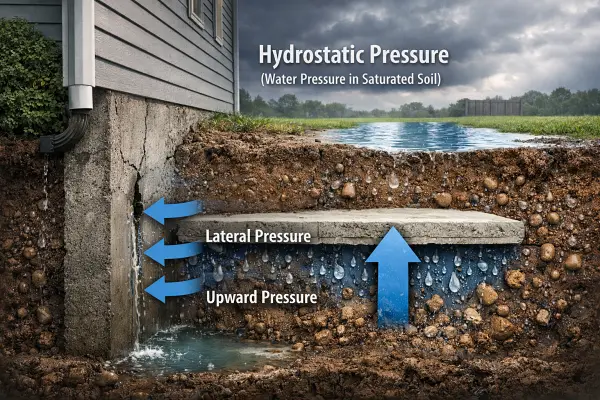
What Hydrostatic Pressure Means
In simple terms, hydrostatic pressure is the weight of water pressing against a surface. In the context of foundations, it refers to the force that saturated soil places against below-grade walls and slabs.
The deeper the soil saturation extends, the greater the potential pressure.
This pressure can push moisture through:
Small foundation cracks
Porous concrete surfaces
Wall-to-floor joints
Over time, sustained pressure can contribute to interior symptoms such as wet basement walls or recurring water in the basement after heavy rain.
Why Saturated Soil Creates Lateral Force
Water naturally seeks the path of least resistance. When drainage pathways are limited, due to dense clay soil, compacted backfill, or insufficient exterior drainage, water remains trapped in the surrounding soil.
As saturation increases, the soil mass becomes heavier and denser. That added weight creates lateral force (sideways pressure) against foundation walls and upward pressure beneath slabs.
When combined with poor grading around the foundation or concentrated roof discharge, this pressure can intensify.
How Pressure Affects Foundation Walls and Slabs
Concrete is strong in compression but can be vulnerable to prolonged lateral stress. Sustained hydrostatic pressure may:
Contribute to foundation cracking
Exacerbate minor structural weaknesses
Increase the likelihood of moisture intrusion
In clay-dominant soils, the combination of expansion and hydrostatic pressure can compound the force placed on below-grade structures.
Understanding how pressure forms in saturated soil helps clarify why water issues sometimes persist even after visible surface pooling has been addressed.
Regional Differences in Soil Behavior
Soil composition is not uniform across the country. Different regions contain varying proportions of clay, sand, silt, and organic material. These differences influence how water behaves once it enters the ground.
Because of this variation, foundation performance in one area may differ significantly from that in another — even when rainfall patterns appear similar.
High-Clay Regions
Certain parts of the country contain a higher concentration of clay-heavy soils. In these areas, drainage tends to be slower and seasonal expansion and contraction cycles may be more pronounced.
Homes built in clay-dominant regions often experience longer periods of soil saturation following storms. Over time, repeated wet-dry cycles can place fluctuating pressure on foundations.
In these conditions, slow drainage and prolonged saturation can change how water moves across the property. If runoff seems to linger or collect, it may help to review surface runoff and yard drainage to better understand how water is being directed.
Mixed and Fast-Draining Regions
Other regions contain more balanced or sandy soils. These soils typically allow water to move through them more freely, reducing the duration of saturation around a structure.
While water issues can still occur in these areas, pressure buildup is often more closely tied to surface drainage patterns rather than prolonged soil moisture retention.
Understanding regional soil tendencies helps explain why some neighborhoods experience recurring movement or moisture exposure, while others with similar rainfall totals do not.
Signs Soil Saturation May Be Contributing to a Problem
Soil-related pressure does not always present itself dramatically. In many cases, subtle exterior and interior patterns develop over time. Recognizing these patterns can help homeowners determine whether prolonged soil saturation may be influencing foundation performance.
Persistent Damp Soil Around the Foundation
If the soil surrounding a home remains damp several days after rainfall, drainage may be limited. Clay-heavy soil often retains moisture long after surface water has disappeared.
Persistent saturation near the foundation can increase the likelihood of pressure-related moisture exposure, particularly when combined with poor grading around the foundation or limited runoff control.
Over time, this persistent moisture can begin to show up inside the home. If you’re noticing damp walls or musty conditions, it may help to review wet basement walls to better understand what may be happening.
Seasonal Soil Cracking
During extended dry periods, expansive clay may shrink and form visible cracks in the ground. These cracks often close once the soil becomes wet again.
Seasonal soil cracking can indicate repeated expansion and contraction cycles, which may correspond with subtle structural changes such as foundation cracks or minor movement over time.
Recurring Exterior Pooling
Repeated pooling near the home after storms may signal that water is not dispersing efficiently through the soil.
If this pattern repeats in the same areas, it may help to take a closer look at water pooling near the foundation to understand how surface-level drainage issues can begin affecting moisture conditions around the home.
Persistent surface water can also be influenced by how readily the ground accepts rainfall. Soil compaction can affect foundation drainage by reducing infiltration and increasing the amount of water that remains at the surface.
Interior Changes After Heavy Rain
Interior symptoms may develop gradually as exterior pressure builds. These can include:
-
Damp basement walls
-
Musty odors
-
Water appearing at wall-to-floor joints
If you’re noticing these changes after rainfall, it may help to review wet basement walls or water in the basement to better understand what may be contributing.
While these signs do not confirm a specific cause, they may suggest that prolonged soil saturation is contributing to moisture exposure.
How Soil Saturation Problems Are Commonly Evaluated
| Common Symptom | Often Associated With | Common Response Path |
|---|---|---|
| Stair-step wall cracks | Expansive clay movement | Drainage and moisture management evaluation |
| Recurring basement moisture | Saturated surrounding soil | Water intrusion and runoff assessment |
| Sticking doors or windows | Foundation shifting or soil movement | Structural movement inspection |
| Uneven floors | Settlement or changing soil pressure | Foundation stabilization review |
When Soil Saturation Is Only Part of the Issue
Soil type plays a significant role in how water behaves around a foundation, but it is rarely the only factor involved. In many cases, prolonged saturation works in combination with other exterior conditions.
Properties may also contain both native and disturbed soils with different drainage characteristics. Understanding fill soil vs. native soil around foundations can help explain why water and moisture conditions may vary from one area of a property to another.
For example, if roof water is not directed far enough away from the home, concentrated discharge can repeatedly oversaturate nearby soil. Issues related to downspout discharge may intensify the effects of clay-heavy ground conditions.
Similarly, subtle slope problems can allow surface water to move toward the structure before it has a chance to disperse. Conditions described in poor grading around the foundation may increase moisture exposure even when rainfall totals are moderate.
In some cases, what appears to be a soil issue may also involve broader surface runoff and yard drainage patterns that concentrate water near the home.
Understanding how soil saturation interacts with drainage, grading, and water management systems provides a more complete picture of foundation water exposure. Addressing the contributing factors together, rather than in isolation, often leads to more stable long-term conditions. Because saturated soil is only one factor that can contribute to foundation moisture, it can help to determine whether you’re dealing with a drainage problem or foundation problem before deciding on the most appropriate solution.
Key Takeaways
- Soil saturation occurs when the ground becomes filled with water and cannot absorb additional moisture.
- Expansive clay soils can absorb water and swell, increasing pressure around foundations.
- Repeated wet and dry cycles may cause soil movement that affects foundation stability.
- Managing surface drainage and soil moisture can help reduce long-term foundation stress.
Where To Go Next
To understand changing soil conditions:
If water is collecting around the foundation:
If moisture or foundation movement is appearing:
For local soil and water conditions:
Frequently Asked Questions About Soil Saturation and Expansive Clay
These related sections expand on how foundation water problems develop, how to recognize early warning signs, and how different types of issues are commonly addressed. Exploring these topics can help clarify how individual problems fit into the broader picture.
Does clay soil always cause foundation problems?
No. Many homes are built successfully on clay-heavy soil. Issues are more likely to develop when drainage is limited, moisture cycles are extreme, or water is repeatedly directed toward the foundation. Soil type increases susceptibility, but it does not automatically create damage.
Can soil around a foundation be replaced?
Complete soil replacement is uncommon and typically limited to specific construction scenarios. In most cases, water management strategies, such as improving grading or redirecting runoff, are used to reduce prolonged saturation rather than removing existing soil.
How can I tell if my soil is expansive clay?
Visible signs such as seasonal soil cracking, noticeable swelling after heavy rain, or recurring foundation movement patterns may suggest expansive characteristics. Local soil surveys or geotechnical evaluations provide more definitive information about soil composition.
Does hydrostatic pressure require flooding to develop?
No. Hydrostatic pressure (the force exerted by water within saturated soil) can develop even when there is no standing water inside the home. Prolonged soil saturation alone can create pressure against foundation walls and slabs.
Can Expansive Clay Cause Basement Moisture Problems?
Home › Soil & Ground Conditions › Soil Saturation and Expansive Clay