
Downspout Discharge Issues: How Roof Runoff Reaches Your Foundation
Downspouts are designed to carry rainwater from the roof to ground level and discharge it safely away from a home’s foundation. When discharge points are too close to the structure, improperly sloped, or obstructed, large volumes of water can accumulate near the base of the foundation.
Because roof surfaces collect and concentrate rainfall, even moderate storms can produce significant runoff. A single downspout may channel hundreds of gallons of water during heavy rain. If that water is not directed far enough away from the home, soil saturation can increase along foundation walls, raising the likelihood of moisture intrusion over time.
In some cases, roof runoff becomes a contributing factor to hydrostatic pressure (water pressure that builds up in saturated soil). Understanding how downspout discharge works, and where that water ultimately flows, helps homeowners determine whether roof drainage may be influencing foundation moisture conditions.
What Are Downspout Discharge Issues?
Downspout discharge issues occur when roof runoff is released too close to the foundation or directed into areas where water cannot drain properly. During rainstorms, a large volume of water can flow off a roof in a short period of time. If this runoff is deposited near the home, it may collect along the foundation perimeter instead of draining away.
Over time, repeated roof runoff near the structure can contribute to soil saturation and water pooling. These conditions may increase moisture pressure against foundation walls and contribute to basement dampness, crawl space moisture, or other interior water problems.
Roof drainage issues like this are one of several exterior water problems that can influence how moisture reaches a home’s foundation.
How Downspouts Are Intended to Work
A roof drainage system is designed to collect rainwater and move it away from the home in a controlled manner. When functioning properly, each component plays a specific role in preventing water from concentrating near the foundation.
Roof Surface Collection
The roof is the first point of contact during rainfall. Instead of allowing water to fall randomly around the perimeter of the home, roofing materials are angled to direct water downward toward the edge of the structure. This concentrates runoff into predictable channels rather than dispersing it unevenly around the foundation.
Because roofs cover a large surface area, they can collect substantial volumes of water during even short storms. Without a controlled drainage path, that water would fall directly beside exterior walls.
Gutter Channeling
Gutters are installed along the roofline to intercept runoff and guide it horizontally toward designated downspout locations. When properly pitched (sloped slightly toward the downspout), gutters prevent water from overflowing at random points along the roof edge.
If gutters are misaligned or clogged, water may spill over the sides and fall directly next to the foundation, increasing localized soil saturation.
Downspout Discharge Location
Downspouts carry water vertically from the gutter to ground level. The final and most critical step is where that water is released. Ideally, discharge points extend far enough away from the foundation so runoff can disperse safely across the yard.
When discharge ends too close to the home, water may accumulate along the base of the structure, especially if surface slope is inadequate. Poor grading conditions can compound the issue by allowing runoff to flow back toward the foundation (see: poor grading around the foundation).
If water repeatedly collects near exterior walls after storms, it may lead to water pooling near the foundation, increasing the likelihood of moisture exposure and interior dampness over time.
If runoff is not directed far enough away from the home, it can contribute to repeated moisture exposure and may begin to affect below-grade areas.
Short Downspout Extensions
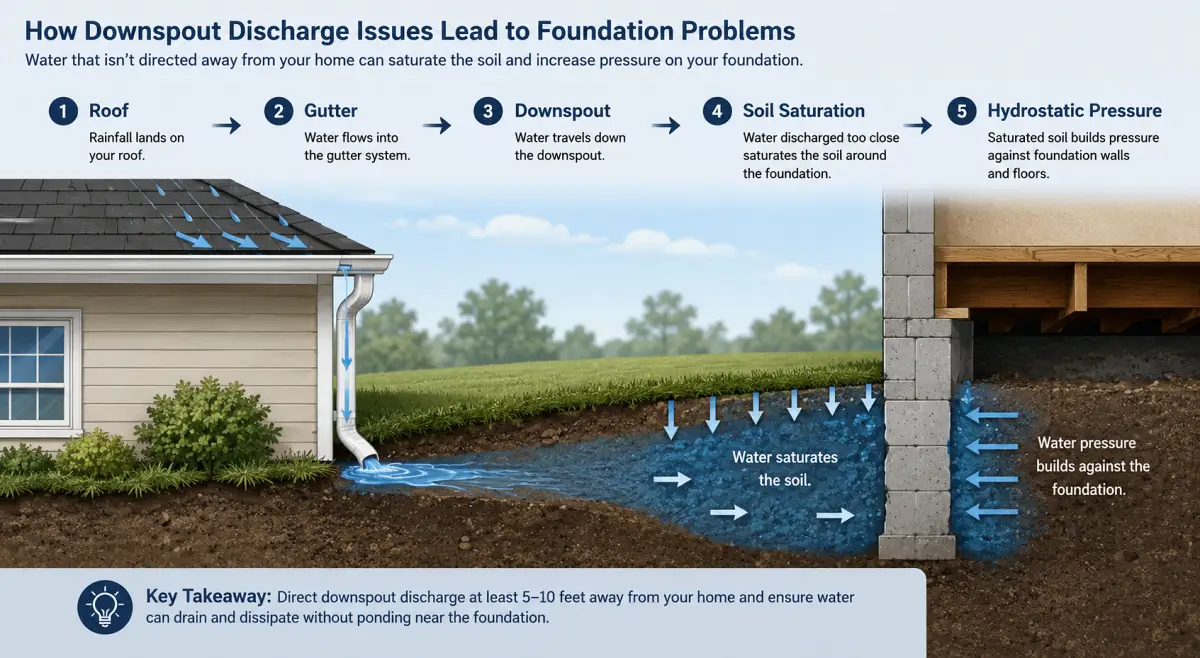
One of the most common discharge issues occurs when downspouts release water too close to the home. Even if the roof drainage system is functioning properly, runoff that exits directly beside the foundation can create a concentrated saturation zone in the surrounding soil.
Because roof runoff is funneled into a single point, the volume of water released at the base of a downspout is often much greater than natural rainfall distribution alone. When that water repeatedly enters the same small area, soil can become saturated more quickly than it can drain or evaporate.
Over time, this localized saturation increases the amount of moisture in direct contact with foundation walls. In below-grade areas, prolonged exposure may contribute to seepage through small cracks, wall joints, or porous concrete surfaces.
Short discharge points can be especially problematic in clay-heavy soils. Clay tends to absorb water slowly and retain moisture for extended periods. As the soil becomes saturated, it can expand and hold water against the foundation longer than sandy or well-draining soils would.
Even in otherwise well-graded yards, short downspout extensions may undermine surface drainage by introducing concentrated runoff at the most vulnerable point, directly beside the structure.
How Short Extensions Lead to Water Problems
When downspouts release water too close to the foundation, runoff can saturate the surrounding soil and contribute to repeated moisture exposure.
Splash Blocks vs. Buried Drain Lines
Downspout discharge is often managed using either surface splash blocks or buried drain extensions. Both methods are designed to move water away from the foundation, but they function differently and can perform differently depending on site conditions.
Splash blocks are placed at the base of a downspout to redirect runoff across the ground surface. Their purpose is to disperse water outward rather than allowing it to collect directly beside the home. For splash blocks to function properly, they must be positioned on stable ground and angled slightly away from the structure so water continues moving downhill rather than pooling at the edge.
If a splash block shifts, sinks into soft soil, or becomes partially buried by mulch or sediment, its ability to redirect water may be reduced. In those cases, runoff can begin to accumulate near the foundation again.
Buried drain extensions (sometimes called underground downspout extensions) carry water below the surface and discharge it farther away from the home. These systems are designed to transport concentrated roof runoff beyond the immediate perimeter of the foundation.
However, buried systems can also encounter problems. If the underground line becomes clogged with debris, crushed by soil pressure, or improperly sloped, water may back up and discharge near the foundation instead of at its intended outlet.
In both cases, the effectiveness of the system depends not only on the type of discharge method used, but on proper alignment and continued functionality. When water is not consistently carried away from the home, foundation exposure may gradually increase over time.
Comparing Common Downspout Drainage Methods
| Drainage Method | Typical Use | Works Best When | Common Limitation |
|---|---|---|---|
| Splash block | Redirects water away from the downspout outlet | The yard already slopes away from the home | Water may still collect nearby if drainage is poor |
| Downspout extension | Carries roof runoff farther from the foundation | Additional runoff distance is needed | May shift or disconnect over time |
| Buried drain line | Moves water underground toward a discharge area | Surface runoff needs more controlled routing | Requires proper slope and periodic maintenance |
| Pop-up emitter | Releases water farther away from the home | Runoff is routed underground across the yard | Can clog or freeze in some conditions |
Clogged Gutters and Downspouts
Clogged gutters and downspouts are one of the most common roof drainage issues. Leaves, twigs, roofing granules, and other debris can accumulate inside the gutter channel, restricting the normal flow of water toward the downspout.
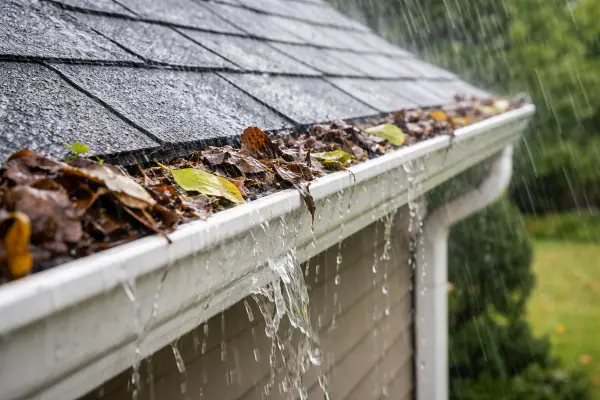
When gutters cannot carry runoff efficiently, water may spill over the front or back edge instead of moving through the drainage system. During heavy rain, this overflow can create concentrated sheets of water cascading down exterior walls and collecting near the foundation.
In some cases, debris may also block the downspout itself. When this occurs, water can back up within the gutter and overflow at the roofline or discharge at unintended locations along the home’s perimeter.
Because roof runoff is concentrated along the gutter edge, repeated overflow in the same area can increase soil saturation directly beside the foundation. Over time, this pattern may contribute to water pooling conditions, damp exterior walls, or moisture intrusion in below-grade spaces.
While clogged gutters are often viewed as a routine maintenance issue, their impact on drainage patterns can be significant when left unaddressed.
When Overflow Begins to Affect the Foundation
When gutters or downspouts overflow, large volumes of water can be released near the base of the home, increasing the risk of soil saturation and foundation moisture problems.
Overflow at the Roofline
Overflow at the roofline can occur even when gutters and downspouts appear intact. In some cases, the issue is related to gutter pitch (the slight slope that allows water to move toward the downspout). If gutters are not angled correctly, water may stagnate in certain sections and spill over the edge during moderate to heavy rainfall.
Undersized gutters can create similar problems. When the volume of roof runoff exceeds the system’s carrying capacity, water may overflow before it can be directed into the downspout. This is more likely during intense storms, when large amounts of rainfall are concentrated in a short period of time.
In colder climates, ice dams may also contribute to overflow conditions. Ice dams form when melting snow refreezes near the roof edge, preventing proper drainage. As water backs up behind the ice, it can spill over the gutter or flow beneath roofing materials, increasing exterior moisture exposure.
When overflow occurs at the roofline, water often cascades directly down exterior walls rather than following a controlled drainage path. Repeated exposure along the same section of the foundation can increase localized soil saturation and contribute to long-term moisture concerns.
Even small, recurring overflow patterns can gradually influence how water behaves around the home, particularly when combined with other drainage factors such as poor grading or slow-draining soil.
Signs Downspout Discharge May Be Contributing to Water Problems
Certain visible conditions around a home may indicate that downspout discharge is contributing to drainage problems. When roof runoff is repeatedly released too close to the structure, concentrated water flow can begin to affect soil, grading, and foundation surfaces over time.
The following signs may suggest that roof runoff is not being directed far enough away from the home and may be contributing to foundation moisture conditions.
Erosion Beneath the Downspout
One of the clearest exterior indicators of discharge problems is visible soil erosion directly beneath a downspout outlet. When concentrated runoff repeatedly strikes the same area, it can wash away soil and create small trenches or depressions near the foundation.
Over time, this erosion may lower the soil level at the base of the wall, reducing the protective grading that helps move water away from the structure. If left unaddressed, repeated erosion can increase the likelihood of surface water accumulation during storms. Repeated erosion can gradually change the ground surface and alter how runoff moves near the home. See Soil Erosion Around Foundations for a closer look at how concentrated water flow can remove soil and affect drainage patterns.
Pooling Near Foundation
If water gathers at the base of a downspout after rainfall, discharge may not be extending far enough away from the home. Because roof runoff is concentrated into a single exit point, even short periods of rain can create localized pooling conditions.
Persistent pooling near the foundation can increase soil saturation and raise moisture exposure risks. If you are noticing standing water after storms, see our guide on water pooling near the foundation for additional context.
Foundation Wall Staining
Repeated overflow or discharge too close to the structure can leave visible staining on exterior foundation walls. Dark streaks, mineral deposits, or discoloration may indicate that water is consistently running down the same section of wall.
These exterior signs sometimes correspond with interior moisture patterns, particularly in below-grade areas. When staining appears alongside interior dampness, roof runoff should be evaluated as a potential contributing factor.
For related interior symptoms, see wet basement walls.
Interior Dampness After Storms
In some homes, roof drainage issues are first noticed inside. If a basement becomes damp or small amounts of moisture appear after heavy rain, concentrated runoff near the foundation may be increasing pressure against exterior walls.
When downspout discharge combines with poor grading or slow-draining soil, water may remain in contact with foundation surfaces longer than intended. This can contribute to seepage patterns that resemble other types of moisture intrusion.
If you are observing moisture inside the home after storms, you may find it helpful to review water in the basement for additional guidance.
Related Water and Foundation Issues to Watch For
If these signs are present, it may help to review how runoff is affecting the foundation and surrounding structure.
If you’re unsure how serious the issue may be:
When Roof Runoff Is Only Part of the Issue
While downspout discharge can significantly influence how water behaves around a home, roof runoff is rarely the only factor involved in foundation moisture patterns. In many cases, drainage conditions are shaped by the interaction of multiple exterior elements.
For example, even properly extended downspouts may not fully prevent water exposure if surface slope directs runoff back toward the structure. In these situations, roof drainage and grading conditions work together to influence how water collects near the foundation. If exterior slope is inadequate, runoff from a well-functioning downspout system can still contribute to localized saturation (see: poor grading around the foundation).
Soil composition also plays a role. In clay-heavy soils, water may drain slowly and remain in contact with foundation walls longer than in sandy or well-draining soil types. When concentrated roof runoff repeatedly enters slow-draining soil, moisture levels can gradually increase over time. Soil composition also plays a role. In clay-heavy soils, water may drain slowly and remain in contact with foundation walls longer than in sandy or well-draining soil types. When concentrated roof runoff repeatedly enters slow-draining soil, moisture levels can gradually increase over time. See How Water Moves Through Different Soil Types for more about how soil composition affects infiltration and drainage.
High seasonal groundwater levels can further complicate the picture. When subsurface water rises toward foundation depth, surface drainage improvements may reduce runoff exposure but may not eliminate moisture entirely. In these cases, roof runoff becomes one contributing factor among several influencing foundation conditions.
Because exterior drainage systems operate as an interconnected system, roof, gutters, discharge, grading, soil, and groundwater, evaluating one component in isolation may not provide a complete understanding of the issue. Recognizing how these elements interact supports a more accurate assessment of potential moisture contributors.
Other Conditions That May Contribute to Water Problems
Downspout discharge often interacts with other drainage and soil conditions. Reviewing these factors together can provide a clearer picture of how water is affecting the foundation.
Key Takeaways
- Downspout discharge issues occur when roof runoff is released too close to the foundation or into poorly draining areas.
- Short downspouts can allow large volumes of water to collect near the home during storms.
- Repeated roof runoff near the foundation can saturate soil and contribute to water pooling along exterior walls.
- Redirecting downspout discharge away from the home can help reduce moisture pressure and interior water risks.
Where To Go Next
If you want to review other exterior drainage conditions:
If interior moisture symptoms are beginning to appear:
If drainage problems continue or seem to be getting worse:
If you want to understand foundation water problems where you live:
Frequently Asked Questions About Downspout Discharge Issues
Can short downspouts really cause basement water problems?
Short downspouts can contribute to basement moisture problems when roof runoff is discharged too close to the foundation. Repeated water accumulation near the home may saturate surrounding soil and increase moisture exposure along below-grade walls over time.
How far should downspouts discharge from a home?
Are buried downspout extensions better than splash blocks?
Buried drain lines and splash blocks manage roof runoff differently depending on drainage conditions around the home. Splash blocks may work well where soil already slopes away from the structure, while buried extensions are often used when runoff needs to be routed farther from the foundation.
Can clogged gutters increase foundation moisture risk?
Home › Exterior Water Problems › Downspout Discharge issues