
Foundation Water Problems in Texas
Many foundation problems in Texas begin with changes in the moisture surrounding a home’s foundation. Expansive clay soils, prolonged drought, heavy rainfall, poor drainage, plumbing leaks and uneven irrigation can all cause the ground beneath and around a foundation to shrink, swell or remain saturated. Understanding how soil and water interact is the first step toward identifying the cause of foundation movement and choosing the right solution.
Texas Foundation Water Problems at a Glance
Texas is one of the most challenging states for foundation performance because changing soil moisture continually affects expansive clay soils. Extended drought, sudden heavy rain, poor drainage and plumbing leaks can all cause the ground beneath a home to shrink, swell or remain saturated. Understanding how water moves through Texas soils is the key to diagnosing many foundation problems.
Why Texas Homes Are Especially Vulnerable
Texas experiences some of the most challenging foundation conditions in the country because of the way soil and water interact throughout the year. Expansive clay soils, prolonged drought, intense rainfall and uneven moisture around foundations all contribute to foundation movement. While every property is different, understanding these statewide risk factors can help homeowners recognize why foundation water problems are so common across Texas.
Expansive Clay Soils
Expansive clay is one of the leading contributors to foundation movement in Texas. Unlike sandy soils that drain quickly, clay expands as it absorbs water and shrinks as it dries. These repeated changes place continual pressure on foundations, especially slab-on-grade homes.
- Learn more about soil saturation and expansive clay
- Understand foundation settlement caused by changing soil moisture
Long Dry Periods and Heavy Rainfall
Texas weather often swings between extended dry spells and sudden periods of heavy rain. During drought, clay soils lose moisture and contract. When heavy rainfall returns, those same soils rapidly expand. These repeated cycles create uneven movement beneath foundations that can lead to cracks, settlement and structural stress.
Uneven Soil Moisture Around Foundations
Foundation movement is often caused by uneven moisture, not simply too much or too little water. Leaking plumbing, poor drainage, overwatering one side of the home or roof runoff concentrated in one area can create different soil conditions beneath various sections of the foundation. Uneven expansion and shrinkage can cause differential settlement and structural movement over time.
Regional Differences Across Texas
Texas covers a wide range of climates, soil types and groundwater conditions. North Texas commonly experiences highly expansive clay soils, while Gulf Coast communities contend with higher rainfall and groundwater levels. Central, East and West Texas each present their own combination of weather patterns and soil behavior, making local conditions an important part of understanding foundation water problems.
| Risk Factor | Why It Matters |
|---|---|
| Expansive clay soils | Shrink and swell as moisture changes |
| Prolonged drought | Causes soil shrinkage and foundation settlement |
| Heavy rainfall | Rehydrates clay and may create rapid expansion |
| Poor drainage | Allows water to collect around foundations |
| Plumbing leaks | Create localized soil saturation beneath foundations |
| Uneven irrigation | Produces inconsistent soil moisture and differential movement |
| Regional climate differences | Soil behavior varies across Texas |
Why Foundation Water Problems Are So Common in Texas
Texas experiences more foundation movement than many other parts of the country because of the unique relationship between its soils, weather patterns and residential construction. Across much of the state, expansive clay soils shrink during prolonged dry periods and swell when moisture returns. Combined with intense rainfall, uneven drainage and common slab-on-grade foundations, these conditions create an environment where foundation water problems are both common and often misunderstood.
Why Texas Is Especially Prone to Foundation Water Problems
| Risk Factor | How It Affects Foundations |
|---|---|
| Expansive clay soils | Shrink during drought and expand when moisture returns, causing soil movement. |
| Long dry periods | Soil contracts and may allow portions of the foundation to settle unevenly. |
| Heavy rainfall | Rapid soil expansion and water accumulation can place additional pressure on foundations. |
| Slab-on-grade construction | Common throughout Texas and directly influenced by changing soil conditions beneath the slab. |
| Poor drainage | Allows water to collect near the foundation, increasing soil saturation and movement. |
| Plumbing leaks | Create localized soil saturation beneath or beside the foundation, leading to differential movement. |
| Regional climate differences | Soil types, rainfall and groundwater conditions vary considerably across the state. |
Related Resources – Learn More
How Soil and Water Affect Texas Foundations
Most foundation problems in Texas begin below the surface, where changing soil moisture affects the ground supporting a home’s foundation. As soil dries, it can shrink and lose its ability to provide uniform support. When moisture returns, some soils expand while others become saturated and unstable. Understanding how these changes influence the soil beneath your home is essential to identifying the cause of foundation movement and determining the most appropriate solution.
When Soil Becomes Too Dry
Extended drought and high summer temperatures can cause expansive clay soils to lose moisture and contract. As the soil shrinks, gaps may develop beneath portions of the foundation, reducing support and allowing sections of the structure to settle unevenly. This type of movement often develops gradually and may appear as new cracks, sticking doors or uneven floors.
Related Resources
When Soil Becomes Too Wet
Heavy rainfall, poor drainage, plumbing leaks or prolonged saturation can all increase the amount of water surrounding a foundation. In clay soils, excess moisture may cause the soil to expand and place upward pressure on portions of the foundation. In other situations, saturated soil may lose strength and provide less stable support. Both conditions can contribute to uneven foundation movement over time.
Related Resources
Why Uneven Moisture Causes Foundation Movement
Many foundation problems result from uneven soil moisture rather than uniformly wet or dry conditions. For example, a plumbing leak beneath one corner of a home, poor drainage along one wall or concentrated roof runoff can create different soil conditions beneath different parts of the foundation. As some areas of soil expand while others shrink, the foundation may experience differential movement that leads to cracks, settlement and structural stress.
Maintaining consistent moisture levels around the foundation is often more important than simply keeping the soil as dry as possible.
Related Resources
How Changing Soil Moisture Affects Foundations
| Soil Condition | What Happens Below Ground | Possible Result |
|---|---|---|
| Soil becomes too dry | Clay soils shrink and lose volume | Settlement, cracks and uneven support |
| Soil becomes too wet | Soil expands or becomes saturated | Upward pressure or reduced bearing strength |
| Moisture becomes uneven | Different areas of soil expand or shrink at different rates | Differential foundation movement and structural stress |
Common Causes of Foundation Water Problems in Texas
Foundation water problems in Texas rarely have a single cause. In many cases, foundation movement results from a combination of weather, soil conditions, drainage and plumbing issues that change the moisture surrounding a home’s foundation. Identifying the underlying cause is essential because the appropriate solution depends on why the soil is changing—not simply where the symptoms appear.
Poor Grading and Roof Runoff
The ground surrounding a home should slope away from the foundation so rainwater drains safely away. Improper grading or downspouts that discharge too close to the home can allow water to collect near the foundation, increasing soil saturation and contributing to foundation movement over time.
Related Resources
Water Pooling Around the Foundation
Standing water beside a foundation is often a sign that drainage is not functioning as intended. Persistent pooling can increase soil moisture, encourage erosion and place additional stress on foundation systems, especially during periods of heavy rainfall.
Related Resources
Inadequate Yard Drainage
Poor yard drainage can allow stormwater to remain near a home long after rainfall has ended. Low areas, compacted soil and inadequate drainage systems may all contribute to prolonged soil saturation around the foundation.
Related Resources
Plumbing and Under-Slab Leaks
Leaks beneath or adjacent to a foundation can create localized areas of saturated soil that differ from the surrounding ground. Over time, this uneven moisture may contribute to differential foundation movement, even when the rest of the property appears dry.
Related Resources
Overwatering and Uneven Irrigation
Landscape irrigation is intended to maintain healthy plants, but inconsistent watering patterns can create uneven soil moisture around a foundation. Regularly soaking one side of a home while allowing another side to dry may contribute to differential soil movement in expansive clay.
Related Resources
Drought and Soil Shrinkage
Extended periods without meaningful rainfall allow expansive clay soils to dry and contract. As soil loses moisture, portions of the foundation may lose uniform support, increasing the likelihood of settlement and structural movement.
Related Resources
High Groundwater and Prolonged Saturation
Although not every part of Texas experiences elevated groundwater, some regions are more susceptible to prolonged soil saturation because of local geology, seasonal rainfall or naturally high water tables. These conditions can influence both foundation performance and drainage requirements.
Related Resources
Common Causes of Foundation Water Problems in Texas
| Cause | Primary Effect on the Foundation | Most Common Source |
|---|---|---|
| Poor grading | Water collects beside the foundation | Improper site grading |
| Roof runoff | Concentrated water near the home | Short or damaged downspouts |
| Yard drainage problems | Prolonged soil saturation | Low spots and poor drainage |
| Plumbing leaks | Localized soil saturation | Under-slab or supply line leaks |
| Uneven irrigation | Differential soil moisture | Inconsistent landscape watering |
| Drought | Soil shrinkage and settlement | Extended dry weather |
| High groundwater | Saturated supporting soils | Regional groundwater conditions |
Note:
Many of these conditions can produce similar symptoms, making it difficult to determine the true cause of foundation movement. Before deciding on a repair, it’s important to understand what warning signs to look for and whether the problem is related to drainage, plumbing or the foundation itself.
Warning Signs of Foundation Water Problems
Foundation water problems often develop gradually, making the early warning signs easy to overlook. While no single symptom confirms a foundation issue, changes around your home, new structural cracks, persistent moisture or plumbing concerns may indicate that changing soil conditions are affecting the foundation. Recognizing these warning signs early can help homeowners identify potential problems before they become more significant.
Changes Around the Outside of Your Home
Many foundation water problems first become visible outside the home. Water that consistently collects near the foundation, eroding soil, uneven settling or visible gaps between the soil and foundation can all indicate changing moisture conditions. Homeowners should also watch for overflowing gutters, short downspouts and grading that directs water toward the home rather than away from it.
Related Resources
Interior Cracks and Structural Movement
As soil beneath a foundation expands or contracts, portions of the home may move unevenly. Common warning signs include new wall cracks, ceiling cracks, sticking doors and windows, uneven floors or gaps around trim. While these symptoms do not always indicate a serious structural problem, they should be monitored, particularly if they continue to worsen over time.
Related Resources
Moisture and Drainage Symptoms
Persistent dampness around the foundation, musty odors, wet basement walls or standing water after rainfall may indicate that water is not draining properly away from the home. In some cases, these symptoms result from surface drainage problems, while in others they may be associated with groundwater or hydrostatic pressure.
Related Resources
Plumbing-Related Warning Signs
Some foundation problems begin with plumbing leaks rather than rainfall or drainage issues. An unexplained increase in water usage, damp soil near the foundation, warm spots on floors or recurring moisture in one area of the home may indicate an under-slab or underground plumbing leak. Because plumbing leaks can change soil moisture beneath a foundation, prompt investigation is recommended.
Related Resources
Common Warning Signs and What They May Indicate
| Warning Sign | Possible Cause | Learn More |
|---|---|---|
| Standing water near the foundation | Poor grading or drainage | Water Pooling Near a Foundation |
| New wall or floor cracks | Foundation movement | Foundation Cracks |
| Doors and windows that stick | Differential settlement | Settlement From Water |
| Damp basement walls or musty odors | Water intrusion or drainage issues | Wet Basement Walls |
| Unusually high water bills | Possible plumbing leak | Drainage Problem or Foundation Problem |
Is It a Drainage Problem or a Foundation Problem?
Many foundation water problems begin with symptoms that can be difficult to interpret. Standing water, foundation cracks, sticking doors or damp basement walls do not always point to the same underlying issue. In some cases, improving drainage may resolve the problem. In others, plumbing leaks, changing soil moisture or structural movement may require a different approach. Understanding the difference is an important first step before investing in repairs.
Drainage Problem vs. Foundation Problem
| If You Notice… | It May Be Related To… |
|---|---|
| Water pooling after rain | Drainage or grading |
| Overflowing gutters or short downspouts | Exterior drainage |
| Damp basement walls | Water intrusion or hydrostatic pressure |
| New foundation cracks | Soil movement or structural settlement |
| Doors and windows sticking | Differential foundation movement |
| Sudden increase in water usage | Possible plumbing leak beneath the foundation |
Not sure which problem you’re dealing with?
Use our Drainage Problem or Foundation Problem Assessment to better understand the likely cause of your home’s symptoms and learn which type of professional may be most appropriate.
How Foundation Water Problems Differ Across Texas
Although many foundation water problems share similar warning signs, the conditions that create them vary considerably across Texas. Differences in soil composition, climate, rainfall patterns and groundwater levels mean that homeowners in one part of the state may experience very different foundation challenges than those in another. A home in the Dallas–Fort Worth area, for example, faces different risks than a home along the Gulf Coast or in the arid regions of West Texas.
Expansive clay soils dominate much of North and Central Texas, where repeated cycles of drought and heavy rainfall can cause significant soil movement beneath foundations. Along the Gulf Coast, higher rainfall, elevated groundwater and prolonged soil saturation often play a greater role. East Texas generally receives more consistent precipitation, while West Texas and the Panhandle contend with drier conditions, greater evaporation and unique soil characteristics.
Understanding these regional differences helps explain why no single solution works for every home. As Foundation Water Guide expands its Texas coverage, each region and major metropolitan area will include more detailed information about local soil conditions, common foundation water problems and the drainage or foundation solutions most appropriate for that area.
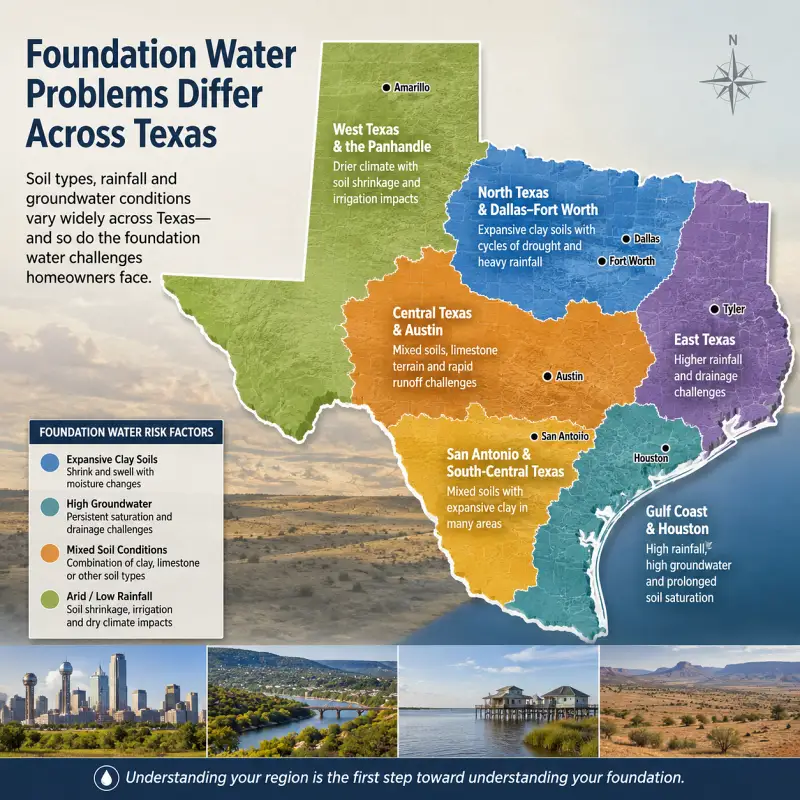
North Texas and Dallas–Fort Worth
North Texas is widely associated with expansive clay soils that react strongly to changes in moisture. Long summer dry periods can cause the soil to contract, while heavy rainfall or concentrated irrigation can cause it to swell again. These repeated cycles may create uneven support beneath slab-on-grade foundations, particularly when drainage or watering conditions differ from one side of the home to another.
Homeowners in the Dallas–Fort Worth area should pay close attention to soil separation, pooling water, runoff from downspouts and new signs of foundation settlement.
Learn more about soil saturation and expansive clay and settlement caused by changing soil moisture.
Central Texas and Austin
Central Texas contains a mixture of clay soils, limestone terrain and shallow or rocky ground. Because these conditions can change within relatively short distances, foundation-water behavior may vary considerably from one property to another.
Intense rainfall can move quickly across hard or sloped surfaces, creating runoff and drainage problems around homes. In areas with expansive clay, dry weather and uneven irrigation may also contribute to shrinking and swelling beneath foundations. Proper grading and control of roof runoff are therefore especially important.
Learn more about surface runoff and yard drainage and poor grading around foundations.
Gulf Coast and Houston
The Gulf Coast receives more rainfall and generally experiences greater humidity and moisture exposure than much of inland Texas. Flat terrain, slow drainage, intense storms and elevated groundwater in some areas can allow soil around foundations to remain wet for extended periods.
Homes may be affected by surface runoff, localized flooding, saturated soil or water that cannot drain away efficiently. Expansive clay is also present in parts of the region, so alternating wet and dry conditions may still contribute to foundation movement.
Learn more about high groundwater around foundations and the difference between surface water and groundwater.
San Antonio and South-Central Texas
San Antonio and South-Central Texas include a varied combination of expansive clay, limestone and mixed soils. Some areas experience rapid runoff across rocky or sloped ground, while others are more affected by clay shrinkage during prolonged dry weather.
Foundation-water problems may result from uneven irrigation, poor grading, concentrated roof runoff or changing soil moisture around the perimeter of a home. Because local terrain and soil conditions vary, homeowners should evaluate what is happening on their individual property rather than relying only on regional assumptions.
Learn more about foundation risk factors and downspout discharge problems.
East Texas
East Texas generally receives more rainfall and has more vegetation than the drier western portions of the state. Higher precipitation can increase the importance of yard drainage, grading and controlling water that collects near a foundation.
Soils vary across the region, but homes may be affected by prolonged dampness, surface runoff and localized saturation after repeated storms. Dense vegetation and shaded areas can also slow evaporation, allowing some sections of a property to remain wetter than others.
Learn more about water pooling near a foundation and how water enters a foundation
West Texas and the Panhandle
West Texas and the Panhandle are generally drier, with greater evaporation and longer periods between significant rainfall events. In these regions, foundation problems may be influenced more by soil moisture loss, shrinkage and uneven irrigation than by persistent saturation.
Sudden storms can still create runoff problems, especially where dry or compacted soil cannot absorb water quickly. Irrigation leaks or concentrated watering may also create isolated wet areas next to otherwise dry soil, producing uneven conditions around the foundation.
Learn more about foundation settlement from changing soil moisture and whether a symptom points to a drainage problem or foundation problem.
Explore Texas Local Foundation Water Guides
Explore local guides for a closer look at how soil, drainage, groundwater, geology and changing moisture conditions can affect foundations in different parts of Texas.
Dallas–Fort Worth
Explore foundation water conditions across Dallas, Fort Worth and surrounding communities, including the role of expansive soils, drought, heavy rainfall, drainage and localized groundwater conditions.
Houston
Explore foundation water conditions across the Houston metro, including the role of heavy rainfall, Gulf Coast soils, flat terrain, drainage, groundwater and land subsidence.
San Antonio
Explore foundation water conditions across the San Antonio metro, including the role of limestone and karst geology, heavy rainfall, rapid runoff, drainage and Edwards Aquifer recharge.
Seasonal Foundation Water Risks in Texas
Foundation water problems in Texas are closely tied to seasonal weather patterns. Periods of drought, heavy rainfall, changing temperatures and shifting irrigation practices all influence the amount of moisture surrounding a home’s foundation. Understanding how each season affects soil conditions can help homeowners recognize potential risks early and take steps to maintain more consistent moisture around the foundation throughout the year.
Spring Rainfall
Spring often brings heavier rainfall to many parts of Texas, increasing the potential for saturated soils, standing water and drainage problems around foundations. Gutters, downspouts and grading should be inspected to ensure water is directed away from the home before prolonged spring storms arrive.
Related Resources
Summer Heat and Soil Shrinkage
Extended summer heat and prolonged dry conditions can cause expansive clay soils to lose moisture and shrink. As the soil contracts, portions of the foundation may lose uniform support, increasing the likelihood of settlement and structural movement. Maintaining consistent soil moisture, without overwatering, is often more beneficial than allowing repeated wet-and-dry cycles.
Related Resources
Fall Moisture Changes
Fall weather often brings changing rainfall patterns and cooler temperatures. Homes that experienced significant soil shrinkage during the summer may see soils begin to regain moisture. Because moisture levels rarely return evenly around the entire foundation, homeowners should continue monitoring drainage, irrigation and new foundation movement during this transition period.
Related Resources
Winter Freezes and Plumbing Leaks
Although severe winter weather is less common across much of Texas than in northern states, freezing temperatures can still affect plumbing and drainage systems. Frozen or damaged pipes may create hidden leaks beneath or near the foundation, while winter storms can temporarily overwhelm drainage systems in some regions.
Related Resources
Seasonal Foundation Risk Calendar
| Season | Primary Foundation Water Risk | Recommended Homeowner Check |
|---|---|---|
| Spring | Heavy rainfall, pooling water and saturated soils | Inspect gutters, downspouts and yard drainage |
| Summer | Soil shrinkage and foundation settlement | Monitor soil moisture and avoid uneven irrigation |
| Fall | Changing moisture levels and soil movement | Watch for new cracks or sticking doors and windows |
| Winter | Plumbing leaks and seasonal drainage issues | Check exposed plumbing and inspect drainage after storms |
Note:
Understanding seasonal risks is only part of protecting your home. Regular inspections, proper drainage maintenance and early attention to changing conditions can help reduce the likelihood of more serious foundation water problems over time.
What Texas Homeowners Should Do
While no homeowner can control the weather or soil conditions beneath their property, many foundation water problems can be reduced by managing how water moves around the home. Regular inspections, proper drainage and early attention to changing conditions can help minimize uneven soil moisture and make it easier to identify potential problems before they become more significant. The goal isn’t to eliminate every risk, it’s to recognize changing conditions early and respond appropriately.
Watch How Water Moves Around Your Home
One of the simplest ways to evaluate foundation risk is to observe your property during and after a rainfall. Look for areas where water collects near the foundation, downspouts that discharge too close to the home, erosion along the foundation or sections of the yard that remain wet long after surrounding areas have dried.
Understanding how water naturally flows across your property often reveals drainage issues before structural symptoms develop.
Related Resources
Maintain Gutters and Drainage
Gutters, downspouts and surface drainage systems play an important role in directing rainwater away from the foundation. Keep gutters free of debris, extend downspouts away from the home where appropriate and periodically inspect grading to ensure water continues to flow away from the structure.
Small maintenance tasks performed throughout the year can help reduce prolonged soil saturation around the foundation.
Related Resources
Monitor Cracks and Structural Changes
Not every crack indicates a serious foundation problem, but new or expanding cracks, sticking doors, uneven floors and recurring structural changes deserve attention. Photographing cracks and monitoring them over time can help determine whether movement appears to be stable or continuing.
Tracking changes over several months often provides more useful information than relying on a single observation.
Related Resources
Know When to Seek Professional Help
Some issues can be addressed through routine drainage maintenance, while others require professional evaluation. Persistent water intrusion, significant structural movement, suspected plumbing leaks or rapidly changing foundation symptoms should not be ignored.
The most appropriate professional depends on the underlying cause. A drainage contractor, plumber, structural engineer or foundation repair specialist may each play a different role in diagnosing and resolving foundation water problems.
Related Resources
Homeowner Action Checklist
| ✓ | Action |
|---|---|
| ☐ | Observe how water drains around your home during heavy rain. |
| ☐ | Clean gutters and verify downspouts discharge away from the foundation. |
| ☐ | Check for standing water or erosion around the foundation. |
| ☐ | Monitor new cracks, sticking doors and uneven floors. |
| ☐ | Investigate unexplained moisture or unusually high water bills. |
| ☐ | Seek professional guidance if symptoms worsen or multiple warning signs appear. |
Finding the Right Professional in Texas
Foundation water problems don’t always require the same type of professional. The right person to contact depends on what is causing the problem, not simply the symptoms you see. Some issues are best addressed by improving drainage, while others may involve plumbing, structural evaluation or foundation repair. Understanding who does what can save time, prevent unnecessary repairs and help you find the most appropriate solution.
Drainage Contractors
Drainage contractors focus on managing how water moves around a property. They may recommend grading improvements, French drains, downspout extensions, swales or other drainage solutions to prevent water from collecting near the foundation. If your primary concern is standing water, poor drainage or runoff after rain, a drainage specialist may be the appropriate first call.
Best for:
- Standing water
- Poor grading
- Yard drainage problems
- Surface runoff
Plumbers and Leak Detection Specialists
A plumbing leak beneath or near a foundation can change soil moisture and contribute to uneven foundation movement. If you notice unusually high water bills, damp soil during dry weather or suspect a hidden leak, a licensed plumber or leak detection specialist can determine whether plumbing is contributing to the problem.
Best for:
- Under-slab leaks
- Hidden water leaks
- Unexplained water usage
- Wet soil without rainfall
Structural Engineers
Structural engineers evaluate how a home’s foundation is performing and whether observed movement raises structural concerns. They provide independent assessments and can help determine whether foundation movement is minor, progressive or requires repair.
Best for:
- Significant structural cracks
- Uneven floors
- Complex movement
- Independent structural evaluations
Foundation Repair Contractors
Foundation Repair Contractors
Foundation repair contractors address movement that has already affected the foundation. Depending on the cause and severity, repairs may include stabilization, underpinning, pier systems or other structural solutions. Before proceeding with repairs, it’s important to understand whether drainage, plumbing or changing soil moisture contributed to the problem.
Best for:
- Foundation settlement
- Structural stabilization
- Foundation repair recommendations
- Homes with confirmed movement
| If Your Main Concern Is… | Start With… |
|---|---|
| Standing water after rain | Drainage Contractor |
| Water collecting around the foundation | Drainage Contractor |
| Suspected plumbing leak | Plumber / Leak Detection Specialist |
| Large structural cracks or uneven floors | Structural Engineer |
| Confirmed foundation movement | Foundation Repair Contractor |
| Unsure of the cause | Take the Foundation Water Assessment |
Key Takeaways
- Foundation problems often begin below the surface.
- Changing soil moisture is the biggest risk.
- Too little water can be just as harmful as too much.
- Texas soils behave differently from one region to another.
- Watch for changes before they become major repairs.
- Diagnose the cause before choosing the solution.
Where To Go Next
Whether you’re trying to identify the cause of a foundation water problem or learn more about how soil and water affect your home, these resources can help you take the next step.
If you’re not sure what’s causing the problem:
If you want to understand how water affects foundations
If you’re investigating common water-related problems
If you’ve noticed foundation movement
Official Texas Resources
The following organizations provide trusted information about Texas soils, groundwater, geology, weather patterns and foundation-related conditions. These public resources can help homeowners learn more about the factors that affect foundations across Texas.
Common Texas Foundation Water Questions
The foundation water problems that affect Texas homes often lead to similar questions. If you’re trying to understand what’s happening around your home, these guides provide more detailed answers to some of the most common concerns.
Frequently Asked Questions
What causes most foundation problems in Texas?
Can too much rain damage a Texas foundation?
Heavy rainfall can contribute to foundation problems when it saturates the soil surrounding a home or exposes existing drainage deficiencies. Water pooling near the foundation, poor grading and prolonged soil saturation may increase movement in expansive clay soils. However, excessive rain is only one part of the equation. In Texas, repeated cycles of drought followed by heavy rainfall often create greater foundation stress than a single storm.
Can drought cause foundation problems?
Yes. Extended drought can cause expansive clay soils to lose moisture and shrink. As the soil contracts, portions of the foundation may lose uniform support, leading to settlement, structural movement and foundation cracks. Drought-related foundation problems are common in many parts of Texas because prolonged dry weather is often followed by periods of heavy rainfall that cause the soil to expand again.
Should you water your foundation during dry weather?
Maintaining consistent soil moisture is generally more important than applying large amounts of water after the soil has become extremely dry. In some situations, controlled watering may help reduce rapid soil shrinkage around foundations built on expansive clay. However, excessive or uneven watering can also create foundation movement. Homeowners should avoid dramatic moisture changes and follow guidance appropriate for their soil conditions and foundation type.
Is clay soil a problem everywhere in Texas?
No. Expansive clay is common throughout much of Texas, particularly in North and Central Texas, but soil conditions vary considerably across the state. Some regions have mixed soils, limestone or different drainage characteristics that influence how water affects foundations. Local rainfall, groundwater conditions and terrain also play important roles in determining foundation risk.
Who should inspect foundation water problems?
The appropriate professional depends on the likely cause of the problem. Drainage contractors evaluate grading and runoff issues, plumbers investigate leaks that may affect soil moisture, structural engineers assess foundation movement and foundation repair contractors recommend structural repairs when needed. If you’re unsure where the problem originates, beginning with a careful evaluation of the symptoms can help determine the most appropriate professional to contact.
Are foundation problems worse in some parts of Texas?
How can I tell if I have a drainage problem or a foundation problem?
Home › Foundation Water Problems by State › Texas