
Fill Soil vs. Native Soil Around Foundations
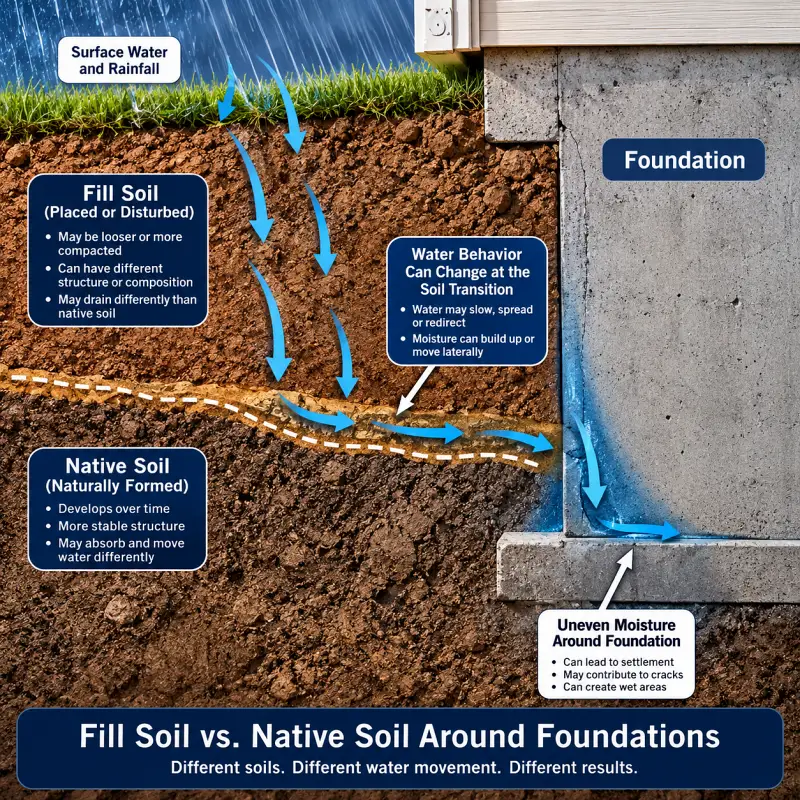
The ground around a foundation is not always made up of the same soil that naturally existed on the property. During construction, excavation and grading often move soil or introduce additional material around the home.
This creates an important distinction between native soil, which developed naturally at the site, and fill soil, which has been moved, placed, or disturbed.
Both can provide stable conditions, but differences in soil composition, placement, compaction, and moisture can affect how water moves through the ground and how soil behaves around a foundation over time.
What Is the Difference Between Fill Soil and Native Soil?
Native soil is soil that occurs naturally at a site and has not been intentionally placed there as part of construction or grading. Its characteristics depend on the local geology and may include clay, sand, silt, loam, rock, or combinations of different materials.
Fill soil is material that has been moved and placed in a new location. Around a home, fill is commonly used to replace soil removed during excavation, establish finished grades, raise low areas, or shape the ground around the foundation.
The important difference is not that one is automatically better than the other. How either soil behaves depends on its composition, moisture, density, layering, and surrounding site conditions. Fill also introduces another variable: how the material was placed and compacted.
Why Fill Soil Is Used Around Foundations
Fill soil is a normal part of many construction projects. Building a foundation requires excavation, and once the foundation is completed, some of the space around it must be filled again. Soil may also be added or moved to establish the final grade, raise low areas, create landscaping contours, or prepare other parts of the property.
The material used as fill can vary. In some cases, excavated soil from the property is reused. In others, different material may be brought to the site. As a result, fill around a foundation may not have the same composition or drainage characteristics as the undisturbed native soil nearby.
How the fill is placed and compacted also matters. Soil that is placed in disturbed layers can behave differently from soil that has remained naturally established, particularly as water moves through it or as the material settles over time.
“Fill soil around a foundation is not automatically a problem. What matters is the material itself, how it was placed and compacted, and how it interacts with water and the surrounding native soil.”
— Foundation Water Guide Editorial Team
How Fill Soil and Native Soil Can Behave Differently
Fill and native soil are not necessarily different soil types. Fill may contain the same clay, sand, silt, or other material found naturally on the property. The difference is that fill has been excavated, moved, placed, or otherwise disturbed, while native soil remains in its naturally developed location.
That disturbance can change soil structure, density, layering, and water pathways. As a result, two areas containing similar soil materials may still behave differently around a foundation.
Soil composition
The composition of fill soil depends on where the material came from. It may consist primarily of excavated native soil, imported material, or a mixture of different soils.
Native soil also varies widely by location, but its layers developed naturally over time. When fill with different characteristics is placed beside or above native soil, water may encounter materials that absorb, retain, and transmit moisture differently.
See How Water Moves Through Different Soil Types for more about how clay, sand, silt, and loam behave with water.
Compaction
Moving soil disturbs the arrangement of its particles and pore spaces. How fill is compacted after placement can therefore influence both its stability and the way water moves through it.
Looser fill may settle as particles gradually rearrange, while heavily compacted areas may allow less water to infiltrate from the surface. Actual behavior depends on the material, how it was placed, moisture conditions, and other site factors.
Drainage and water movement
Water does not necessarily move through fill and native soil at the same rate. Differences in composition, density, and soil structure can cause moisture to slow, spread, or change direction as it moves through the ground.
This can help explain why one area near a foundation remains wet while another dries more quickly, even when both receive the same rainfall.
Settlement
Fill soil can settle after placement as particles rearrange and void spaces decrease. The amount of settlement varies considerably and depends on the material, placement, compaction, moisture, and depth of the fill.
Native soils can also settle, shrink, swell, or otherwise change over time. Seeing settlement therefore does not automatically mean fill soil is responsible.
If movement begins affecting the structure, our Settlement From Water guide explains how changing moisture and soil conditions can contribute to foundation settlement.
Layering and transitions between soils
A property may contain several layers of native and fill material with different drainage characteristics. Water moving downward through one layer can behave differently when it reaches another layer that accepts water more slowly.
These underground transitions can create complicated moisture patterns that are not obvious from looking at the soil surface.
That’s why identifying the visible surface soil alone may not explain a property’s drainage behavior. What lies beneath it can matter just as much.
Fill Soil vs. Native Soil Comparison
Fill soil and native soil can both provide stable conditions around a foundation. The important differences come from where the soil originated, its composition, whether it has been disturbed or placed, and how it interacts with water. This comparison shows general tendencies rather than predicting how soil will behave at a specific property.
| Ground condition | Fill soil | Native soil | Why it may matter |
|---|---|---|---|
| Origin | Moved or placed material | Naturally occurring soil | Helps explain differences around a property |
| Composition | May vary significantly | Reflects local geology | Influences water movement |
| Compaction | Depends on placement | Developed naturally over time | Can affect infiltration and settlement |
| Drainage | Highly variable | Depends on native soil type | Water may move differently between layers |
| Settlement | Can occur as placed soil consolidates | Can also settle or change | Uneven conditions may affect support |
How Water Moves Between Fill Soil and Native Soil
Water moving through the ground does not always travel straight downward at a consistent rate. When it reaches a transition between fill soil and native soil, differences in particle size, compaction, structure, or moisture can change how quickly and in what direction the water moves.
For example, water may move relatively easily through one layer and then slow when it reaches soil that accepts water less readily. Moisture may temporarily accumulate near that transition, spread laterally, or follow another available pathway through the ground.
The opposite can also occur. Water entering a less-permeable surface layer may eventually reach a coarser material that allows it to move more freely.
This is one reason drainage conditions around a foundation can be uneven even when the surface appears relatively uniform. The soils below the surface may contain layers and transitions that homeowners cannot see.
For more on these differences, see How Water Moves Through Different Soil Types.
Signs Fill or Disturbed Soil May Be Affecting Drainage
Fill or disturbed soil usually cannot be identified as the cause of a drainage problem from a single visible sign. However, patterns around the property may suggest that water and soil conditions are behaving differently in certain areas.
Homeowners may notice:
- Recurring wet or soft areas near the foundation
- Water pooling in specific locations after rain
- Depressions or low spots developing as soil settles
- Signs of soil erosion around the foundation, such as channels forming through disturbed ground
- One area remaining wet noticeably longer than surrounding soil
- Changes in surface drainage after grading, landscaping, or construction
- Recurring moisture problems inside a basement or crawl space near the affected area
These signs do not prove that fill soil is responsible. Grading, surface runoff and yard drainage, groundwater, soil type, downspout discharge, and other conditions can produce similar patterns.
Looking at where the problem occurs, when it appears, and whether it repeatedly returns is generally more useful than trying to identify the cause from one observation.
Why Compaction Matters in Fill Soil
When soil is excavated and placed as fill, the arrangement of particles and the spaces between them are disturbed. Compaction reduces those spaces and increases the density of the placed soil, which can influence both settlement and water movement. Learn more about how soil compaction affects foundation drainage, including its influence on infiltration, runoff, and moisture movement.
If fill remains relatively loose, particles may gradually rearrange as the soil is exposed to moisture, drying, and loads from above. This can contribute to settling or the development of low areas over time.
Compaction can also affect drainage. More densely compacted soil may accept surface water more slowly, while looser or differently textured material may allow water to move through it more readily. The actual behavior depends on the soil type, moisture conditions, depth, and how the material was placed.
This is why compaction is only one part of the picture. Soil composition, grading, drainage, and surrounding native soil all influence how fill behaves around a foundation.
When Fill Soil Conditions May Need Closer Evaluation
The presence of fill soil alone is not a reason for concern. Closer evaluation may be useful when changes in the ground occur repeatedly, appear to be progressing, or are accompanied by drainage or foundation symptoms.
Conditions worth taking a closer look at include:
- Low spots or depressions that continue to develop
- Recurring water pooling near the foundation
- Soil erosion or visible changes in surface drainage
- Persistent wet areas that differ from the surrounding ground
- Noticeable changes in existing foundation cracks
- Doors or windows beginning to stick along with other signs of movement
- Recurring basement or crawl-space moisture near the affected area
These observations do not establish that fill soil is the cause. They indicate that soil, water, and foundation conditions may need to be considered together.
If structural movement appears to be developing, our Do I Need a Professional? guide can help homeowners understand when further evaluation may make sense.
Key Takeaways
- Fill soil is material that has been moved or placed, while native soil developed naturally at the site.
- Fill soil is not inherently a problem; its behavior depends on composition, placement, compaction, and moisture.
- Water may move differently where fill and native soil meet, creating uneven drainage or moisture patterns.
- Both fill and native soil can settle or change as moisture conditions vary.
- Recurring drainage, settlement, or foundation changes are more meaningful than the presence of fill soil alone.
Where To Go Next
If you want to understand how water behaves in different soils:
If you’re seeing drainage problems around the foundation:
If you’re seeing soil or foundation movement:
If you want to understand local soil and water conditions:
Frequently Asked Questions About Fill Soil and Native Soil
What is fill soil around a foundation?
Fill soil is material that has been excavated, moved, or placed around a foundation during construction, grading, or landscaping. It may consist of soil originally excavated from the property or material brought in from another location. Fill is commonly used to replace soil removed during foundation construction and to establish the finished grade around a home.
Is fill soil bad for a foundation?
No. The presence of fill soil does not mean there is a foundation problem. Its behavior depends on factors such as the type of material, how it was placed and compacted, moisture conditions, drainage, and the surrounding native soil. Properly placed fill can remain stable, while changing conditions can affect both fill and native soils.
Does fill soil drain differently than native soil?
It can. Fill and native soil may differ in composition, density, compaction, and structure, all of which can influence how water moves through the ground. Water may slow, spread, or change direction when it reaches a transition between soils with different drainage characteristics.
Can fill soil settle over time?
It can. Fill and native soil may differ in composition, density, compaction, and structure, all of which can influence how water moves through the ground. Water may slow, spread, or change direction when it reaches a transition between soils with different drainage characteristics.
Can a property have both fill soil and native soil?
Home › Soil & Ground Conditions › Fill Soil vs. Native Soil Around Foundations