
Foundation Risk Factors: Why Some Homes Are More Vulnerable to Water Problems
Not all homes respond to water the same way. Two houses on the same street can experience very different moisture patterns depending on soil, grading, construction details, and regional climate.
Understanding foundation risk factors helps explain why water problems develop gradually in some homes while others remain unaffected.
What Are Foundation Water Risk Factors?
Foundation water risk factors are conditions that increase the likelihood that moisture will accumulate near or around a home’s foundation. These factors often relate to how water moves across the property, how soil behaves when it becomes wet, and how the structure interacts with surrounding ground conditions.
Common risk factors include drainage patterns that direct water toward the home, soil types that retain moisture, and groundwater conditions that raise the level of water beneath the surface. When these conditions persist, they may contribute to exterior water problems that eventually lead to interior moisture symptoms.
Over time, prolonged exposure to moisture and soil movement can also increase the likelihood of certain types of foundation damage.
Grading and Drainage Patterns
Water exposure around a foundation is heavily influenced by how a property is shaped and how runoff is directed. Long before moisture appears indoors, small landscape and drainage details determine whether water disperses safely away from the structure or remains concentrated near it.
This pattern often connects with surface drainage issues, surface water vs. groundwater, or develops into a drainage problem or foundation problem as conditions worsen.
Negative Slope Toward the Foundation
When soil slopes toward the foundation instead of away from it, rainfall and irrigation water gradually collect near the wall. Even a subtle reverse slope can increase saturation at the base of the structure.
Over time, settled backfill soil often changes the original grading design. What was once properly sloped can slowly flatten or invert, increasing moisture contact along the foundation perimeter.
This pattern often connects with surface-driven issues outlined in surface water vs. groundwater.
Downspout Discharge Locations
A roof collects a large volume of water and concentrates it into specific discharge points. Where that water lands matters.
Downspouts that terminate too close to the structure repeatedly saturate soil at footing depth. Even when no visible pooling occurs, this concentrated discharge can elevate local moisture levels.
Repeated cycles of saturation can contribute to patterns later described in how water enters a foundation.
Hardscape and Surface Runoff Changes
Driveways, patios, sidewalks, and landscape edging redirect water in ways that may not be obvious.
If hard surfaces channel runoff toward foundation walls, the structure becomes the lowest resistance point for accumulating water. These changes are often gradual and may not appear problematic until symptoms begin indoors.
Soil Type and Water Retention
Soil does more than support a structure, it controls how water behaves around it. Soil does more than support a structure; it controls how water behaves around it. Different soil types influence how water moves, how quickly moisture drains, how long it remains in contact with foundation materials, and how pressure develops below grade.
Understanding soil behavior helps explain why identical rainfall can produce very different outcomes from one property to another.
The sections below outline how common soil types and saturation patterns affect long-term foundation exposure.
Clay-Heavy Soils
Clay retains moisture longer than sandy soil. When saturated, clay can expand and increase lateral pressure against foundation walls.
This expansion does not require flooding, only repeated saturation. In some regions, expansive clay is a primary risk factor in long-term structural movement. This expansion does not require flooding, only repeated saturation. In some regions, soil saturation and expansive clay can become important factors in long-term structural movement.
This behavior directly influences hydrostatic pressure described in how water enters a foundation.
Sandy or Loamy Soils
Sandy soils drain quickly because the larger particles allow water to pass through more easily. Loam, a balanced mix of sand, silt, and clay, also tends to drain better than heavy clay while still retaining some moisture.
Because these soils allow water to move downward efficiently, surface runoff may disappear quickly. However, faster drainage does not always mean lower risk. Water can travel deeper into the soil and remain in contact with foundation walls or footing levels below grade.
In some conditions, especially when groundwater levels rise seasonally, moisture may accumulate beneath the surface even when the yard appears dry.
Soil Saturation Cycles
Even moderate rainfall can create risk if soil does not dry fully between events.
Repeated wet-dry cycles gradually change soil structure, increase permeability inconsistencies, and influence settlement patterns.
These cycles help explain why some homes develop foundation damage only after years of exposure.
Home Age and Construction Style
A foundation’s vulnerability is shaped not only by the surrounding soil and drainage patterns, but also by how and when the structure was built. Construction practices, materials, and waterproofing strategies have evolved over time, meaning homes from different eras may respond to water exposure in different ways.
The sections below outline how historical building methods, foundation types, and perimeter systems influence long-term moisture performance.
Historical Waterproofing Methods
Waterproofing strategies have changed significantly over the past century. Earlier construction often relied on basic exterior coatings, tar-based sealants, and gravity-driven perimeter drains to manage moisture. These systems were designed primarily to shed bulk water rather than resist long-term soil saturation.
In many older homes, footing drains were installed without modern filter fabrics, which can allow sediment buildup over time. As these systems age, drainage capacity may gradually decline without obvious warning signs. Exterior coatings can also dry, crack, or separate from foundation walls, reducing their effectiveness against sustained moisture exposure.
Modern construction typically incorporates more advanced waterproof membranes, drainage boards, and interior management systems. However, even newer materials depend on proper installation and ongoing grading stability to perform as intended.
This variation in historical waterproofing approaches helps explain why two homes in similar soil conditions may experience different moisture patterns.
Foundation Type Differences
Basements, crawl spaces, and slab-on-grade foundations each respond to water differently.
Basements experience lateral soil pressure.
Crawl spaces often show moisture through ventilation and vapor transmission.
Slab foundations may reveal moisture through flooring or perimeter cracking.
These variations connect to patterns explained in interior water problems.
Waterproofing Materials and Perimeter Systems
Foundations are typically protected by a combination of exterior waterproofing materials and perimeter drainage systems. These may include coatings or membranes on the outside of the wall, footing drains that move water away, and drainage layers that reduce soil saturation along the foundation perimeter.
Performance depends on both design and condition. Over time, drainage lines can clog, shift, or lose slope, and exterior materials can degrade or separate from the wall. When perimeter systems stop managing water effectively, moisture is more likely to show up as interior water problems or contribute to longer-term patterns associated with foundation damage.
This is also why the same rainfall can produce different outcomes between homes, one property may still be shedding and draining water efficiently, while another is holding moisture at the foundation line.
Regional Climate Patterns
Climate does not create foundation risk by itself, but it influences how often other risk factors are activated. Temperature swings, seasonal precipitation patterns, and long-duration moisture exposure all affect how soil behaves and how water interacts with a structure. These conditions can vary significantly by region; see Foundation Water Problems by State for location-specific information.
In some regions, water-related stress is driven by snowmelt and freeze-thaw cycles. In others, extended rainfall or irrigation patterns create sustained saturation. The sections below outline common climate-driven contributors to foundation vulnerability.
Snowmelt and Freeze-Thaw Cycles
In colder regions, snow accumulation does not always create problems immediately. Risk often increases during rapid thaw periods, when melting snow saturates soil faster than it can drain. This temporary surge in moisture can elevate groundwater levels and increase lateral pressure against foundation walls.
Freeze-thaw cycles also affect soil structure itself. When moisture within the soil freezes, it expands. As it thaws, the soil contracts and settles differently than before. Over repeated cycles, this process can gradually alter grading slopes, create small depressions, and shift backfill density around the foundation perimeter.
These seasonal transitions may explain why some homes experience moisture symptoms primarily in late winter or early spring rather than during peak snowfall.
Prolonged Rainfall Periods
Extended periods of moderate rainfall often create more sustained risk than short, intense storms. When soil remains saturated for days or weeks at a time, natural drying cycles are interrupted. This prolonged saturation increases hydrostatic pressure and extends the duration of wall-to-soil contact.
Unlike surface runoff events that appear quickly and then disappear, long-duration rainfall can quietly elevate groundwater levels beneath the surface. Moisture may not become visible indoors immediately, but repeated seasonal exposure can gradually increase interior humidity, staining, or minor seepage patterns.
In these climates, the frequency and duration of moisture exposure often matter more than the total annual rainfall amount.
Irrigation and Landscape Watering
In many regions, artificial watering patterns can influence foundation moisture as much as natural rainfall. Sprinkler systems positioned near foundation walls, overwatering of garden beds, or persistent drip irrigation can maintain elevated soil moisture levels for extended periods.
Because irrigation is controlled by homeowners rather than weather cycles, it can create consistent saturation zones near the structure, even during otherwise dry seasons. Over time, this repeated moisture exposure may mimic the effects of a wet climate.
Landscape changes, such as adding dense plantings near the foundation or adjusting watering schedules, can subtly shift moisture behavior without obvious signs at the surface.
Lot Position and Surrounding Landscape
A home’s position within its neighborhood influences how water naturally moves across and beneath the property. Elevation changes, nearby structures, and subdivision drainage design all shape where runoff concentrates and how groundwater levels fluctuate.
Even when grading around the immediate foundation appears correct, broader landscape conditions can gradually increase moisture exposure. The following scenarios illustrate how lot placement and surrounding features affect foundation risk.
Homes at the Bottom of a Slope
Homes located at the base of a slope often receive runoff from higher elevations. Rainfall that begins several yards or even several properties away can ultimately collect near lower-positioned structures.
This concentration increases surface saturation and may elevate groundwater levels seasonally. Over time, repeated downhill flow can also alter soil density and grading near the foundation perimeter.
Because gravity continuously directs water toward the lowest point, bottom-of-slope properties often require especially well-managed drainage systems to prevent long-term moisture accumulation.
Retaining Walls and Drainage Alterations
Retaining walls change the natural movement of water across a property. When properly designed, they redirect and manage runoff. When poorly drained, they can trap water behind the wall, increasing hydrostatic pressure and redirecting moisture toward nearby foundations.
Improperly installed or aging retaining walls may lack adequate drainage channels, allowing water to accumulate in backfill soil. This stored moisture can gradually migrate toward foundation walls, especially during prolonged rainfall or snowmelt periods.
Alterations to landscaping, patio installations, or added hardscape features can similarly shift runoff paths in ways that are not immediately obvious.
Neighborhood Drainage Design
Subdivision layout and stormwater planning play a significant role in how water behaves across multiple properties. Street elevation, curb placement, and shared drainage swales all influence where runoff is directed during heavy rain.
In some neighborhoods, surface water may be designed to flow toward specific collection areas. If those systems become blocked or overwhelmed, water may temporarily accumulate near adjacent homes.
This broader drainage context helps explain why two neighboring properties with similar construction may experience different moisture patterns over time.
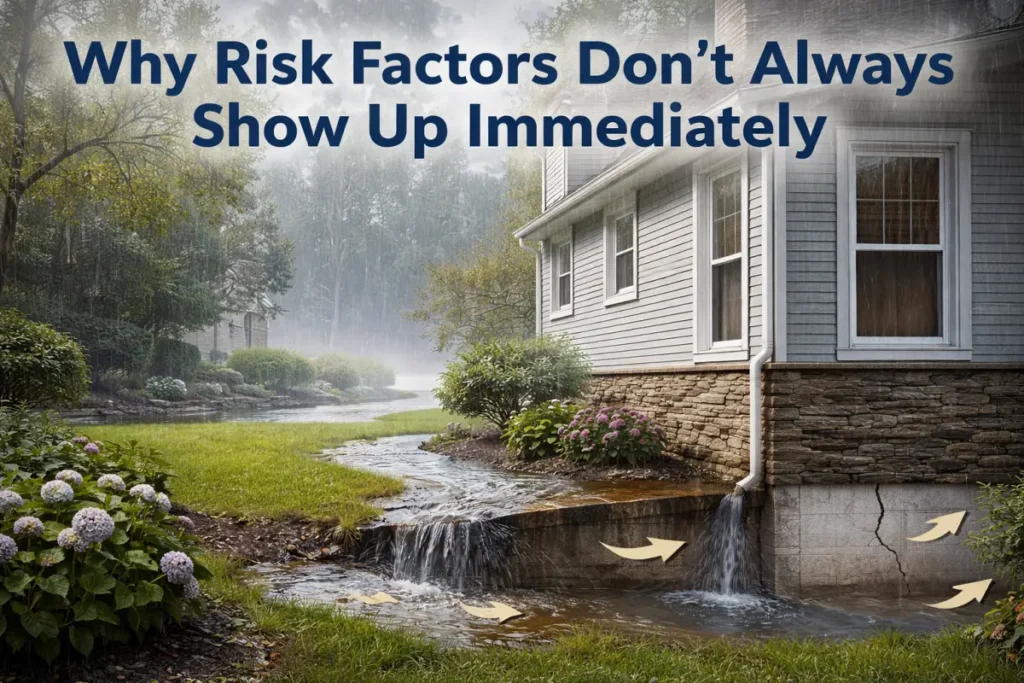
Why Risk Factors Don’t Always Show Up Immediately
Foundation water problems rarely appear overnight.
Risk factors often accumulate gradually, especially when:
• Soil remains intermittently saturated
• Drainage degrades slowly
• Minor cracks widen over time
This explains why some issues seem to appear “suddenly” even though underlying conditions have been developing for years.
Foundation Water Risk Score
| Risk Factor | Low Risk | Medium Risk | High Risk |
|---|---|---|---|
| Soil Type | Sandy or well-draining soil | Mixed soil conditions | Expansive clay soil |
| Grading | Positive slope away from foundation | Minor drainage concerns | Negative grading toward foundation |
| Home Age | Less than 15 years | 15–40 years | More than 40 years |
| Downspout Discharge | 6+ feet from foundation | 3–6 feet from foundation | Less than 3 feet from foundation |
| Groundwater Conditions | Low groundwater influence | Seasonal groundwater fluctuations | High or persistent groundwater levels |
Key Takeaways
- Foundation water risk factors are conditions that increase the chance of moisture accumulating near a foundation.
- Drainage patterns, soil composition, and groundwater levels all influence how water behaves around a home.
- Persistent moisture exposure may lead to interior symptoms such as damp walls or basement water entry.
- Long-term water conditions can also contribute to structural changes associated with foundation damage.
Where to Go Next
If you’re unsure whether your home’s layout increases vulnerability, these topics can help explain how water behaves around foundations:
If you’re noticing moisture or drainage issues around the home
If you’re trying to determine whether the situation needs attention:
If you want to understand local foundation risks:
Frequently Asked Questions About Foundation Risk Factors
Many homes experience different levels of moisture exposure depending on soil conditions, drainage patterns, climate, and construction design. Because of this, homeowners often have questions about how these factors influence basement moisture, foundation movement, and long-term water risk.
The questions below address some common concerns related to foundation water risk. If you want to explore additional topics homeowners frequently ask about basement moisture and drainage, you can review more foundation water problem questions that explain how these issues develop.
Does newer construction eliminate water risk?
Not entirely. Modern systems improve drainage and waterproofing, but grading and soil conditions still influence performance.
If my neighbor has no issues, why do I?
Small differences in elevation, soil composition, and landscaping can significantly change water movement.
Can landscaping changes increase risk over time?
Yes. Added irrigation, garden beds against walls, or altered runoff paths can gradually increase saturation levels.
Is clay soil always a problem?
Not always, but clay retains moisture longer and can expand when saturated, increasing pressure against foundation walls.
Do risk factors mean I need repairs immediately?
Risk factors describe vulnerability, not diagnosis. Monitoring moisture patterns and structural changes helps determine next steps.
Home › Foundation Risk Factors