
Foundation Water Problems in the Houston Metro Area
Foundation water problems in the Houston metro are shaped by a combination of heavy rainfall, flat terrain, Gulf Coast soils, groundwater conditions and an extensive network of bayous and drainage systems.
Houston sits on the Gulf Coastal Plain, where layers of sand, silt and clay extend beneath much of the region. During periods of heavy rain, soil can become saturated while large amounts of surface water move through neighborhoods toward nearby creeks, bayous and larger drainage systems. Because the terrain is relatively flat, water may also drain slowly from some properties.
Conditions are not the same throughout the metro. Soil, elevation, development, drainage, groundwater and proximity to bayous or low-lying areas can all change how water behaves around a home. Understanding those local conditions can help homeowners make better sense of what they are seeing before deciding what to do next.
Houston Metro Foundation Water Problems at a Glance
Houston’s foundation-water story is strongly influenced by heavy rainfall, saturated soil and the challenge of moving water across very flat terrain. Gulf Coast sediments and groundwater conditions add another layer, while historical land subsidence has altered elevations and drainage in portions of the region.
That does not mean every Houston property faces the same risks. Conditions can vary considerably between neighborhoods and even individual properties, making the source and timing of water important clues.
Why Foundation Water Problems Occur in the Houston Metro
Houston’s foundation water conditions are influenced by more than rainfall alone. Soil and sediment layers, very flat terrain, groundwater, bayous and the way water moves through developed neighborhoods can all affect how long moisture remains near a foundation and where it travels.
Several conditions are especially important across the Houston metro:
Gulf Coast Soils and Layered Sediments
Houston is located on the Gulf Coastal Plain, where the ground beneath the region includes layers of sand, silt and clay. These materials do not all absorb, hold or transmit water in the same way.
Fine-grained clay and silt layers can hold moisture and drain relatively slowly, while more permeable sandy layers may allow water to move more readily. As a result, subsurface water conditions can vary with location, depth, rainfall and local geology.
For homeowners, the important point is that water does not always move uniformly through the ground. Soil that appears relatively dry at the surface does not necessarily indicate the same moisture conditions deeper beside or beneath a foundation.
Heavy Rainfall and Soil Saturation
Houston can receive large amounts of rain during storms and prolonged wet periods. When rainfall arrives faster than soil and drainage systems can accommodate it, the ground around a home may become saturated and additional water may begin moving across the surface.
Saturated soil can remain wet after the rain has stopped, particularly where drainage is slow or water repeatedly collects beside a foundation. Roof runoff, irrigation and neighboring drainage can add even more water to already wet conditions.
The amount of rain matters, but where that water goes after it reaches the property is often just as important.
Flat Terrain, Bayous and Surface Drainage
Much of the Houston area is relatively flat, which can make moving stormwater away from developed properties more challenging. Houston also depends on an extensive system of streets, storm drains, ditches, creeks and bayous to carry runoff through local watersheds.
When water cannot move away efficiently, it may collect in low areas, remain in yards or repeatedly saturate soil near a foundation. Development, grading and changes to nearby drainage paths can also influence how runoff moves from one property to another.
Being near a bayou does not automatically mean a home has a foundation-water problem. However, local elevation, drainage and position within a watershed can affect how a property responds during heavy rainfall.
Groundwater and Land Subsidence
Groundwater is another part of Houston’s regional water story. The Gulf Coast aquifer system beneath the area contains water within layers of sand and other sediments, and groundwater conditions vary considerably by location and depth.
Houston also has a documented history of land subsidence associated with groundwater withdrawal. When water is removed from certain underground sediments, fine-grained layers can compact, gradually lowering the land surface. Changes in land elevation can affect regional drainage and flood susceptibility.
However, regional subsidence should not be assumed to explain an individual home’s foundation symptoms. Property-level problems still need to be considered in the context of drainage, soil conditions, rainfall, groundwater and the structure itself.
Definition: Land Subsidence
Land subsidence is the gradual sinking or lowering of the ground surface. In parts of the Houston region, historical groundwater withdrawal has contributed to compaction of underground sediments, causing the land above to slowly lower.
Related Resources – Learn More
Find Foundation Water Conditions in Your Area
Foundation water conditions are not identical across the Houston metro. Differences in soil, elevation, groundwater, development, bayou systems and drainage can change how water behaves around a home.
Use the regional guide below to explore the part of the metro closest to you. These areas represent broad patterns rather than property-level boundaries; conditions can still vary from one neighborhood or lot to another.
Choose the area closest to your home to explore the foundation water conditions that may be most relevant to your property.
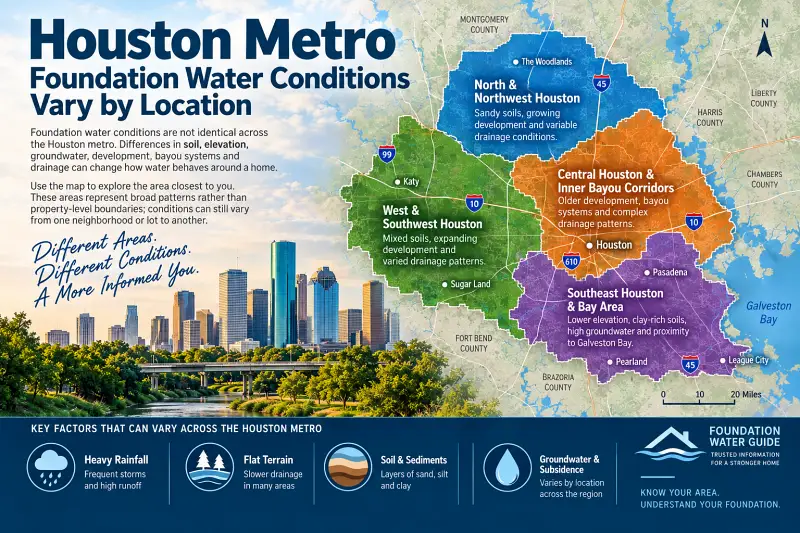
Central Houston & Inner Bayou Corridors
Central Houston is heavily developed and crossed by major bayou systems and drainage networks. Impervious surfaces, dense development and proximity to bayous can influence how quickly stormwater moves through neighborhoods and where it collects. Local elevation and drainage can vary even over relatively short distances.
Homes in this area may be affected by heavy rainfall, saturated soil, concentrated runoff and drainage limitations, particularly where water collects near the foundation or surrounding drainage systems are overwhelmed.
North & Northwest Houston
North and northwest Houston include portions of the Cypress Creek, Spring Creek and Greens Bayou watersheds, along with rapidly developed suburban areas.
Foundation-water conditions can be influenced by heavy rainfall, soil saturation, neighborhood drainage and changing runoff patterns as development alters the landscape. Groundwater withdrawal and land subsidence have also been important regional issues in portions of northern and northwestern Harris County.
West & Southwest Houston
West and southwest Houston include areas influenced by Buffalo Bayou and the Addicks and Barker reservoir systems, as well as communities extending toward Fort Bend County.
Heavy rainfall can place substantial amounts of water into local drainage systems, while flat terrain, soil conditions, grading and development patterns can affect how quickly water leaves individual properties. Portions of western Harris County and northern Fort Bend County have also experienced documented land subsidence.
Southeast Houston & Bay Area
Southeast Houston transitions toward lower-elevation Gulf Coast and Galveston Bay environments, including areas associated with Clear Creek, Armand Bayou and other drainage systems.
Very flat terrain, heavy rainfall, slow drainage, clay-rich soils and proximity to bayous or coastal waters can make water management particularly important. Some areas have also experienced substantial historical land subsidence, which has altered elevations and drainage patterns over time.
Note:
These regions describe broad foundation-water patterns across the Houston metro, not the conditions beneath a specific home. Soil, elevation, groundwater, grading and drainage can vary within the same neighborhood. Local symptoms and the timing of moisture are often more useful than location alone when trying to understand a problem.
Central Houston & Inner Bayou Corridor Foundation Water Conditions
Central Houston is densely developed and crossed by several major bayous and drainage systems. Heavy rainfall, large areas of pavement and development, local elevation and the capacity of nearby drainage systems can all influence how water moves around individual properties.
For homeowners, the important question is often not simply how much rain fell, but where the water traveled, where it collected and how long the soil around the foundation remained wet.
What Homeowners May Notice
Homeowners in central Houston may notice:
- Water collecting near the foundation during or after heavy rain
- Areas of the yard that remain wet after surrounding areas begin to dry
- Water flowing toward the home from driveways, patios or neighboring properties
- Recurring dampness or moisture in crawl spaces or other below-floor areas
- Erosion or washed soil where runoff becomes concentrated
- Foundation cracks or other changes that appear or become more noticeable over time
The timing of a symptom can provide an important clue. Moisture that appears primarily after heavy rain may point toward a different set of causes than moisture that persists through extended dry weather.
What Can Contribute to the Problem
Several conditions may contribute to foundation-water concerns in central Houston:
- Heavy rainfall that saturates soil and produces large amounts of runoff
- Flat terrain that can slow the movement of water away from a property
- Dense development and impervious surfaces that reduce the amount of rainfall absorbed where it lands
- Local grading or drainage problems that direct water toward the foundation
- Roof and downspout discharge concentrated too close to the home
- Nearby streets, storm drains, ditches and bayous that influence how stormwater moves through the neighborhood
- Layered Gulf Coast sediments that can hold and transmit water differently below the surface
Proximity to a bayou does not by itself mean that a home will experience foundation-water problems. Property elevation, grading and local drainage conditions still matter.
What Homeowners Can Do
Start by observing the property during and shortly after a significant rain.
Look for where roof runoff goes, whether water flows toward or away from the foundation, where puddles develop and which areas remain wet longest. Check gutters and downspouts for concentrated discharge near the home and look for settled soil or low areas beside the foundation.
It can also help to photograph recurring wet areas and note the weather conditions when symptoms appear. Those observations can make it easier to determine whether the pattern appears related to surface drainage, saturated soil or another moisture source.
Avoid assuming that a foundation repair is necessary simply because moisture or a crack is present. Identifying the likely source of the water should come first.
Who Should You Talk to About a Foundation Water Problem?
The appropriate professional depends on what the observations suggest.
- Standing water, poor grading or concentrated runoff: a drainage or grading professional may be appropriate.
- Recurring water intrusion or persistent moisture: a waterproofing or water-management professional may help identify the entry path.
- Suspected plumbing or supply-line leak: a licensed plumber may be the appropriate starting point.
- Changing cracks, uneven floors or other signs of movement: a foundation professional or structural engineer may be appropriate.
- Cause remains unclear: an evaluation focused on identifying the source before recommending repairs may be the best next step.
Not Sure Who to Contact?
Tell us a little about what you’re seeing and we’ll help you identify the type of professional who may be appropriate.
Note:
Similar symptoms can have very different causes. A wet basement wall, foundation crack or damp area does not by itself reveal whether the source is drainage, groundwater, plumbing or foundation movement. Look for patterns in when and where the problem occurs before deciding what type of repair may be appropriate.
Related Resources – Learn More
North & Northwest Houston Foundation Water Conditions
North and northwest Houston include rapidly developed suburban areas along with portions of the Cypress Creek, Spring Creek and Greens Bayou watersheds. Heavy rainfall remains an important factor, but development, local drainage and changing land conditions can influence how water moves from one property to another.
Groundwater withdrawal and land subsidence have also affected portions of northern and northwestern Harris County, adding another regional factor to consider when understanding drainage and changing ground elevations.
What Homeowners May Notice
Homeowners may notice:
- Water collecting in low areas of the yard after heavy rain
- Runoff moving onto the property from streets or neighboring lots
- Soil remaining wet near the foundation after rainfall
- Erosion or channels forming where runoff repeatedly follows the same path
- Drainage patterns that appear different after nearby construction or development
- Cracks or other foundation changes that develop or change over time
- Recurring moisture that appears during particular weather conditions
A recurring pattern is generally more useful than a single wet area or isolated crack. Pay attention to when the problem appears, how long it lasts and whether nearby drainage conditions have changed.
What Can Contribute to the Problem
Several conditions may contribute to foundation-water concerns in north and northwest Houston:
- Heavy rainfall and saturated soil
- Flat or gently sloping terrain that can slow drainage
- Rapid development that adds roofs, streets, driveways and other impervious surfaces
- Fill soil and compacted ground associated with construction
- Grading changes that redirect runoff between properties
- Creeks, detention systems and neighborhood drainage networks that influence how stormwater moves through an area
- Groundwater withdrawal and regional land subsidence in portions of northern and northwestern Harris County
These factors can interact. A property may have adequate drainage under ordinary conditions but develop problems when saturated soil, concentrated runoff and heavy rainfall occur at the same time.
What Homeowners Can Do
Observe how water moves across the property during a substantial rain rather than evaluating drainage only when the yard is dry.
Check whether water moves away from the foundation, neighboring runoff enters the property, downspouts discharge into low areas or recently developed areas have changed drainage patterns. Look for erosion, settled fill soil and areas that remain wet considerably longer than the surrounding yard.
If the problem began after construction, landscaping or grading changes, document when the change occurred. Photos taken during and after rain can help identify patterns that may otherwise be difficult to describe.
Who Should You Talk to About a Foundation Water Problem?
The symptoms can help determine where to start:
- Standing water, runoff or grading concerns: drainage or grading professional
- Settled fill or suspected soil-related concerns: geotechnical or foundation professional may be appropriate depending on the symptoms
- Recurring water intrusion: waterproofing or water-management professional
- Possible plumbing leak: licensed plumber
- Changing cracks, uneven floors or other movement: foundation professional or structural engineer
- Unclear source: begin with an evaluation intended to identify the cause before selecting a repair
Not Sure Who to Contact?
Tell us a little about what you’re seeing and we’ll help you identify the type of professional who may be appropriate.
Note:
Development can change how water behaves on a property. Grading, fill soil, compacted ground, streets, neighboring lots and drainage systems may redirect water from its natural path. The soil beneath a neighborhood may be similar while individual lots handle water very differently.
Related Resources – Learn More
West & Southwest Houston Foundation Water Conditions
West and southwest Houston include communities influenced by Buffalo Bayou, the Addicks and Barker reservoir systems, and drainage networks extending toward Fort Bend County. Heavy rainfall can place large amounts of water into these systems, while relatively flat terrain can make local grading and drainage especially important.
Portions of western Harris County and northern Fort Bend County have also experienced documented land subsidence, adding another regional factor that can influence elevation and drainage over time.
What Homeowners May Notice
Homeowners may notice:
- Water collecting beside the foundation after heavy rain
- Low areas of the yard that drain slowly or remain saturated
- Runoff moving across driveways, patios or neighboring properties
- Water accumulating near fences, property lines or drainage easements
- Erosion where runoff repeatedly follows the same path
- Recurring dampness or moisture beneath or around the home
- Foundation cracks or other changes that develop or change over time
Where water collects can be just as important as how much rain falls. Repeated wet areas may help identify grading, drainage or runoff patterns affecting a particular property.
What Can Contribute to the Problem
Several conditions may contribute to foundation-water concerns in west and southwest Houston:
- Heavy rainfall and prolonged soil saturation
- Flat terrain that limits how quickly water moves away
- Local grading and low areas that allow water to collect near a foundation
- Roof runoff and irrigation that add moisture to already wet soil
- Streets, detention areas and neighborhood drainage systems that influence local runoff
- Development and changes to surrounding drainage paths
- Layered Gulf Coast sediments that affect how water moves through the ground
- Regional land subsidence in portions of western Harris County and northern Fort Bend County
The presence of nearby reservoirs, bayous or drainage infrastructure does not by itself indicate a property-level problem. Conditions on the individual lot still matter.
What Homeowners Can Do
Watch the property during and after heavy rainfall. Identify where water enters the lot, where it travels and which areas remain wet longest.
Check gutters, downspouts, grading, drainage swales and low spots beside the foundation. Look for erosion or settled areas that may have changed the direction of runoff. Irrigation should also be checked for leaks or repeated watering that keeps one portion of the foundation unusually wet.
If moisture repeatedly appears in the same location, photographs taken during different weather conditions can help establish whether the pattern is related to rainfall, irrigation or another source.
Who Should You Talk to About a Foundation Water Problem?
The likely source can help determine the appropriate professional:
- Standing water, grading or runoff problems: drainage or grading professional
- Recurring water intrusion: waterproofing or water-management professional
- Irrigation or plumbing leak: irrigation specialist or licensed plumber
- Changing cracks, uneven floors or other signs of movement: foundation professional or structural engineer
- Suspected soil or ground-related movement: geotechnical evaluation may be appropriate
- Source remains unclear: begin with an evaluation focused on identifying the cause before selecting a repair
Not Sure Who to Contact?
Tell us a little about what you’re seeing and we’ll help you identify the type of professional who may be appropriate.
Note:
Houston’s flat terrain means that small differences in elevation and grading can influence where stormwater collects and how quickly it drains. A property does not need to be on a noticeable slope to have a drainage problem. Watch where water travels during heavy rain and which areas remain wet afterward.
Related Resources – Learn More
Southeast Houston & Bay Area Foundation Water Conditions
Southeast Houston and the Bay Area extend toward Clear Creek, Armand Bayou, the lower San Jacinto River and Galveston Bay. Compared with other parts of the metro, very low relief, coastal influence, bayous and historically significant land subsidence can make drainage and changing water levels especially important regional considerations.
Heavy rainfall remains the most immediate homeowner concern. When soil is already saturated and local drainage systems are carrying large amounts of runoff, water may remain around some properties longer or collect in low areas.
What Homeowners May Notice
Homeowners may notice:
- Water collecting in yards or beside foundations after heavy rainfall
- Low areas that remain wet after surrounding ground begins to dry
- Recurring soil saturation near the home
- Runoff backing up or moving slowly through local drainage paths
- Erosion or soil movement where water repeatedly concentrates
- Dampness or moisture in crawl spaces or other low areas beneath a home
- Foundation cracks or other changes that develop or change over time
The presence of moisture does not identify its source. Rainfall, surface drainage, plumbing, irrigation and groundwater can produce symptoms that may initially look similar.
What Can Contribute to the Problem
Several conditions may contribute to foundation-water concerns in southeast Houston and the Bay Area:
- Heavy rainfall and prolonged soil saturation
- Very flat, low-relief terrain that can slow drainage
- Bayous, creeks and coastal drainage systems that influence how water moves through the area
- Clay-rich and other fine-grained Gulf Coast sediments that can retain moisture
- Local groundwater conditions, which can vary with location, geology and nearby surface water
- Historical land subsidence that has lowered ground elevations in portions of the region
- Development, grading and impervious surfaces that alter natural runoff patterns
- Roof runoff and irrigation that add water close to a foundation
These conditions often overlap, which is why the timing and location of the moisture are important when trying to identify its source.
What Homeowners Can Do
Observe the property during heavy rain and again after the storm has passed. Look for where water collects, how long it remains and whether the same areas become saturated repeatedly.
Check gutters, downspouts, grading and nearby drainage paths. Look for low spots beside the foundation and areas where erosion or settled soil may be changing the direction of runoff.
If moisture appears when there has been little or no recent rainfall, note that as well. Persistent moisture during otherwise dry conditions may justify investigating irrigation, plumbing or subsurface water rather than assuming rainfall is responsible.
Photographs and simple notes about rainfall and timing can make recurring patterns much easier to recognize.
Who Should You Talk to About a Foundation Water Problem?
The likely source can help determine where to begin:
- Standing water, slow drainage or runoff: drainage or grading professional
- Recurring water intrusion: waterproofing or water-management professional
- Possible plumbing or irrigation leak: licensed plumber or irrigation professional
- Persistent moisture with no obvious surface source: further evaluation may be needed to determine whether subsurface water is involved
- Changing cracks, uneven floors or other signs of movement: foundation professional or structural engineer
- Cause remains unclear: begin with an evaluation focused on identifying the source before choosing a repair
Not Sure Who to Contact?
Tell us a little about what you’re seeing and we’ll help you identify the type of professional who may be appropriate.
Not sure which problem you’re dealing with?
Use our Drainage Problem or Foundation Problem Assessment to better understand the likely cause of your home’s symptoms and learn which type of professional may be most appropriate.
Warning Signs Houston Homeowners Should Pay Attention To
Not every crack, damp spot or drainage problem indicates serious foundation damage. What matters more is whether a symptom is new, recurring, getting worse or appearing together with other changes around the home.
Because Houston can experience heavy rainfall and prolonged wet conditions, homeowners may also want to notice whether symptoms appear during storms, remain after the rain has stopped or occur even during otherwise dry weather.
Houston-area homeowners may want to take a closer look when they notice:
| What You Notice | What It May Be Worth Checking |
|---|---|
| Water pooling beside the foundation | Grading, downspouts, runoff and irrigation |
| Areas of the yard that remain saturated | Drainage, low areas and concentrated runoff |
| Damp or wet crawl-space or other low areas | Surface drainage, saturated soil or other moisture sources |
| Recurring moisture after heavy rain | Where water is entering and how long the condition persists |
| Moisture appearing during dry weather | Plumbing, irrigation or possible subsurface moisture |
| New or changing foundation cracks | Whether movement is occurring over time |
| Sticking doors or windows with other changes | Possible movement that deserves closer evaluation |
| Erosion or soil washing away | Concentrated runoff and changing drainage paths |
Patterns are generally more informative than a single symptom. A small crack that remains unchanged may tell a different story than one that grows while doors begin sticking and drainage problems appear outside.
Photographs with dates can help homeowners compare conditions after heavy rain and during drier periods rather than relying on memory.
Reducing Foundation Water Risk Around Your Houston Home
Many foundation-water concerns begin with something relatively simple: too much water reaching one part of the foundation, water remaining there too long or drainage repeatedly concentrating moisture near the home. Houston homeowners cannot control heavy rainfall or the soil beneath their property, but they can pay attention to how water is managed around the foundation.
Practical steps include:
- Keep gutters clear and direct downspout discharge away from the foundation.
- Watch how the yard drains during heavy rain rather than assuming the grading is working properly.
- Avoid repeatedly saturating soil immediately beside the foundation with irrigation.
- Repair leaking or poorly aimed sprinkler heads.
- Look for low areas where stormwater repeatedly collects near the home.
- Watch for erosion, settled soil or new drainage paths after heavy rain.
- Pay attention when patios, walkways, landscape beds or other improvements change drainage patterns.
- Periodically check crawl spaces or other low areas for new moisture or musty conditions.
The goal is not to keep soil around a foundation completely dry. Consistent, well-managed drainage is generally more useful than allowing one area to remain repeatedly saturated while other parts of the property drain normally.
When a Foundation Water Problem May Need Professional Evaluation
Many foundation-water concerns can begin with simple observations and drainage corrections. Professional evaluation becomes more appropriate when the source of the water is unclear, the problem keeps returning or moisture is accompanied by signs of possible foundation movement.
Consider getting professional input when:
- Water or persistent moisture returns despite correcting obvious drainage problems.
- Water appears during dry weather without an obvious surface source.
- Foundation cracks are new, widening or changing over time.
- Cracking occurs along with sticking doors, windows or noticeable changes in floors.
- A foundation wall appears to be bowing, leaning or shifting.
- Water repeatedly enters a crawl space or other low area beneath the home.
- Significant erosion, soil movement or recurring saturation is occurring near the foundation.
- Drainage from neighboring properties, streets or surrounding development is difficult to control.
- You cannot determine whether the problem involves surface drainage, plumbing, irrigation, groundwater, soil conditions or the foundation itself.
The right professional depends on the suspected cause. Drainage problems, water intrusion, plumbing leaks, soil concerns and structural movement require different types of expertise. An evaluation should help identify the cause before a homeowner commits to a repair.
Houston Metro Foundation Water Problems: Homeowner Checklist
Houston-area foundation-water conditions can change quickly during periods of heavy rainfall and prolonged wet weather. A simple inspection during and after major rain events can help homeowners identify developing drainage, soil or moisture patterns before they become harder to understand.
Around the outside of your home:
☐ Check that the ground directs water away from the foundation.
☐ Look for low areas where rainwater collects or drains slowly.
☐ Make sure gutters are clear and functioning properly.
☐ Check where each downspout releases water.
☐ Look for erosion or soil washing away near the house.
☐ Watch for areas of soil that remain saturated after surrounding ground begins to dry.
☐ Make sure sprinklers are not repeatedly soaking the foundation perimeter.
☐ Watch for drainage arriving from neighboring properties, streets or surrounding development.
Inside the home:
☐ Look for new damp areas in crawl spaces or other low areas beneath the home.
☐ Check for signs of recurring moisture or water intrusion.
☐ Pay attention to new musty odors or unusually damp conditions.
☐ Note new cracks or changes in existing cracks.
☐ Watch for doors or windows that begin sticking along with other changes.
After heavy rain:
☐ Walk the property and observe where water actually travels.
☐ Identify areas where water collects or remains after the storm.
☐ Check crawl spaces or other low areas for new moisture.
☐ Photograph unusual drainage, moisture or cracking.
☐ Record the date, rainfall conditions and how long wet areas take to drain.
You do not need to diagnose the problem yourself. The purpose of the checklist is to identify patterns, where water travels, when symptoms appear and whether conditions are changing. That information can make the next step much easier if professional evaluation becomes necessary.
Key Takeaways
- Heavy rainfall and soil saturation are major foundation-water concerns across Houston.
- Flat terrain and extensive bayou systems can make drainage especially important.
- Layers of sand, silt and clay affect how water moves and remains in the ground.
- Groundwater and land subsidence vary by location and should not be assumed to explain every foundation problem.
- Recurring moisture or changing symptoms are more useful clues than a single isolated event.
Official Houston Metro Resources
These official resources provide additional information about Houston-area watersheds, groundwater, Gulf Coast geology and land subsidence.
Common Houston Foundation Water Questions
Frequently Asked Questions About Foundation Water Problems in Houston
Can heavy rain cause foundation water problems in Houston?
Yes. Heavy rainfall can saturate soil and produce large amounts of surface runoff. If water collects near a foundation or drainage is slow, soil may remain wet after the storm has passed. How the property is graded and where runoff travels can be just as important as the amount of rain that falls.
Why does water drain slowly around some Houston homes?
Houston’s relatively flat terrain can make it difficult for water to move away quickly. Low areas, grading, soil conditions, neighboring development and local drainage systems can all influence how long water remains around an individual property.
Does Houston have a high water table?
There is no single groundwater condition that applies throughout the Houston metro. Groundwater depth and behavior vary by location, geology, rainfall, nearby surface water and other local conditions. The presence of groundwater beneath the region does not mean every property has a shallow water table.
What is land subsidence, and can it affect Houston homes?
Land subsidence is the gradual lowering of the ground surface. In portions of the Houston region, historical groundwater withdrawal has contributed to compaction of underground sediments and lowering of the land above. Subsidence can affect regional elevation and drainage, but it should not automatically be assumed to be the cause of a problem at an individual home.
Why does water keep pooling near my Houston foundation?
Recurring pooling may be related to grading, downspout discharge, low areas, compacted soil, neighboring runoff or limitations in local drainage. Watching where the water comes from and how long it remains after rainfall can help narrow down the possible cause.
Who should evaluate a foundation water problem in Houston?
That depends on the suspected cause. Drainage and grading problems, water intrusion, plumbing leaks, soil concerns and structural movement require different types of expertise. When the cause is unclear, identifying the source before committing to a repair is usually the more useful first step.
Home › Foundation Water Problems by State › Texas › Houston Metro Area