
Foundation Water Problems in the St. Louis Metro Area
Foundation water problems in the St. Louis metro can be influenced by a distinctive combination of carbonate bedrock, karst terrain, variable soils, heavy rainfall and major river valleys.
In upland areas, limestone and dolomite can create karst features and complex pathways for water below the surface. Along the Mississippi, Missouri and Meramec river valleys, alluvial deposits and locally shallow groundwater can create very different conditions. Heavy rain, saturated ground and property-level drainage can add another layer to how water behaves around a home.
Understanding these differences can help homeowners make sense of basement moisture, recurring seepage, drainage problems and other changes around the foundation before deciding what type of solution may be appropriate.
St. Louis Metro Foundation Water Problems at a Glance
St. Louis foundation water conditions can vary significantly by location. Upland areas may be influenced by limestone and dolomite bedrock, karst features and overlying soils, while the major river valleys contain alluvial deposits where groundwater can play a greater role.
Across the metro, heavy rainfall, soil saturation, runoff and local drainage can affect how much water reaches a foundation and how long moisture remains nearby.
The key is not to assume one cause based on location alone. Where and when water appears, and what happens after heavy rain, can provide important clues about what may be contributing to the problem.
Why Foundation Water Problems Occur in the St. Louis Metro
Foundation water problems across St. Louis are influenced by both what lies beneath a home and how water moves across and through the surrounding ground. Conditions can change considerably between upland neighborhoods and the major river valleys, so the same rainfall event may affect properties differently.
Limestone, Dolomite and Karst Terrain
Parts of the St. Louis region are underlain by limestone and dolomite, carbonate rocks that can slowly dissolve as groundwater moves through fractures and openings. Over time, this process can create karst features such as sinkholes, enlarged underground pathways, caves and springs.
Karst does not mean that every St. Louis home is at risk of a sinkhole. It does mean that subsurface water movement can be more complex in some areas, and unusual depressions or ground changes should not automatically be assumed to have a simple drainage cause.
Variable Soils and Soil Saturation
Soils across the metro vary and may include loess, residual soils developed over bedrock and river-deposited materials. These different materials do not absorb, store or transmit water in the same way.
During prolonged wet periods, soil near a foundation can become saturated. Water may then remain near basement walls longer, move through more permeable layers or follow pathways created by differences in soil and underlying rock.
Heavy Rainfall, Runoff and Local Drainage
Heavy rain can deliver more water than the soil and drainage around a property can handle at one time. Water may collect beside the foundation, move downhill across the property or concentrate in low areas.
Grading, gutters, downspouts, landscaping, paved surfaces and neighboring properties can all change where that runoff travels. This makes property-level drainage important even when regional geology contributes to the broader conditions.
River Valleys, Alluvium and Local Groundwater
The Mississippi, Missouri and Meramec river valleys contain unconsolidated alluvial deposits that can include clay, silt, sand and gravel. Some of these deposits are highly permeable and form important groundwater-bearing areas.
This does not mean the entire St. Louis metro has a high water table. Groundwater influence can be much more important in portions of the major river valleys than in upland areas over carbonate bedrock. That distinction is one reason foundation-water conditions can vary substantially across the metro.
Find Foundation Water Conditions in Your Area
Foundation water conditions are not identical across the St. Louis metro. Differences in bedrock, karst terrain, soils, groundwater, river valleys, development and drainage can change how water behaves around a home.
Use the regional guide below to explore the part of the metro closest to you. These areas represent broad patterns rather than property-level boundaries; conditions can still vary from one neighborhood or lot to another.
Choose the area closest to your home to explore the foundation water conditions that may be most relevant to your property.
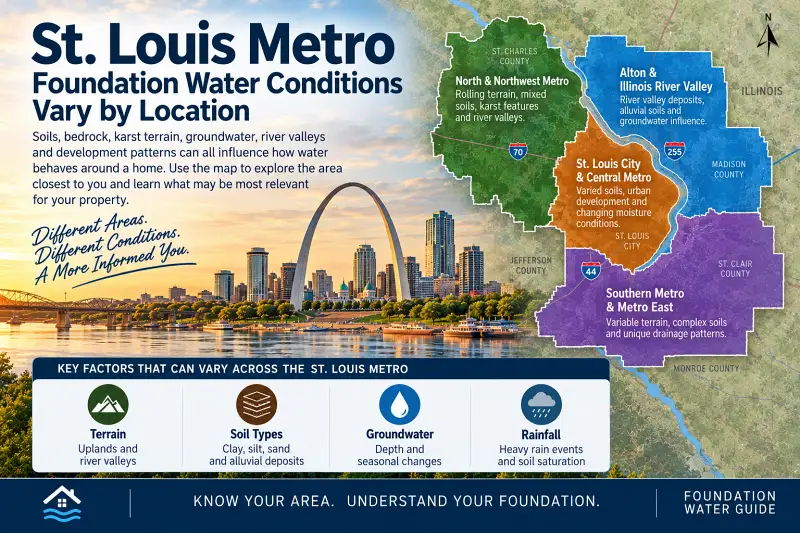
St. Louis & Central Metro
The central metro includes older developed neighborhoods, dense streets and paved surfaces, and properties with long-established drainage patterns. Heavy rainfall can place additional demand on gutters, storm drainage and the soil surrounding basements and foundations.
Underlying limestone and dolomite also occur across portions of the region, but conditions can vary considerably from one neighborhood to another. Here, property-level grading, drainage and where water collects after storms may be especially useful clues when investigating recurring moisture.
North & Northwest Metro
North and northwest portions of the metro include upland areas as well as land approaching the Missouri River valley. Ground conditions can transition from soils over bedrock to unconsolidated river deposits as elevation and terrain change.
Heavy rainfall, runoff and saturated soil can contribute to foundation-water concerns in upland neighborhoods, while alluvial deposits and groundwater may become more important closer to the Missouri River and its tributaries.
South & Southwest Metro / Karst & Meramec Area
South and southwest of St. Louis, limestone and dolomite bedrock and karst terrain become particularly important to understanding how water can move underground. Dissolution of carbonate rock can create fractures, enlarged openings, sinkholes and other subsurface drainage features.
The Meramec River and its tributaries add another environment, with alluvial deposits and groundwater influencing portions of the river corridor. Karst conditions do not mean every depression, crack or moisture problem is related to a sinkhole, but unusual ground changes may deserve closer evaluation.
Mississippi, Missouri & Major River Valleys
Along the Mississippi, Missouri and lower Meramec river valleys, the ground can be very different from the surrounding uplands. These valleys contain alluvial deposits of clay, silt, sand and gravel, including permeable deposits that can carry substantial groundwater.
In these areas, groundwater levels, river conditions, prolonged rainfall and drainage can interact. Shallow groundwater may be more relevant here than across the metro as a whole, which is why river-valley properties should not automatically be evaluated using the same assumptions as homes on higher ground.
Note:
These regions describe broad foundation-water patterns across the St. Louis metro, not the conditions beneath a specific home. Bedrock, karst features, soil, grading, groundwater and drainage can vary within the same area. Local symptoms and the timing of moisture are often more useful than location alone when trying to understand a problem.
St. Louis & Central Metro Foundation Water Conditions
Homes in St. Louis and the central metro sit within a heavily developed environment where older neighborhoods, paved surfaces, established drainage systems and variable ground conditions can all affect how water reaches a foundation.
During heavy rain, understanding what happens immediately around the property, where runoff travels, where it collects and when basement moisture appears, can be especially useful for identifying the likely source.
What Homeowners May Notice
- Damp or wet basement walls after heavy rain.
- Water appearing near the basement wall-floor joint.
- Pooling water or persistently wet soil beside the foundation.
- Musty odors or recurring basement moisture.
- Runoff collecting near patios, walkways or other paved surfaces.
- Foundation cracks that appear to be changing over time.
What Can Contribute to the Problem
- Heavy rainfall that saturates soil around the foundation.
- Paved surfaces that concentrate or redirect runoff.
- Older or altered grading that allows water to collect near the home.
- Short or poorly directed downspout discharge.
- Settled soil or landscaping that changes established drainage paths.
- Variable soils and underlying limestone or dolomite bedrock.
The cause is often a combination of regional ground conditions and property-level drainage, rather than one factor acting alone.
What Homeowners Can Do
Start by watching the property during or shortly after a substantial rain.
- Identify where roof and surface runoff travels.
- Check whether water collects beside the foundation.
- Make sure gutters and downspouts move water away from the house.
- Look for settled soil, low areas or erosion near the foundation.
- Compare outside drainage patterns with where moisture appears inside.
- Photograph recurring moisture or cracks so changes can be tracked over time.
These observations can help distinguish a relatively straightforward surface-drainage problem from one that may require additional investigation.
Who Should You Talk to About a Foundation Water Problem?
The right professional depends on what appears to be causing the problem.
A drainage or landscape professional may be appropriate when runoff or grading is the primary concern. A basement-waterproofing professional may evaluate recurring water intrusion, while a plumber may be needed when a leak cannot be ruled out.
If cracks, wall movement or other structural changes accompany the moisture, a foundation specialist or structural engineer may be more appropriate.
The goal is to identify the likely source before choosing the repair, rather than selecting a solution based only on where the water appears.
Not Sure Who to Contact?
Tell us a little about what you’re seeing and we’ll help you identify the type of professional who may be appropriate.
Note:
Similar symptoms can have very different causes. A wet basement wall, foundation crack or damp area does not by itself reveal whether the source is drainage, groundwater, plumbing or foundation movement. Look for patterns in when and where the problem occurs before deciding what type of repair may be appropriate.
Related Resources – Learn More
North & Northwest Metro Foundation Water Conditions
North and northwest portions of the St. Louis metro include developed upland neighborhoods, rolling terrain and areas approaching the Missouri River valley. Ground and water conditions can change as the landscape transitions toward lower elevations and river-deposited soils.
For homeowners, that means surface drainage may dominate in one location while saturated soil or groundwater becomes more important in another.
What Homeowners May Notice
- Water collecting in low areas after heavy rain.
- Basement dampness or seepage that returns during prolonged wet periods.
- Runoff moving downhill toward the house from streets or neighboring properties.
- Soil remaining wet near the foundation after surrounding areas begin to dry.
- Erosion or settled soil where runoff has become concentrated.
- New or changing cracks that appear along with moisture or drainage problems.
What Can Contribute to the Problem
- Heavy rainfall and prolonged soil saturation.
- Rolling terrain that concentrates runoff toward lower portions of a property.
- Grading changes associated with development and landscaping.
- Fill soil or compacted ground that changes how water infiltrates.
- Streets, driveways and other paved surfaces that redirect runoff.
- Alluvial deposits and greater groundwater influence closer to the Missouri River valley.
The transition toward the Missouri River is important because groundwater and river-deposited materials can become more relevant in lower valley areas than on surrounding uplands.
What Homeowners Can Do
- Watch where water travels during a heavy rain.
- Check whether runoff arrives from higher ground, streets or neighboring properties.
- Look for low areas that remain wet long after rainfall ends.
- Check gutters and downspouts for concentrated discharge near the foundation.
- Look for erosion, settled soil or changes in grading around the home.
- Compare the timing of basement moisture with rainfall and outside drainage conditions.
If moisture persists even after obvious surface-drainage problems have been addressed, subsurface conditions may deserve a closer look.
Who Should You Talk to About a Foundation Water Problem?
A drainage or landscape professional may be useful when grading, runoff or water arriving from surrounding property appears to be the main concern.
Recurring basement seepage may warrant evaluation by a waterproofing or drainage professional. A plumber can help rule out leaking water or sewer lines, while foundation movement or significant cracking may call for a foundation specialist or structural engineer.
Where groundwater or unusual soil conditions appear to be involved, additional evaluation may be needed before choosing a repair.
Not Sure Who to Contact?
Tell us a little about what you’re seeing and we’ll help you identify the type of professional who may be appropriate.
Note:
Development can change how water behaves on a property. Grading, fill soil, compacted ground, streets, neighboring lots and drainage systems may redirect water from its natural path. The soil beneath a neighborhood may be similar while individual lots handle water very differently.
Related Resources – Learn More
South & Southwest Metro / Karst & Meramec Area Foundation Water Conditions
South and southwest portions of the St. Louis metro bring together two important water environments: carbonate-bedrock uplands where karst can influence subsurface drainage, and the Meramec River corridor where alluvial deposits and groundwater become more important.
That combination can make water behavior less obvious. Water seen near a foundation may come from surface drainage, saturated soil or subsurface pathways, so the location and timing of symptoms are especially important here.
What Homeowners May Notice
- Basement seepage or damp walls after heavy or prolonged rainfall.
- Water collecting in low areas or depressions around the property.
- Runoff moving downhill toward the foundation.
- Areas of soil that remain unusually wet after surrounding ground begins to dry.
- Erosion or changes in how surface water moves across the property.
- New depressions or unusual changes in the ground surface.
What Can Contribute to the Problem
- Limestone and dolomite bedrock affected by karst processes.
- Fractures and subsurface openings that can create complex water pathways.
- Heavy rainfall and prolonged soil saturation.
- Sloped terrain that concentrates runoff toward lower areas.
- Grading, downspouts and other property-level drainage conditions.
- Alluvial deposits and groundwater influence along the Meramec River and tributary valleys.
Karst is important here, but a depression, crack or wet area should not automatically be interpreted as evidence of a sinkhole. Natural ground conditions, drainage and man-made infrastructure can produce symptoms that require different explanations.
What Homeowners Can Do
- Watch where runoff travels during heavy rain.
- Look for low areas where water repeatedly collects.
- Check gutters, downspouts and grading around the foundation.
- Photograph new depressions, cracks or unusual ground changes so they can be compared over time.
- Note whether basement moisture appears only after rain or persists during otherwise dry conditions.
- Avoid assuming an unusual ground feature is a sinkhole without appropriate evaluation.
Who Should You Talk to About a Foundation Water Problem?
When the evidence points toward surface runoff or grading, a drainage or landscape professional may be an appropriate starting point. Recurring basement water may call for a waterproofing or drainage professional, while plumbing should be considered when a leak cannot be ruled out.
Unusual depressions, suspected subsurface voids or other ground changes deserve a different approach. Where karst or possible ground collapse is a concern, a geotechnical professional or other qualified specialist familiar with local geology may be appropriate before repair work is chosen.
Foundation movement accompanied by significant cracking, bowing or other structural changes may warrant evaluation by a structural engineer or foundation professional.
Not Sure Who to Contact?
Tell us a little about what you’re seeing and we’ll help you identify the type of professional who may be appropriate.
Note:
Karst terrain can create complex underground drainage, but not every depression, crack or wet area is evidence of a sinkhole. Surface drainage, soil settlement, utilities and other conditions can sometimes produce similar symptoms. Unusual or changing ground conditions should be evaluated based on the evidence rather than appearance alone.
Related Resources – Learn More
Mississippi, Missouri & Major River Valley Foundation Water Conditions
The Mississippi, Missouri and lower Meramec river valleys create a distinctly different foundation-water environment from St. Louis uplands. These valleys contain alluvial deposits of clay, silt, sand and gravel, including permeable layers that can carry substantial groundwater.
Here, foundation-water conditions may be influenced by a combination of rainfall, river conditions, groundwater and property-level drainage, making it especially important to distinguish surface water from subsurface moisture.
What Homeowners May Notice
- Basement seepage or moisture during prolonged wet periods.
- Water appearing near the basement wall-floor joint.
- Low areas that remain wet long after rainfall ends.
- Recurring moisture that does not clearly correspond with runoff beside the house.
- Changes in moisture conditions during extended periods of high river levels or wet weather.
- Sump pumps running more frequently during particularly wet periods.
What Can Contribute to the Problem
- Locally shallow groundwater within major river-valley deposits.
- Permeable layers of sand and gravel that allow groundwater to move through the alluvium.
- Prolonged rainfall that raises soil moisture and groundwater levels.
- River and tributary conditions that can influence nearby groundwater.
- Low-lying terrain where surface water drains more slowly.
- Property-level grading, downspouts and drainage conditions.
The important distinction is that groundwater can be more influential in portions of these valleys than across the St. Louis metro generally. That does not mean every river-valley home has shallow groundwater or that groundwater is responsible for every basement-water problem.
What Homeowners Can Do
- Track whether moisture appears only after rain or continues after surface conditions begin to dry.
- Check grading, gutters and downspouts before assuming groundwater is responsible.
- Watch how long soil and low areas remain wet after storms.
- Note whether sump-pump activity changes during prolonged wet periods.
- Photograph recurring basement moisture and record when it appears.
- Pay attention to whether the same problem returns under similar weather conditions.
The timing of the water can be one of the most useful clues. Surface-runoff problems often respond closely to individual storms, while subsurface moisture may persist after rainfall has ended.
Who Should You Talk to About a Foundation Water Problem?
If water is clearly associated with grading, downspouts or surface runoff, a drainage professional may be an appropriate starting point. Recurring basement seepage may warrant evaluation by a basement-waterproofing or drainage professional.
When groundwater appears to be involved, or the source remains unclear after obvious surface drainage issues have been ruled out, additional evaluation may be appropriate. Significant cracking or foundation movement may warrant a foundation professional or structural engineer.
The objective is to determine whether the water is primarily coming from the surface, saturated soil, groundwater, plumbing or another source before selecting a repair.
Not Sure Who to Contact?
Tell us a little about what you’re seeing and we’ll help you identify the type of professional who may be appropriate.
Not sure which problem you’re dealing with?
Use our Drainage Problem or Foundation Problem Assessment to better understand the likely cause of your home’s symptoms and learn which type of professional may be most appropriate.
Related Resources – Learn More
Warning Signs St. Louis Homeowners Should Pay Attention To
Not every crack, damp spot or drainage problem indicates serious foundation damage. What matters more is whether a symptom is new, recurring, getting worse or appearing together with other changes around the home.
Because St. Louis can experience heavy rainfall, saturated ground, complex subsurface drainage and localized groundwater influence, homeowners may want to take a closer look when they notice:
| What You Notice | What It May Be Worth Checking |
|---|---|
| Water pooling beside the foundation | Grading, downspouts, runoff and drainage |
| Damp or wet basement walls | Surface drainage, saturated soil or other moisture sources |
| Water near the basement wall-floor joint | Drainage, saturated soil and possible subsurface moisture |
| Low areas remaining wet long after storms | Drainage, soil conditions and possible groundwater influence |
| New or changing foundation cracks | Whether movement is occurring over time |
| Sticking doors or windows with other changes | Possible movement that deserves closer evaluation |
| Erosion or soil washing away | Concentrated runoff and changing drainage paths |
| New or changing ground depressions | Drainage, settlement, subsurface conditions or possible karst-related changes |
| Recurring moisture after heavy rain | Where water is entering and how long the condition persists |
Patterns are generally more informative than a single symptom. A small crack that remains unchanged may tell a different story than one that grows while doors begin sticking, basement moisture appears or the surrounding ground begins changing.
Photographs with dates can help homeowners compare conditions after heavy rain and during drier periods rather than relying on memory.
Reducing Foundation Water Risk Around Your St. Louis Home
Many foundation-water concerns begin with something relatively simple: too much water reaching one part of the foundation or water remaining there longer than it should. Homeowners cannot control St. Louis rainfall or the ground beneath their homes, but they can pay attention to how water is managed around the property.
Practical steps include:
- Keep gutters clear and direct downspout discharge away from the foundation.
- Watch how the yard drains during heavy rain rather than assuming the grading is working properly.
- Avoid repeatedly saturating soil immediately beside the foundation with irrigation.
- Repair leaking or poorly aimed sprinkler heads.
- Look for erosion, settled soil or new low areas near the house.
- Watch for runoff arriving from higher portions of the property or neighboring lots.
- Pay attention when patios, walkways, landscape beds or other improvements change drainage patterns.
- Periodically check basements and crawl spaces for new moisture or musty conditions.
- Document unusual or changing ground depressions rather than assuming they are simply drainage problems.
The goal is not to keep soil around a foundation completely dry. Well-managed drainage that prevents water from repeatedly collecting or remaining near the foundation is generally more useful than trying to eliminate normal changes in soil moisture.
When a Foundation Water Problem May Need Professional Evaluation
Many foundation-water concerns can begin with simple observations and drainage corrections. Professional evaluation becomes more appropriate when the source of the water is unclear, the problem keeps returning or moisture is accompanied by signs of possible foundation movement.
Consider getting professional input when:
- Basement or crawl-space water returns despite correcting obvious drainage problems.
- Water appears during dry weather without an obvious surface source.
- Foundation cracks are new, widening or changing over time.
- Cracking occurs along with sticking doors, windows or noticeable changes in floors.
- A foundation wall appears to be bowing, leaning or shifting.
- Water repeatedly enters through basement walls, floors or the wall-floor joint.
- Significant erosion or soil movement is occurring near the foundation.
- A new or changing ground depression appears without an obvious explanation.
- Drainage from neighboring or uphill properties is difficult to control.
- You cannot determine whether the problem involves drainage, plumbing, groundwater or the foundation itself.
The right professional depends on the suspected cause. Drainage problems, water intrusion, plumbing leaks, soil concerns and structural movement require different types of expertise. An evaluation should help identify the cause before a homeowner commits to a repair.
St. Louis Metro Foundation Water Problems: Homeowner Checklist
Around the outside of your home:
☐ Check that the ground directs water away from the foundation.
☐ Look for low areas where rainwater collects or remains after storms.
☐ Make sure gutters are clear and functioning properly.
☐ Check where each downspout releases water.
☐ Look for erosion or soil washing away near the house.
☐ Look for settled soil or new or changing ground depressions.
☐ Make sure sprinklers are not repeatedly soaking the foundation perimeter.
☐ Watch for drainage arriving from neighboring or uphill properties.
Inside the home:
☐ Look for new damp areas on basement or crawl-space walls.
☐ Check the wall-floor joint for signs of recurring moisture.
☐ Pay attention to new musty odors or unusually damp conditions.
☐ Note new cracks or changes in existing cracks.
☐ Watch for doors or windows that begin sticking along with other changes.
After heavy rain or prolonged wet weather:
☐ Walk the property and observe where water actually travels.
☐ Check the basement or crawl space for new moisture.
☐ See how long low areas and soil near the foundation remain wet.
☐ Photograph unusual drainage, moisture, cracking or ground changes.
☐ Record the date and weather conditions when a problem appears.
You do not need to diagnose the problem yourself. The purpose of the checklist is to identify patterns, where water travels, when symptoms appear and whether conditions are changing. That information can make the next step much easier if professional evaluation becomes necessary.
Take the Checklist With You
Download the St. Louis Foundation Water & Drainage Home Inspection Checklist
Walk around your property and record what you see. This printable 6-page worksheet helps you document drainage conditions, foundation moisture, gutters and downspouts, basement or crawl space concerns, recent weather, photos, and changes over time.
You can also use the completed checklist and your photos to help explain what you’ve observed if you decide to speak with a local professional.
Download the Free St. Louis Home Inspection Checklist
* Free PDF from Foundation Water Guide. No signup required.
Key Takeaways
- St. Louis foundation-water conditions are influenced by carbonate bedrock, karst terrain, variable soils, heavy rainfall and local drainage.
- Upland and major river-valley conditions can behave very differently, especially where alluvial deposits and groundwater become more important.
- Heavy or prolonged rainfall can contribute to soil saturation, runoff and recurring basement moisture.
- Karst can create complex subsurface drainage, but a crack, depression or wet area does not by itself indicate a sinkhole.
- Where and when water appears—and whether conditions are changing—can help narrow down the likely cause before choosing a repair.
Official St. Louis Metro Resources
These official resources provide additional information about St. Louis-area karst, sinkholes, groundwater and the major river-valley aquifers that can influence how water behaves below and around foundations. Missouri DNR documents karst and known/probable sinkholes, while USGS research identifies important groundwater-bearing alluvial deposits along the Mississippi, Missouri and Meramec Rivers.
Common St. Louis Foundation Water Questions
Explore answers to common questions about basement water, saturated soil, hydrostatic pressure, drainage and groundwater that may affect St. Louis-area homeowners.
Frequently Asked Questions About Foundation Water Problems in St. Louis
Why do St. Louis basements sometimes get wet after heavy rain?
Heavy or prolonged rain can saturate soil and increase the amount of water moving toward a foundation. Runoff, grading, saturated ground and subsurface moisture can all contribute, so where and when the water appears can help narrow down the likely source.
What is karst, and why does it matter around St. Louis?
Does seeing a depression in my yard mean I have a sinkhole?
Does the St. Louis metro have a high water table?
Not uniformly. Shallow groundwater can be more relevant in portions of the Mississippi, Missouri and Meramec river valleys, where permeable alluvial deposits contain significant groundwater. Conditions on higher ground over bedrock can be quite different.
Why can foundation-water conditions differ so much across the St. Louis metro?
Who should evaluate a foundation-water problem in St. Louis?
It depends on the suspected cause. Drainage professionals, waterproofing professionals, plumbers, foundation specialists, structural engineers and geotechnical professionals address different types of problems. Identifying the likely source should come before choosing a repair.
Home › Foundation Water Problems by State › Missouri › St. Louis Metro Area