
Can Sinkholes or Karst Affect My Foundation?
Yes. Karst terrain can affect both how water moves below the ground and how soil supports a foundation. Karst develops where groundwater gradually dissolves soluble rock such as limestone or dolomite, creating fractures, openings and underground drainage pathways. In some situations, these conditions can contribute to soil movement, settlement or sinkhole development.
However, living in a karst area does not mean a home will develop a sinkhole or foundation damage. Cracks, settling soil, wet basements and depressions in a yard can have many other causes, including drainage problems, ordinary soil settlement, erosion or leaking utilities.
Understanding how karst works, and how water interacts with it, can help homeowners recognize when an unusual condition may deserve further investigation without assuming the worst.
Three Ways to Learn About Poor Drainage
Everyone learns differently. Choose the format that works best for you.
- Browse the slide presentation
- Watch the educational video
- Read the complete guide below
Slide Presentation
Educational Video
What Is Karst and How Does It Form?
Karst is a type of landscape that develops where water slowly dissolves soluble rock beneath the ground, most commonly limestone and dolomite. Over long periods, water moving through cracks and fractures can enlarge those openings and create complex underground drainage systems.
Karst terrain may contain fractures, underground channels, caves, springs and sinkholes, but these features are not necessarily visible at the surface. A home can be located in a karst region without an obvious cave or sinkhole nearby.
For homeowners, the important point is that water may move through karst terrain differently than it does through soil alone. Understanding what lies beneath the soil helps explain why drainage and groundwater can sometimes behave unexpectedly.
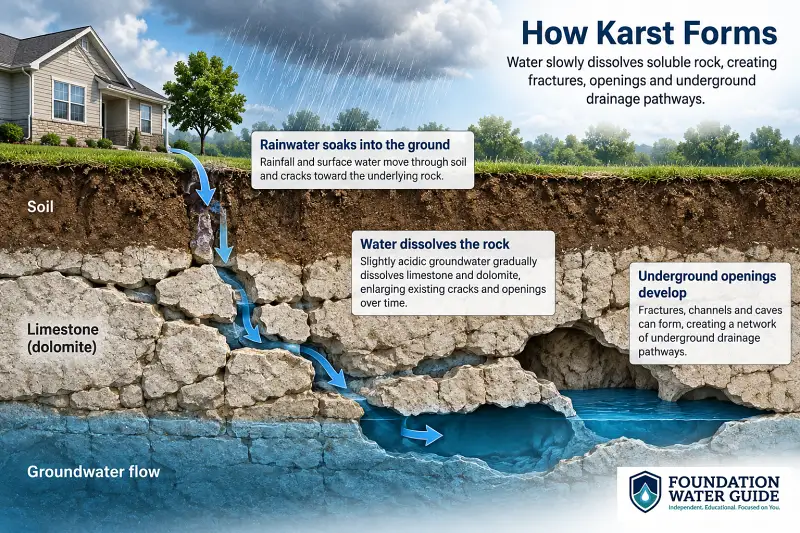
What does “karst” mean?
Karst is not a type of soil. It is a geologic condition that develops where soluble bedrock, usually limestone or dolomite, is gradually dissolved by water.
As the rock dissolves, natural cracks and fractures can enlarge into underground openings, channels, caves and other drainage pathways. Soil and other material may sit above this karst bedrock and, in some cases, move into those openings.
Karst = the geologic system. Sinkholes are one possible feature that can develop within it.
How Do Sinkholes Develop?
A sinkhole can develop when soil or other material near the surface moves downward into openings within the underlying rock. In karst terrain, those openings may have developed gradually as water dissolved limestone, dolomite or other soluble rock.
Some sinkholes form slowly enough that the first visible change is a shallow depression. Others can develop more suddenly when material above an underground opening can no longer support itself. How a sinkhole develops depends partly on the bedrock, the material above it and changing water conditions.
Not Every Sinkhole Forms the Same Way
Sinkholes can develop through different processes. In some areas, exposed or thinly covered carbonate rock gradually dissolves at the surface, producing broad depressions over long periods.
Where thicker soil covers the bedrock, loose material may gradually move into fractures or openings below, sometimes creating a depression at the surface. This process can occur slowly and may continue as additional soil is carried downward.
In other situations, cohesive soil can temporarily bridge an underground opening. If that support weakens enough, the material above the opening can collapse more abruptly.
These differences are one reason the appearance of a depression alone cannot tell a homeowner exactly what is happening underground.
Why Heavy Rain and Changing Water Conditions Can Matter
Water conditions can influence both the movement of soil and the support provided by the ground. Heavy or prolonged rainfall can increase the amount of water entering the soil and moving through existing subsurface pathways.
Changes in groundwater can matter as well. Rising water can saturate soil, while falling groundwater may reduce support that water had been providing to material above an opening. Concentrated runoff or leaking water lines can also introduce water into areas that were previously drier.
This does not mean a heavy rainstorm will cause a sinkhole beneath a home. Rather, significant changes in water conditions can sometimes contribute to soil movement where susceptible karst conditions already exist.
How Can Karst Affect a Home’s Foundation?
Karst does not affect every home built over limestone or dolomite, and the presence of karst does not automatically mean a foundation is unstable. Problems can develop when changes below the surface alter the support provided by the soil and rock beneath or near a foundation.
For homeowners, there are three useful ways to understand how this can happen: uneven settlement, subsurface erosion of soil, and, in less common situations, ground collapse associated with a sinkhole.
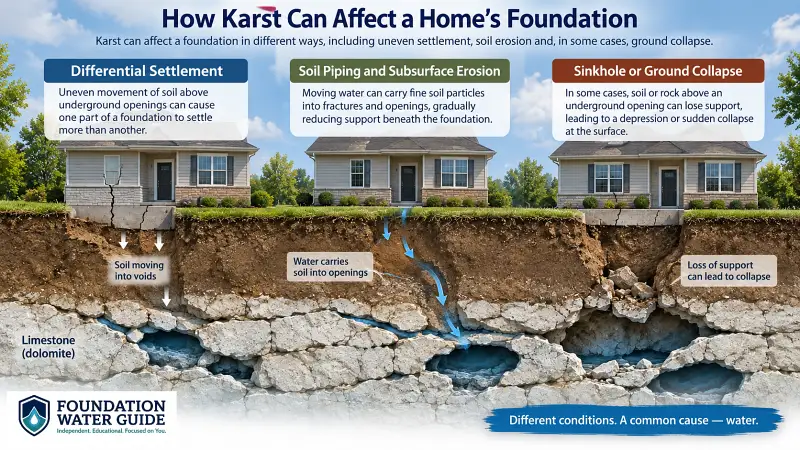
Differential Settlement
A foundation performs best when the ground beneath it provides relatively consistent support. In karst terrain, soil depth, bedrock elevation and subsurface conditions can vary over relatively short distances.
If soil moves downward into openings in the underlying rock or one portion of the ground settles more than another, the foundation may experience differential settlement.
Possible effects can include new or changing cracks, uneven floors or doors and windows that begin sticking, but these symptoms have many possible causes. They do not by themselves indicate that karst or a sinkhole is responsible.
Soil Piping and Subsurface Erosion
Soil piping occurs when moving water gradually carries fine soil particles into fractures, openings or voids below the surface. Unlike obvious surface erosion, this process can occur underground where a homeowner cannot see it happening.
As material is removed, small voids can develop or existing openings can become larger. Over time, this may reduce support beneath part of a foundation or contribute to settlement at the surface.
Water is important to this process, which is why drainage, leaking pipes and concentrated water flow can be relevant when evaluating unusual settlement in karst terrain.
Sinkhole or Ground Collapse
In some karst settings, soil or rock above an underground opening can eventually lose enough support for the ground surface to sink or collapse.
A sinkhole does not have to be a dramatic, sudden opening. Some develop gradually as the ground subsides, while others can form more abruptly depending on the geology and material above the opening.
If a new depression is enlarging, the ground is changing rapidly or foundation movement appears to be occurring at the same time, the condition may deserve professional evaluation. A homeowner should not assume from appearance alone that the cause is a sinkhole.
What Signs May Be Worth Paying Attention To?
Most signs associated with ground movement are not unique to sinkholes or karst. Foundation cracks, sticking doors, uneven floors and low areas in a yard can develop for many reasons.
What may deserve closer attention is a new condition, a condition that is changing, or several changes appearing together.
Signs worth documenting can include:
- A new or enlarging depression in the yard.
- Ground that appears to be settling or sinking in a localized area.
- New foundation cracks or existing cracks that are widening.
- Doors or windows beginning to stick along with other signs of movement.
- Changes in floors, patios, walkways or other surfaces near the home.
- Unexpected changes in how water drains or where water disappears into the ground.
- Erosion or loss of soil around the foundation or elsewhere on the property.
- Several unusual changes developing in the same area or during the same period.
No single item on this list confirms a sinkhole. The pattern, location and rate of change are generally more useful than the presence of one symptom by itself. Photographs and dates can help show whether a condition is stable or continuing to develop.
Sinkhole vs. Ordinary Settlement or Drainage Problems
One of the difficulties with suspected sinkhole problems is that many of the visible symptoms overlap with much more common foundation and drainage issues.
| What You Notice | Other Possible Explanations |
|---|---|
| Depression in the yard | Settled fill, buried materials, erosion, utility work or drainage |
| Foundation cracks | Normal shrinkage, soil movement, differential settlement or structural movement |
| Sticking doors or windows | Foundation movement, framing changes, humidity or ordinary building movement |
| Soil washing away | Concentrated runoff, poor drainage, leaking water lines or subsurface erosion |
| Wet or unusually soft ground | Poor drainage, saturated soil, plumbing leaks or groundwater |
| Changes in patios or walkways | Settlement, erosion, poorly compacted fill or ground movement |
| Water disappearing into the ground | Drainage features, permeable soil, buried infrastructure or subsurface openings |
This is why appearance alone usually cannot determine what is happening below the surface. A depression does not automatically mean sinkhole, just as a foundation crack does not automatically mean the ground beneath the home is collapsing.
The more useful question is whether the condition can be explained by ordinary drainage, soil settlement, erosion, plumbing or construction conditions, or whether something remains unexplained and continues to change.
How Can Drainage and Water Affect Karst Conditions?
Water is a natural part of how karst landscapes develop, but where water enters the ground and how concentrated that flow becomes can also influence soil movement above karst bedrock.
Heavy rainfall, poorly directed downspouts, drainage channels, leaking water or sewer lines, and other concentrated water sources can saturate soil or increase the movement of water into existing fractures and openings. In some settings, moving water can also carry fine soil particles downward, contributing to subsurface erosion or soil piping.
This does not mean ordinary drainage problems will create a sinkhole. The underlying geology must already be susceptible. However, in karst terrain, uncontrolled or concentrated water can be an important factor to investigate when unusual settlement or ground changes occur.
For homeowners, the practical lesson is familiar: manage roof and surface runoff, repair leaks and pay attention when water begins flowing or collecting somewhere it did not before.
What Should I Do If I Notice a Depression or Unusual Ground Movement?
A new depression or unusual ground movement deserves attention, but the first step is not to assume that it is a sinkhole. Settled fill, buried materials, drainage problems, leaking utilities, erosion and other conditions can produce similar changes at the surface.
If you notice something unusual:
- Photograph the area and record when you first noticed the change.
- Monitor whether the depression or affected area is growing or changing.
- Look for nearby drainage problems, erosion or concentrated runoff.
- Check for signs of leaking irrigation, water or sewer lines.
- Note whether foundation cracks, walkways, floors or other nearby surfaces are changing at the same time.
- Keep people and vehicles away if the ground appears unstable or is changing rapidly.
Avoid simply filling an unexplained depression before understanding why it formed. Filling the visible low area may hide the symptom without addressing an underlying loss of soil or support.
If the depression is enlarging, appears suddenly, affects the foundation or cannot be reasonably explained by ordinary drainage, utilities or settlement, professional evaluation can help determine what is happening below the surface.
Who Should Evaluate a Possible Karst or Sinkhole Problem?
The right professional depends on what is changing and what needs to be investigated. A suspected karst or sinkhole concern may involve geology, soil, groundwater, drainage, utilities or the structure itself, so one type of professional may not answer every question.
A professional geologist or geotechnical engineer may be appropriate when there is an unexplained depression, suspected subsurface void, unusual soil movement or concern about the underlying geology. They can evaluate ground conditions and determine whether additional investigation is warranted.
If the primary concern is foundation movement or structural damage, a structural engineer may be appropriate. Drainage professionals can evaluate surface-water problems, while plumbers or utility professionals may be needed when a leaking water or sewer line could be contributing to the condition.
In areas known for karst, a state geological survey or local geological agency may also provide information about regional geology, documented sinkholes and appropriate local resources.
The goal is not necessarily to find someone who can “repair a sinkhole.” It is to identify what is actually happening before deciding whether, and how, the condition should be repaired.
Can Sinkhole or Karst Risk Be Prevented?
The underlying geology cannot be changed, so homeowners cannot completely eliminate the possibility of karst-related ground movement. Living in a karst area also does not mean that a sinkhole will develop.
What homeowners can do is avoid creating or ignoring conditions that may concentrate water or contribute to soil erosion:
- Direct roof runoff away from the foundation and avoid concentrating large amounts of water in one location.
- Maintain gutters, downspouts and property drainage.
- Repair leaking water, sewer and irrigation lines promptly.
- Watch for erosion, new depressions or changes in how water drains across the property.
- Avoid repeatedly saturating the same area of ground unnecessarily.
- Investigate unusual ground changes rather than simply filling or covering them.
Related Foundation Water Questions
Homeowners researching karst or unusual ground movement may also find these questions about soil, drainage and foundation conditions helpful.
Home › Foundation Water Problem Questions › Can Sinkholes or Karst Affect My Foundation?