
Common Mistakes Homeowners Make When Water Appears Around a Foundation
When homeowners notice moisture, dampness, or water near a foundation, the first reaction is often to solve the most visible symptom as quickly as possible. In some situations, that response works. In many others, the visible symptom is only part of a larger drainage, groundwater, or structural pattern.
Understanding the common mistakes homeowners make can help reduce unnecessary repairs, avoid misreading the problem, and make it easier to respond in a calm, informed way.
What Mistakes Do Homeowners Commonly Make With Foundation Water Problems?
One of the most common mistakes is focusing only on where water shows up instead of asking why it is appearing in the first place.
Homeowners may try to dry the area, seal a visible crack, or clean up repeated moisture without first understanding whether the issue relates to roof runoff, poor grading, saturated soil, groundwater pressure, or early structural change. A more effective approach is usually to understand how water is moving around the home before deciding what kind of response makes sense.
“Water appearing near a foundation is often a symptom rather than the root cause. The most important question is not where the water is showing up, but why it is collecting there.”
— Foundation Water Guide Editorial Team
Treating the Symptom Instead of the Cause
When water appears inside a basement or near a foundation, it is natural to focus on the most visible problem first. Many homeowners immediately look for ways to dry the area, seal a crack, or prevent the moisture from returning.
While these steps can sometimes help temporarily, they do not always address the underlying cause of the water movement. In many homes, the visible symptom is only part of a larger drainage pattern involving roof runoff, soil saturation, grading, or groundwater pressure.
Understanding this difference is one reason professionals often evaluate both interior symptoms and exterior drainage conditions before recommending a response.
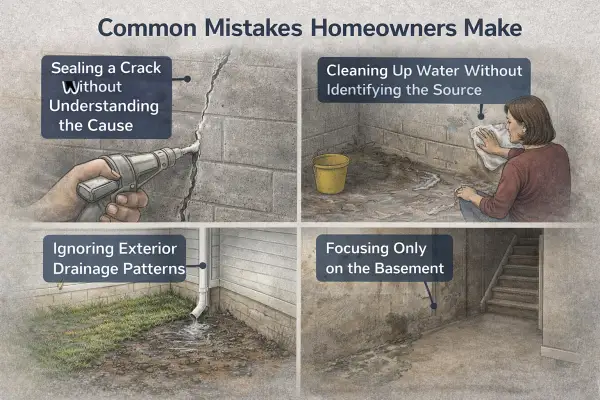
Cleaning up moisture without identifying the source
Drying a wet area, running fans, or wiping down walls may help temporarily, but these steps do not explain why water keeps returning. If moisture repeatedly appears in the same location, the source often deserves closer attention.
This is especially true when symptoms resemble water in basement or wet basement walls.
Assuming every crack is the main problem
A visible crack often attracts the most concern, but cracks are not always the starting point of the issue. In many cases, the crack is a sign that water, soil movement, or pressure is affecting the structure.
Homeowners can better understand this by reviewing foundation cracks and settlement from water.
Ignoring how water behaves outside the home
Many foundation water problems begin outside, long before moisture becomes visible inside. Runoff patterns, grading, and downspout discharge often shape how water reaches the structure.
Pages such as poor grading around the foundation and downspout discharge issues can help explain these patterns.
Misreading Temporary Conditions as Permanent Problems
Not every sign of water near a foundation indicates long-term damage. Some moisture patterns are temporary, weather-related, or seasonal.
Assuming every damp area means structural damage
Moisture alone does not always mean the foundation is failing. In some homes, temporary dampness may be related to humidity, seasonal groundwater conditions, or short-term surface water.
For context, homeowners may want to compare surface water vs. groundwater and review Is This Serious?.
Overreacting to one storm-related event
A single storm can create short-term pooling or dampness that does not necessarily become a recurring issue. Monitoring whether the area dries, returns, or worsens over time can provide more useful information than reacting immediately to a one-time event.
Assuming all moisture problems behave the same way
Water can reach a foundation from multiple directions and under different conditions. Surface runoff, downspout discharge, saturated soil, and groundwater pressure do not all create the same symptoms.
Reviewing how water enters a foundation can help homeowners better understand the difference.
Waiting Too Long When Warning Signs Are Increasing
Just as some homeowners react too quickly, others wait too long even when the signs are becoming more consistent or more severe.
Repeated water intrusion without further evaluation
If water repeatedly enters a basement or crawl space, the issue may be part of a broader water pattern rather than an isolated event. Repeated intrusion often deserves more attention than a single occurrence.
Related pages include crawl space water problems and Do I Need a Professional?.
Cracks or wall movement that continue to change
Cracks that widen, shift, or appear alongside bowing walls or sticking doors may suggest that water is contributing to structural stress.
Homeowners noticing these signs may want to review wall bowing and foundation damage.
Persistent musty odors or moisture buildup
When dampness, odor, or staining persists over time, the issue may be more than seasonal humidity. Repeated symptoms often provide useful clues about ongoing water movement.
This can overlap with musty smell or damp basement.
Skipping the Step of Understanding the Bigger Water Pattern
One of the most common mistakes is looking at a single symptom in isolation instead of understanding how water behaves around the property as a whole.
Focusing only on the basement
Basement symptoms matter, but they are often connected to roof runoff, soil grading, yard drainage, or groundwater conditions outside the home.
Ignoring the relationship between soil and drainage
Soil type, saturation, grading, and drainage conditions all influence how water moves toward or away from the structure. A symptom indoors may begin as a drainage pattern outdoors.
This broader view is part of what foundation water problems and foundation risk factors are designed to explain.
Not connecting symptoms to solution paths
A Simple Way to Evaluate Foundation Water Problems
Step 1: Observe the Pattern
- Did this happen after heavy rain?
- Is it a one-time event?
- Is moisture appearing repeatedly?
Step 2: Look for Possible Causes
- Roof runoff
- Poor grading
- Gutter or downspout issues
- Groundwater conditions
- Foundation openings or cracks
Step 3: Decide Whether More Evaluation Is Needed
- Water returns repeatedly
- Cracks continue changing
- Floors become uneven
- Doors or windows begin sticking
Key Takeaways
- One of the most common mistakes homeowners make is treating visible symptoms without understanding what is causing water to appear in the first place.
- Not every damp area, crack, or pooling event indicates a severe foundation problem. Some conditions are temporary and may need observation before conclusions are drawn.
- Repeated water intrusion, worsening cracks, or persistent moisture patterns often deserve more attention than isolated or short-term symptoms.
- Understanding how water moves around a home can help homeowners avoid misreading the problem. Pages such as how water enters a foundation and foundation risk factors provide helpful context.
- When conditions are difficult to interpret, reviewing Is This Serious?, Do I Need a Professional?, or How Professionals Diagnose Water Problems can help clarify the next step.
Where to Go Next
If you are still deciding whether the issue appears minor or more concerning:
• Is This Serious?
• Do I Need a Professional?
If you want to understand how the cause of the problem is identified:
• How Professionals Diagnose Water Problems
• How Water Enters a Foundation
If you are reviewing symptoms around the home:
• Interior Water Problems
• Exterior Water Problems
• Foundation Damage
Frequently Asked Questions About Common Mistakes Homeowners Make When Water Appears Around a Foundation
Homeowners often try to solve foundation moisture problems quickly, especially when water appears suddenly around the basement or foundation walls. However, acting too quickly without understanding the source of the moisture can sometimes lead to temporary fixes that don’t address the underlying drainage or soil conditions.
The questions below explore some common mistakes homeowners make when dealing with foundation water problems. If you’re looking for more detailed explanations of issues homeowners frequently encounter, you can explore additional foundation water problem questions that explain how basement moisture and drainage problems develop.
Is it a mistake to seal a crack right away?
Not always, but sealing a crack without understanding why it formed may leave the underlying cause unchanged. If water pressure, soil movement, or drainage problems are contributing to the crack, the symptom may return or worsen over time.
Can one heavy storm create a temporary problem that does not come back?
Yes. Some moisture conditions appear during unusual weather and then fully dry out afterward. The key is whether the pattern repeats, intensifies, or begins to affect other parts of the home.
Why do homeowners misread foundation water problems?
Water can come from several sources and create different types of symptoms. Without understanding runoff, grading, soil saturation, or groundwater behavior, it is easy to assume the most visible symptom is the whole problem.
When does waiting become a mistake?
What is the safest first step when I notice water around the foundation?
Home › Interior Water Problems