
How Water Moves Through Different Soil Types
Water does not move through every type of soil in the same way. Some soils allow water to enter and drain relatively quickly, while others absorb water more slowly, retain moisture longer, or become saturated after prolonged rainfall.
These differences are largely influenced by the size and arrangement of soil particles and the spaces between them. Clay, sand, silt, loam, and fill soil can therefore create very different moisture and drainage conditions around a foundation.
Understanding how water moves through soil helps explain why one property may experience pooling, saturated ground, runoff, or persistent foundation-area moisture while another nearby property responds differently to the same rainfall.
How Does Water Move Through Soil?
Water enters soil from rainfall, snowmelt, irrigation, surface runoff, and sometimes groundwater. Once it reaches the ground, some water moves downward through spaces between soil particles, some remains stored within the soil, and some may move across the surface when the ground cannot absorb it quickly enough.
The rate and direction of this movement depend on several factors, including soil type, particle size, soil structure, compaction, existing moisture, and the amount and intensity of incoming water.
When water enters the ground faster than it can move away, soil can become increasingly wet and eventually saturated. When infiltration is limited, more water may remain at the surface or move across the property as runoff.
Why Soil Type Changes How Water Behaves
Soil is made up of particles of different sizes arranged with spaces, or pores, between them. Those pore spaces create pathways where water can enter, collect, and move through the ground.
Coarse soils such as sand generally have larger pore spaces that allow water to move through relatively quickly. Fine-grained soils such as clay have much smaller pores, so water typically moves through them more slowly and may remain in the soil longer.
Particle size is only part of the picture. Soil structure, compaction, existing moisture, and layers of different soil types can all change how easily water moves. A soil that normally accepts water may drain much differently once it is heavily compacted or already wet.
These differences help explain why some properties develop surface runoff and yard drainage problems, while others are more prone to persistent wet or saturated ground.
“The same amount of rain can create very different conditions around two foundations because the soil determines how quickly that water enters, moves through, and leaves the ground.”
— Foundation Water Guide Editorial Team
How Water Behaves in Different Soil Types
Different soils contain different combinations of particle sizes and pore spaces. These differences influence how quickly water enters the ground, how easily it moves through the soil, and how much moisture may remain after rain. Most properties contain mixtures or layers of soils rather than one perfectly uniform soil type.
Clay Soil
Clay consists of very small particles with correspondingly small pore spaces. Water generally moves through clay more slowly than through coarse soils, and clay can retain moisture for longer periods.
During prolonged rainfall, clay-rich ground may become increasingly wet as additional water enters faster than it can drain away. Some clay soils are also expansive, meaning their volume can change substantially as moisture conditions change.
For more on this behavior, see Soil Saturation and Expansive Clay.
Sandy Soil
Sand contains relatively large particles and larger pore spaces. Water can generally enter and move through sandy soil more quickly than through clay or silt, which often allows the ground to drain faster after rainfall.
That does not mean sandy soil eliminates foundation water concerns. Water moving rapidly through the ground can still encounter less-permeable soil layers, a high groundwater table, or other conditions that slow or redirect its movement.
Silt
Silt particles are smaller than sand but larger than clay. As a result, water movement and retention generally fall somewhere between the behavior of coarse sand and fine clay, although actual conditions vary depending on the soil mixture and structure.
Silty soil can retain considerable moisture and may drain slowly when compacted or mixed with clay. It can also be vulnerable to erosion when exposed to moving surface water.
Loam
Loam is a mixture of sand, silt, and clay rather than a single soil particle type. Because its composition varies, so does the way water moves through it.
A well-structured loam may allow water to infiltrate while still retaining some moisture. However, a clay-heavy loam can behave differently from a sand-heavy loam, so the word loam alone does not tell you exactly how well a property will drain.
Fill and Disturbed Soil
Fill soil is material that has been moved or placed during construction, grading, landscaping, or other site work. It may contain clay, sand, silt, rock, organic material, or mixtures of several materials.
How water moves through fill depends on both its composition and how it was placed and compacted. Different layers of fill and native soil can also create changes in water movement as moisture encounters materials with different drainage characteristics.
Because fill and native soil can differ in composition, compaction, and drainage behavior, learn more about Fill Soil vs. Native Soil Around Foundations.
Soil Type and Water Movement Comparison
Soil types behave differently as water enters and moves through the ground. The table below shows general tendencies, but actual drainage can vary with compaction, soil layering, existing moisture, slope, and other site conditions.
| Soil type | Water entry | Drainage tendency | Water retention | What homeowners may notice |
|---|---|---|---|---|
| Clay | Slow | Slow | High | Wet ground may persist after rain; surface runoff or pooling may occur |
| Sand | Fast | Fast | Low | Water may disappear from the surface quickly and move deeper into the ground |
| Silt | Moderate | Slow to moderate | Moderate to high | Ground may remain damp and can become soft or easily eroded |
| Loam | Moderate | Moderate | Moderate | Often absorbs and drains water more evenly, depending on its soil mixture |
| Fill / disturbed soil | Variable | Variable | Variable | Wet areas or drainage patterns may differ across the same property |
What Happens When Soil Becomes Saturated
Soil becomes saturated when its pore spaces are filled with water and additional moisture can no longer move through the ground as easily. This commonly develops after prolonged rainfall, repeated irrigation, poor drainage, or when groundwater contributes moisture from below.
As saturation increases, water movement may slow and the soil can remain wet for extended periods. Additional rainfall may then contribute to pooling or surface runoff because the ground has less capacity to accept more water.
The effects vary by soil type. Clay-rich soils often drain slowly and may retain moisture for longer periods, while sandy soils typically allow water to move through more quickly. However, even well-draining surface soil can remain wet if water encounters a less-permeable layer below it or if the groundwater level is high.
For a deeper explanation of these conditions, see Soil Saturation and Expansive Clay.
How Soil Conditions Affect Water Around a Foundation
The soil surrounding a foundation helps determine where water goes after it reaches the property. Water may soak into the ground, remain stored in the soil, move deeper below the surface, or travel across the yard as runoff.
Around a home, several soil conditions can change that behavior:
- Slow-draining soil can allow moisture to remain near foundation walls longer.
- Compacted soil may reduce infiltration and increase surface runoff.
- Layers of different soils can slow or redirect water below the surface.
- Saturated ground has less capacity to accept additional rainfall.
- Loose or eroding soil can alter established drainage patterns around the home.
These conditions interact with grading, downspouts, rainfall, groundwater, and other site factors. Soil type is therefore an important part of understanding a foundation water problem, but rarely the only factor involved.
For more about water approaching the home from the surface, see Exterior Water Problems.
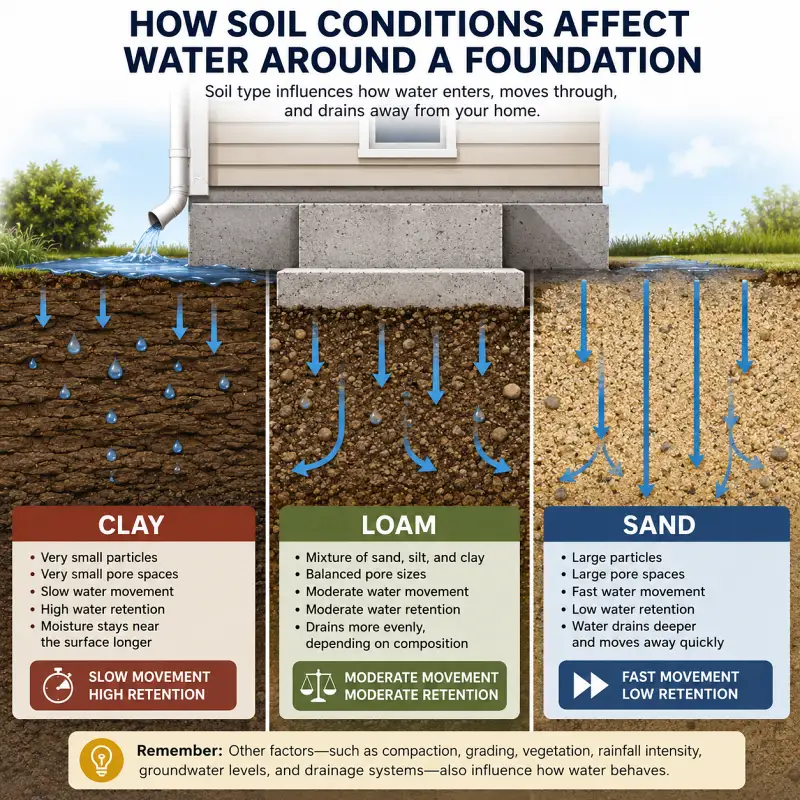
Soil Type Is Only Part of the Drainage Picture
Soil type helps explain how water may behave around a foundation, but it does not determine drainage conditions by itself. The same type of soil can behave differently from one property, or even one part of a property, to another.
Several other conditions influence how water enters, moves through, and leaves the ground:
- Compaction: Compacted soil has less open space for water to enter and move through, which can reduce infiltration and increase surface runoff. See Soil Compaction and Foundation Drainage for a closer look at how compaction can change infiltration, runoff, and drainage around a foundation.
- Grading: The slope of the ground influences where surface water travels before it has a chance to soak into the soil. Poor grading around a foundation can direct water toward the home regardless of soil type.
- Vegetation: Trees, grass, and other plants remove moisture from the soil through their roots and can contribute to differences in moisture conditions across a property.
- Rainfall intensity: Heavy rain can arrive faster than the ground can absorb it, creating pooling or surface runoff even where soil normally allows reasonable infiltration.
- Groundwater: Water moving through the ground from below can contribute to wet or saturated conditions independently of rainfall at the surface. A high groundwater table can therefore affect how much additional water the surrounding soil can hold.
- Fill and native soil: Different soil materials or layers can create changes in how water moves below the surface, particularly where construction has disturbed or replaced the original soil.
- Drainage systems: Gutters, downspouts, swales, foundation drains, and other drainage features can change where water enters the ground and how quickly it is carried away from the foundation.
This is why it is usually too simplistic to think of one soil as “good” and another as “bad” for drainage. Soil type is one part of a larger system that includes the ground, water sources, weather, drainage, and the foundation itself.
When Water or Drainage Patterns May Need Closer Evaluation
Differences in soil type and drainage are normal, and wet ground after rainfall does not automatically indicate a foundation problem. What matters more is whether water or moisture patterns are persistent, recurring, or appearing alongside other changes around the home.
Closer evaluation may be useful when you notice:
- Water repeatedly pooling near the foundation
- Soil remaining saturated long after surrounding areas have dried
- Recurring basement or crawl-space moisture
- Erosion or noticeable changes in soil around the foundation
- New or changing foundation cracks or signs of settlement
- Drainage problems that continue despite correcting obvious sources such as downspout discharge
Because soil type is only one part of the drainage system, determining the actual cause may require looking at grading, soil conditions, groundwater, drainage features, and the foundation together.
If you’re unsure what the pattern means, Is This a Serious Foundation Water Problem? can help you evaluate the warning signs, while Do I Need a Professional? explains when a closer inspection may make sense.
Key Takeaways
- Soil type influences how quickly water enters, moves through, and remains in the ground.
- Clay generally drains more slowly, while sandy soils allow faster water movement.
- Saturation, compaction, and soil layering can change normal drainage behavior.
- Grading, rainfall, groundwater, and drainage systems also influence water around a foundation.
- Soil type is one part of the overall foundation water picture.
Where To Go Next
If you want to understand changing soil conditions:
If you want to understand how water affects foundations
If you’re seeing moisture or possible foundation changes:
If you want to understand conditions where you live:
Frequently Asked Questions About Water Movement Through Soil
Which type of soil drains water the fastest?
Sandy and other coarse soils generally allow water to move through more quickly because they contain larger particles and larger pore spaces. Actual drainage can still vary depending on compaction, soil layers, existing moisture, groundwater, and other site conditions.
Why does clay soil drain slowly?
Clay contains very small particles and small pore spaces, which generally slow the movement of water through the ground. Clay can also retain moisture for longer periods, so clay-rich soil may remain wet after surrounding areas have begun to dry.
Does sandy soil prevent foundation water problems?
No. Sandy soil often drains more quickly than clay, but fast drainage does not eliminate foundation water problems. Water can encounter less-permeable soil layers, groundwater, poor grading, or other conditions that cause moisture to collect or move toward a foundation.
What happens when soil can no longer absorb water?
When water reaches the ground faster than the soil can accept or move it away, additional water may collect at the surface or travel across the property as runoff. If the soil’s pore spaces become filled with water, the ground can become saturated and remain wet until drainage or evaporation reduces the moisture.
Can different soil types exist around the same foundation?
Yes. A property may contain layers or mixtures of clay, sand, silt, loam, native soil, and construction fill. These differences can cause water to move differently from one area of the property to another, which is one reason drainage conditions may vary around the same foundation.
Home › Soil & Ground Conditions › How Water Moves Through Different Soil Types