
Why Is There Water in My Basement?
Water can enter a basement when rain or surface runoff collects near the foundation, groundwater rises around or beneath the home, drainage systems cannot move water away effectively, or moisture finds an opening through a wall, floor, joint, or crack.
Where the water appears and when it happens can provide important clues about the likely source. Water after heavy rain may point toward surface drainage, while persistent seepage during prolonged wet conditions may be related to saturated soil or groundwater.
Basement water does not automatically mean there is a structural problem. The first step is understanding how and where the water may be reaching the basement so you can determine what to investigate next.
Three Ways to Understand Water Entering a Basement
Everyone learns differently. Choose the format that works best for you.
- Browse the slide presentation
- Watch the educational video
- Read the complete guide below
Slide Presentation
Educational Video
Common Causes of Water in a Basement
| Possible Cause | What You May Notice |
|---|---|
| Surface runoff near the home | Water after heavy rain |
| Poor grading around the foundation | Pooling water near exterior walls |
| Downspout or gutter issues | Concentrated water near the foundation |
| Groundwater or saturated soil | Persistent moisture or seepage |
| Foundation openings or joints | Water entering through walls or floor edges |
“Water in a basement is often a sign that moisture is collecting near the foundation or finding a pathway into the home. Identifying the source is usually more important than focusing on where the water appears.”
— Foundation Water Guide Editorial Team
What Can the Timing and Location of Basement Water Tell You?
When and where basement water appears can help narrow down its likely source. Water that shows up immediately after heavy rain may point toward a different problem than moisture that persists during long wet periods or repeatedly appears along the same wall or floor joint.
Use the patterns below to identify which conditions may be worth investigating around your home.
Surface Runoff and Yard Drainage
If basement water appears during or shortly after heavy rain, look at how water moves across the property. Runoff that flows toward the house or collects near the foundation can increase the amount of moisture entering the surrounding soil.
Clue to look for: Ponding or flowing water near the home during rain.
Poor Grading Around the Foundation
Ground that slopes toward the foundation can direct rain and runoff toward the house instead of away from it. This can keep soil near the foundation wetter and increase the chance of basement moisture.
Clue to look for: Low areas or soil that slopes toward the foundation.
Downspout and Gutter Discharge
Gutters and downspouts can concentrate large amounts of roof water in one location. If that water is discharged too close to the foundation, the soil nearby may become saturated.
Clue to look for: Basement moisture near a downspout or water collecting where roof runoff is discharged.
Groundwater and Soil Saturation
Water that appears after prolonged wet weather, or persists even when there is no obvious surface water near the home, may be related to saturated soil or elevated groundwater around the foundation.
Clue to look for: Persistent seepage, moisture near the wall-floor joint, or water appearing during extended wet periods.
Foundation Openings and Entry Points
Water can enter through cracks, joints, penetrations, window wells, or other openings in the foundation. The location where water becomes visible may help identify the pathway, although it does not always reveal the original water source.
Clue to look for: Water repeatedly appearing at the same crack, joint, wall area, or opening.
Not sure which pattern fits? Our Water in Basement Guide explains basement water sources, entry paths, warning signs, and next steps in greater detail.
Does Water in a Basement Mean There Is a Foundation Problem?
Not always. Many basement water issues are related to drainage conditions outside the home rather than structural failure of the foundation itself.
However, repeated moisture intrusion can sometimes contribute to foundation changes over time, especially if surrounding soil remains saturated for long periods.
More information about potential foundation damage from water. For example, prolonged moisture exposure may contribute to conditions such as foundation cracks.
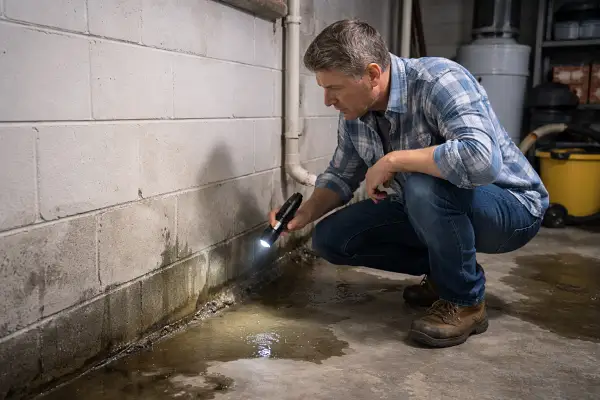
Signs Water May Be Entering the Basement
Basement water is not always obvious. Moisture may first appear as damp walls, musty odors, small wet areas, or water along the basement floor.
Where and when these signs appear can provide clues about how moisture is reaching the basement.
Damp or Wet Basement Walls
Damp areas, staining, or visible moisture on basement walls may indicate water moving through the wall or entering through cracks, joints, or other openings.
What to look for: Whether the moisture appears in one location or across a larger portion of the wall.
Water Appearing After Heavy Rain
Water that consistently appears during or shortly after heavy rain often points toward conditions outside the home, including runoff, grading, gutters, downspouts, or saturated soil.
What to look for: How quickly the water appears after rainfall and whether water is collecting near the foundation outside.
Musty or Damp Odors
A persistent musty smell can be an early indication of excess basement moisture even when visible water is not present.
What to look for: Whether the odor becomes stronger during wet weather or is concentrated in a particular area of the basement.
Water Pooling Along the Floor
Water along the basement floor or wall-floor joint may be associated with groundwater, saturated soil, drainage problems, or a specific entry point.
What to look for: Where the water first becomes visible and whether it appears after rain or during prolonged wet conditions.
When Basement Water May Be Part of a Larger Issue
In some cases, basement water is one symptom of broader water movement around the home. Drainage patterns, soil saturation, and groundwater conditions can influence how moisture behaves near the foundation.
Understanding foundation water risk factors can help homeowners recognize why moisture appears in certain situations.
Learn more about foundation water risk factors and how they affect homes.
If you are unsure whether a basement water issue is minor or more significant, it may also be helpful to review how to tell if a foundation water problem is serious.
Frequently Asked Questions About Water in a Basement
Can water in a basement appear without heavy rain?
Yes. Groundwater conditions, plumbing leaks, condensation, or elevated moisture levels in surrounding soil can sometimes cause basement moisture even when there has been little recent rainfall.
Why does water often appear where the wall meets the floor?
The joint where the basement wall meets the floor creates a natural seam in the foundation. Water moving through saturated soil may follow this path of least resistance and appear along basement edges.
Does water in a basement always mean foundation damage?
Not always. Many basement water problems are related to drainage conditions, soil moisture, or groundwater movement rather than structural failure. However, repeated moisture exposure may contribute to foundation-related concerns over time.
Can gutters and downspouts cause basement water problems?
Home › Foundation Water Problem Questions › Why Is There Water in My Basement?