
Window Well Water Problems: How Exterior Openings Can Lead to Basement Moisture
A window well (a recessed area built outside a below-grade basement window) is designed to allow natural light into the basement and, in many cases, provide emergency egress. These wells are typically lined with metal, plastic, or concrete and filled at the base with gravel to promote drainage.
Because they sit below ground level, window wells can also act as collection points for rainwater, snowmelt, and debris. When drainage within the well is limited or obstructed, water may accumulate near the window opening.
In many cases, water entering around basement windows is related to drainage or sealing issues within the well itself rather than a structural failure of the foundation. Understanding how window wells are designed to function helps clarify why moisture problems sometimes develop in this specific area.
What Are Window Well Water Problems?
Window well water problems develop when water collects near below-grade basement windows instead of draining safely away from the home. In many cases, these conditions are related to clogged drains, saturated soil, heavy roof runoff, or improper surface drainage around the foundation.
Because window wells sit below ground level, they can become collection points for rainwater, snowmelt, and moisture moving through nearby soil. When drainage slows or groundwater conditions remain elevated, moisture may remain near basement windows longer than expected.
Standing water inside a window well often points to drainage-related conditions such as clogged drains, compacted gravel, poor grading, roof runoff, or elevated groundwater levels near the foundation.
When moisture repeatedly collects near below-grade windows, it may contribute to basement seepage, damp wall conditions, recurring leaks after storms, or increased hydrostatic pressure near foundation walls.
- Window wells are designed to move water downward and away from below-grade windows.
- Clogged drains, compacted soil, and blocked gravel can prevent proper drainage inside a window well.
- Heavy rain, snowmelt, and roof runoff may increase moisture accumulation near basement windows.
- Water intrusion near a basement window does not always indicate structural foundation damage.
- Recurring moisture near below-grade windows may point to drainage or groundwater-related conditions.
How Window Wells Are Designed to Drain
Window wells are not intended to hold water. They are built with drainage features that allow moisture to move downward and away from the window opening.
When functioning properly, these components help prevent standing water from collecting against below-grade windows.
Gravel Drainage Base
Most window wells are installed with a layer of gravel at the bottom. Gravel (small, loose stones) allows water to pass through more easily than compacted soil.
Instead of pooling against the window, rainwater and snowmelt are intended to filter through the gravel and move downward toward the underlying drainage system.
If water is not draining as expected, it may help to review how soil saturation and expansive clay can slow drainage beneath the surface and allow moisture to remain trapped near the foundation.
Vertical Drain to Foundation Footing
In many homes, a vertical drain pipe is installed beneath the gravel layer. This pipe connects to the foundation’s perimeter drain system (a drainage system installed around the base of the foundation to collect and redirect water).
The vertical drain provides a pathway for water collected in the well to travel downward and away from the structure.
Connection to Perimeter Drain Systems
The perimeter drain system, sometimes referred to as a footing drain, is designed to relieve hydrostatic pressure (pressure created by water in saturated soil) around the foundation.
When the window well drain connects properly to this system, water entering the well should be directed away from the foundation walls.
Problems typically arise when one or more of these components become blocked, damaged, or overwhelmed.
Clogged or Blocked Well Drains
Even when window wells are properly installed, drainage can fail over time. Because these areas are exposed to the elements, they naturally collect debris such as leaves, soil, and sediment.
When drainage pathways become restricted, water may accumulate in the well instead of moving downward and away from the foundation.
Debris and Sediment Buildup
Leaves, mulch, and wind-blown soil can gradually fill the gravel base of a window well. As sediment accumulates, it reduces the ability of water to filter through the gravel.
Over time, this buildup may prevent proper drainage and allow standing water to rise high enough to contact the window frame.
If water enters at this point, it may contribute to conditions similar to water in the basement, particularly after heavy storms.
Collapsed or Obstructed Drain Pipes
In homes equipped with a vertical drain pipe, the pipe itself can become clogged with sediment or partially collapsed due to soil movement.
When the connection to the perimeter drainage system is blocked, water collected in the well has nowhere to go. Even moderate rainfall can then result in temporary pooling.
Repeated pooling may contribute to moisture patterns similar to those described in wet basement walls, especially around below-grade window openings.
If water cannot move downward through the drainage system, it may help to review high groundwater table conditions to understand how pressure can build beneath the surface.
Standing Water in the Well
Visible standing water is often the clearest sign of a drainage problem. While brief pooling during a heavy downpour may be normal, water that lingers hours or days after rainfall suggests restricted drainage.
If water remains in contact with the window frame, the risk of seepage increases, particularly if seals or flashing have deteriorated.
If standing water remains for extended periods, it may help to look more closely at water in the basement to understand how prolonged exposure at window openings can begin affecting interior areas.
Improper or Missing Window Well Covers
Window well covers are designed to limit the amount of debris and direct rainfall entering the well. While not all wells require covers, improperly fitted or missing covers can increase the volume of water collecting around the window opening.
When covers are damaged, loosely installed, or absent, the well may fill more quickly during storms.
Rain and Snow Accumulation
Without adequate protection, rainfall and melting snow can enter the well directly. Because window wells sit below grade, even moderate precipitation can collect rapidly in the recessed area.
If the surrounding yard allows water to flow toward the house, as described in surface runoff and yard drainage, the well may receive additional runoff beyond direct rainfall.
Surface Runoff Entering the Well
Subtle slope issues near the foundation can direct water toward window wells instead of away from them. Conditions related to poor grading around the foundation may increase the amount of water entering the well during storms.
When surface water repeatedly flows into the well, drainage components may become overwhelmed, increasing the likelihood of standing water and seepage.
Seal Failures Around the Window Frame
Even when drainage components function properly, water can enter if the window assembly itself is not adequately sealed. Basement windows are installed within foundation wall openings, and over time, the materials around those openings can deteriorate.
Seal failures typically involve aging caulk, shifting frames, or small gaps between the window unit and the surrounding concrete.
Aging Caulk and Sealant
Sealants (flexible materials used to close gaps between building components) can degrade due to age, temperature changes, and moisture exposure.
As caulk cracks or pulls away from the window frame, small openings may develop. During heavy rain, water contacting the window surface may seep through these gaps and enter the basement.
This type of localized seepage may resemble conditions described in wet basement walls, particularly near below-grade window openings.
If small gaps are allowing water to pass through, it may also help to review foundation cracks to understand how similar openings can allow moisture intrusion under pressure.
Gaps Between Window and Foundation
Over time, minor settlement or seasonal soil movement can create small separations between the window frame and the surrounding foundation wall.
While these gaps may be subtle, they can allow water to bypass exterior drainage features. If this pattern develops, it may help to review foundation cracks to understand how small openings can allow moisture to enter under pressure.
Water Entering at Wall Openings
When standing water in a window well reaches the lower portion of the frame, it may enter through small imperfections in flashing (a protective barrier designed to redirect water) or deteriorated seals.
This form of water entry is often localized to the window area and may not indicate widespread structural failure. However, repeated exposure can contribute to interior dampness if not addressed.
If water is entering through wall openings, it may help to review how water enters a foundation to better understand the different pathways moisture can take into a structure.
Signs Window Wells May Be Contributing to Basement Moisture
Window well-related moisture problems are often localized near below-grade windows. Because these areas sit lower than surrounding ground level, symptoms may appear quickly after rainfall or snowmelt.
Recognizing these patterns can help determine whether the window well itself is contributing to interior dampness.
Visible Water After Storms
If water is clearly pooling inside the well after rainfall, drainage may be restricted. While brief accumulation during heavy storms can occur, standing water that remains for extended periods increases the likelihood of seepage.
If water appears in the well after storms, it may help to review water in the basement to understand how exterior accumulation near window openings can begin affecting interior spaces.
Dampness Around Basement Windows
Moisture staining, peeling paint, or damp drywall near basement windows may indicate localized water entry at the window opening.
These patterns often resemble wet basement walls, but are concentrated near the window area rather than across the entire wall.
If dampness begins to spread beyond the window area, it may help to continue exploring wet basement walls to see how localized moisture can expand across interior surfaces.
Musty Odors Near Below-Grade Openings
Persistent moisture around basement windows can contribute to musty smells over time. Trapped dampness may increase humidity in the surrounding area.
This type of odor may align with conditions described in musty smell or damp basement, particularly when the source is localized near window wells.
Recurring Leaks After Heavy Rain
If leaks occur consistently after storms but remain limited to specific window areas, the well and its drainage components may be contributing factors.
While broader exterior issues such as surface runoff or poor grading can increase water flow toward the home, window wells can act as concentrated collection points.
If leaks return after multiple storms, it may help to review when foundation water problems may be serious to better understand when recurring patterns may need closer evaluation.
Common Window Well Moisture Patterns
| Observed Condition | Often Associated With | Common Pattern |
|---|---|---|
| Water appears after storms | Surface drainage or roof runoff | Moisture increases shortly after rainfall |
| Standing water remains in the well | Blocked drain or compacted gravel | Water drains slowly or remains trapped |
| Leaks near one basement window | Localized drainage or seal issues | Moisture appears near a specific opening |
| Recurring damp odors near windows | Persistent moisture accumulation | Humidity or musty conditions continue over time |
| Moisture during snowmelt or prolonged rain | Saturated surrounding soil | Water remains near below-grade areas longer than expected |
When Window Well Water Problems May Point to Larger Moisture Issues
Window wells can act as localized collection points, but they are not always the sole source of basement moisture. In many cases, broader exterior water conditions influence how much water reaches the well in the first place.
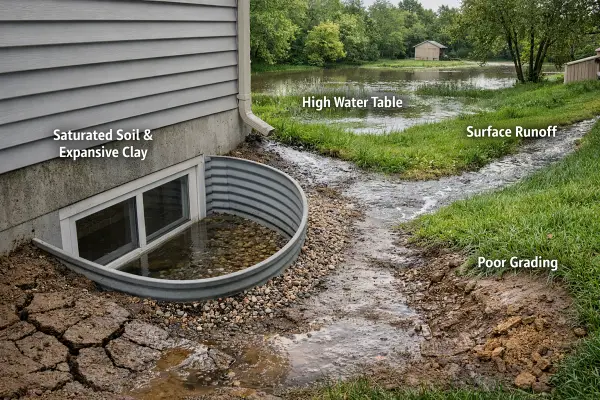
For example, ongoing soil saturation and expansive clay conditions can slow drainage around the foundation, increasing subsurface moisture levels. When the surrounding soil remains damp for extended periods, window wells may experience higher overall water exposure.
Similarly, a high groundwater table can elevate moisture levels beneath the surface, placing sustained pressure on below-grade openings.
Surface conditions also matter. Issues related to surface runoff or poor grading around the foundation can direct additional water toward window wells during storms.
Evaluating window wells in the broader context of soil behavior, groundwater movement, and exterior drainage patterns provides a more complete understanding of foundation moisture exposure. Addressing contributing factors together often leads to more stable long-term results.
In some homes, repeated moisture near below-grade windows may occur alongside broader foundation water patterns. Paying attention to recurring symptoms can help identify when moisture conditions extend beyond the window well itself.
- Recurring seepage after storms
- Moisture spreading along basement walls
- Efflorescence or mineral staining
- Water appearing in multiple basement areas
- Visible wall cracking or shifting near below-grade openings
- Damp conditions that persist long after rainfall ends
Key Takeaways
- A high groundwater table occurs when the natural water level in the soil rises close to the depth of a foundation.
- Groundwater can place continuous moisture pressure against basement walls or slabs below the surface.
- Elevated groundwater conditions may cause seepage or dampness even when surface drainage appears normal.
- Understanding groundwater conditions helps explain certain interior moisture problems that occur after heavy rainfall or seasonal changes.
Where To Go Next
If you want to review related exterior drainage problems:
If moisture is appearing inside the basement:
If you want to understand foundation water problems where you live:
Frequently Asked Questions About Window Well Water Problems
Are window wells supposed to fill with water?
No. Window wells are designed to drain water downward through a gravel base and, in many cases, into a vertical drain connected to the foundation’s drainage system. Brief pooling during heavy storms can occur, but standing water that lingers suggests restricted drainage.
Do all window wells need covers?
Not necessarily. However, properly fitted covers can help reduce the amount of rain, snow, and debris entering the well. In areas with frequent storms or heavy leaf accumulation, covers may reduce the likelihood of drainage blockages.
Can a window well leak even if the foundation is structurally sound?
Yes. Localized moisture near a basement window can sometimes develop from drainage, seal, or window well conditions even when the foundation itself does not show signs of major structural movement.
Why does water only appear near one basement window?
Window well problems are often isolated. If drainage components are blocked or seals are deteriorated at a single well, moisture may appear only in that area rather than across the entire basement wall.
Can Heavy Rain Overwhelm a Window Well Drain?
Yes. During prolonged rain or rapid snowmelt, water may enter a window well faster than the drainage system can remove it. Poor grading, clogged drains, or saturated surrounding soil can increase the likelihood of temporary water buildup.
Can Groundwater Affect Window Wells?
Yes. Elevated groundwater conditions can increase moisture around below-grade basement windows, especially when surrounding soil remains saturated for extended periods. In some homes, groundwater pressure may contribute to recurring dampness near window wells even when surface drainage appears normal.
Home › Exterior Water Problems › Window Well Water Problems