
Surface Runoff and Yard Drainage: How Water Moves Toward a Foundation
Surface runoff refers to rainwater that flows across the ground before it has time to absorb into the soil. On residential properties, the direction and speed of that runoff can significantly influence how much water reaches a home’s foundation.
While some surface flow is normal during heavy rainfall, problems can arise when water is consistently directed toward the structure instead of away from it. Yard slope, compacted soil, hard surfaces such as driveways, and even drainage patterns from neighboring properties can all affect how runoff behaves.
Because surface water follows the path of least resistance (the lowest elevation), small changes in grading or landscape design can gradually alter drainage patterns. Understanding how runoff moves across a property helps homeowners determine whether exterior water flow may be contributing to foundation moisture exposure.
What Is Surface Runoff and Yard Drainage?
Surface runoff refers to rainwater that flows across the ground when the soil cannot absorb it quickly enough. Yard drainage describes how that water moves across a property and whether it is directed safely away from structures such as the foundation.
When runoff is not properly directed away from a home, water may collect near the base of the foundation or flow toward below-grade walls. Repeated runoff patterns can gradually increase soil saturation and contribute to basement dampness, crawl space moisture, or other interior water problems.
How Surface Runoff Forms
Surface runoff develops when rainfall exceeds the ground’s ability to absorb water. While some surface flow is normal during heavy rainfall, problems can occur when water is consistently directed toward the structure instead of away from it. These drainage patterns are one of several exterior water problems that can increase moisture exposure around a home’s foundation.
Rainfall Exceeding Soil Absorption
During light rain, much of the water may infiltrate (soak into) the soil surface. However, when rainfall intensity increases, or when storms last for extended periods, the ground may reach a point where it cannot absorb additional water quickly enough.
During light rain, much of the water may infiltrate (soak into) the soil surface. However, when rainfall intensity increases, or when storms last for extended periods, the ground may reach a point where it cannot absorb additional water quickly enough. Different soil types absorb and transmit water at different rates. See How Water Moves Through Different Soil Types for a closer look at these differences.
At that point, excess water begins to move across the surface instead of downward into the soil. This is the beginning of surface runoff.
When runoff repeatedly exceeds what the soil can absorb, it may begin to collect near the home and contribute to water pooling near the foundation.
Soil Saturation
Soil saturation occurs when pore spaces within the soil become filled with water. Once saturated, the soil can no longer absorb rainfall efficiently. Additional precipitation must travel elsewhere.
Clay-heavy soils tend to reach saturation more quickly and retain water longer than sandy soils. When soil near a foundation remains saturated, surface runoff is more likely to develop during subsequent rainfall events.
Clay-heavy soils tend to reach saturation more quickly and retain water longer than sandy soils. When soil near a foundation remains saturated, surface runoff is more likely to develop during subsequent rainfall events. See Soil Saturation and Expansive Clay for more about how prolonged saturation can affect conditions around a foundation.
Gravity and Natural Flow Direction
Water naturally moves downhill. Once runoff forms, gravity determines its direction and speed. Even subtle elevation differences across a yard can influence where water ultimately collects.
Because runoff follows the lowest available path, small depressions, settlement areas, or slight slope changes can redirect water toward the foundation without being immediately obvious.
Hard Surfaces That Accelerate Runoff
Hard surfaces such as concrete, asphalt, compacted soil, and pavers do not absorb water effectively. Instead, they shed water quickly across their surface.
Driveways, patios, and walkways can significantly increase the speed and concentration of runoff. When these surfaces are angled toward the home, even slightly, they may channel water directly toward the foundation rather than dispersing it across the yard.
Water Flowing Toward the Foundation
Even when runoff forms naturally during rainfall, problems arise when the direction of flow consistently leads back toward the home. In many cases, this movement is subtle and develops gradually over time.
Subtle Yard Slope Toward the Structure
A yard does not need a dramatic incline to influence drainage. Even minor elevation differences can determine where runoff ultimately collects. If the ground surface angles slightly toward the home, whether from natural settling or original design, water may drift back toward the foundation during heavy rain.
These slope changes are often difficult to detect without observing the yard during a storm. Over time, repeated runoff toward the structure can increase the likelihood of localized saturation near the foundation. For more information on how slope direction affects drainage, see poor grading around the foundation.
Over time, this repeated flow toward the structure can lead to wet basement walls or other interior moisture symptoms.
Depressions and Low Spots Near the Home
Small depressions or low areas in the yard can act as collection points for surface runoff. These low spots may form gradually as soil settles or erodes, particularly along the perimeter of the foundation.
When runoff repeatedly gathers in the same area, soil may remain saturated longer after storms. This can contribute to water pooling near the foundation, especially during periods of heavy or repeated rainfall.
Because these depressions are often shallow, they may go unnoticed until pooling becomes visible after storms. Small depressions or low areas in the yard can act as collection points for surface runoff. These low spots may form gradually as soil settles or erodes, particularly along the perimeter of the foundation. (See: Soil Erosion Around Foundations)
“Surface runoff becomes a foundation concern when water repeatedly moves toward the same area instead of draining away from the home. The amount of rain matters, but the direction and duration of water movement often matter more.”
— Foundation Water Guide Editorial Team
Neighboring Property Runoff
Surface runoff patterns are not always limited to a single property. In many residential settings, drainage conditions are influenced by surrounding lots, shared grading designs, and overall neighborhood layout.
Water naturally flows downhill, and in areas where homes are built at varying elevations, runoff from one property may travel toward another. This does not necessarily indicate improper construction — it is often a result of how land was originally shaped for development.
Understanding how surrounding terrain influences drainage can help homeowners recognize whether runoff may be entering their property from beyond their own yard.
When runoff from surrounding areas increases moisture near the home, it can contribute to pooling near the foundation or gradual soil saturation.
Higher Elevation Lots
Homes positioned downhill from neighboring properties may receive additional surface runoff during heavy rain events. Even if a homeowner’s yard is properly graded, water flowing from higher ground can introduce additional moisture into the drainage system.
In these situations, runoff volume may increase beyond what the yard typically handles. The combined effect of natural slope and storm intensity can lead to increased soil saturation or water pooling near the foundation.
This is especially noticeable in developments where backyards step downward in tiers or where homes are built along a gradual incline.
Shared Drainage Paths Between Homes
In many suburban neighborhoods, properties are designed with shared drainage corridors, shallow swales or grading channels that direct water between homes. These systems are intended to guide runoff safely through a subdivision.
However, over time, landscaping changes, fencing, or minor grading alterations can affect how these shared pathways function. If drainage routes become partially obstructed or subtly redirected, runoff may begin collecting closer to one structure than originally intended.
In urban environments, where lot sizes are smaller and hard surfaces are more prevalent, runoff can move quickly between properties. Concrete driveways, sidewalks, and compacted yards may accelerate water movement, increasing the importance of controlled drainage paths.
Because drainage patterns often involve multiple properties, evaluating surface runoff requires looking beyond the immediate foundation and considering the broader landscape context.
Driveways and Hard Surfaces That Channel Water
Hard surfaces change how water behaves across a property. Unlike soil, which absorbs at least some moisture, concrete and asphalt shed water quickly. When these surfaces are sloped toward the home, even slightly, they can channel runoff directly toward the foundation.
Because hard materials do not slow or absorb rainfall, runoff traveling across them tends to move faster and in more concentrated patterns than water flowing across grass or loose soil.
Sloped Driveways Toward the Home
Driveways are often designed with a slight slope to encourage drainage. However, if that slope angles toward the structure instead of toward the street or yard, rainfall may be directed back toward the foundation.
During heavy storms, a driveway can function like a shallow channel, guiding water along its surface edge and concentrating it near the base of the home. When combined with roof runoff or short downspout extensions, this additional water can increase saturation near the foundation (see: downspout discharge issues).
Repeated flow along the same edge of a driveway may also contribute to localized pooling patterns after storms.
When water is repeatedly channeled toward the foundation, it may begin to show up inside as water in the basement or damp wall conditions.
Patio and Walkway Drainage Patterns
Patios and walkways can create similar effects. If installed flush against exterior walls and pitched improperly, these surfaces may prevent water from draining away naturally.
Even slight elevation differences can determine whether runoff disperses outward or accumulates near the structure. When surface water repeatedly collects at the interface between hardscape and foundation, it may lead to water pooling near the foundation, particularly during extended rainfall.
Because hard surfaces accelerate runoff rather than absorbing it, their slope direction plays an important role in shaping overall yard drainage behavior.
Swales and Landscape Features
Landscape design can play a meaningful role in how water moves across a property. Features intended to improve drainage, or simply enhance aesthetics, can influence runoff direction in subtle ways.
If these features are not directing water properly, they can contribute to poor grading conditions and uneven drainage patterns that affect how water moves across the property.
What Is a Swale?
A swale is a shallow, gently sloped channel designed to guide surface water across a yard. Unlike a trench or pipe, a swale is typically grass-covered or landscaped and directs runoff through gradual elevation changes rather than abrupt drops.
In many residential developments, swales are incorporated into overall drainage plans to move water safely between homes or toward designated discharge areas. When properly shaped and unobstructed, they help distribute runoff in a controlled manner.
However, because swales rely on slight elevation differences, even minor alterations, such as soil buildup, landscaping changes, or settling, can affect how water flows through them.
When Landscape Features Redirect Water
Other landscape elements can also influence runoff patterns. Berms (raised mounds of soil), decorative garden borders, and planting beds may unintentionally redirect water toward areas where it was not originally intended to flow.
For example, a berm designed to improve yard aesthetics may block a natural drainage path, causing runoff to pool or change direction. Similarly, built-up flower beds or edging materials can alter subtle slope transitions, shifting where water accumulates during heavy rain.
Because these features are often added gradually over time, changes in runoff behavior may go unnoticed until moisture patterns become more pronounced near the foundation.
Understanding how swales and landscape features interact with natural slope helps homeowners recognize whether yard design may be influencing water movement around the home.
Key Surface Runoff Facts
Surface runoff is influenced by more than rainfall alone. The way water moves across a property can be affected by drainage patterns, landscaping features, soil conditions, and nearby hard surfaces.
- Water naturally follows the path of least resistance and often moves toward low areas of a yard.
- Roof runoff, driveways, patios, and other hard surfaces can concentrate water in specific locations.
- Saturated soil absorbs water more slowly, increasing the likelihood of surface runoff during heavy or repeated rainfall.
- Repeated water movement toward the same area can contribute to soil saturation near a foundation over time.
Signs Surface Runoff May Be Contributing to Water Problems
Surface runoff patterns often reveal themselves through repeated storm behavior. While a single rain event may not indicate a long-term concern, consistent drainage patterns during multiple storms can provide useful clues about how water is interacting with the property.
Visible Flow Lines in the Yard
After heavy rain, faint channels or streaks may appear across grass or soil surfaces. These flow lines indicate the direction runoff is repeatedly traveling.
Even shallow, barely noticeable lines can show how water is naturally moving downhill across the yard. If these flow paths lead toward the foundation rather than away from it, surface drainage may be contributing to moisture exposure.
Over time, repeated runoff following the same path can deepen these channels and increase localized soil saturation near the home.
If these flow patterns consistently lead toward the home, they may be contributing to water pooling near the foundation or early-stage moisture intrusion.
Soil Erosion or Sediment Movement
Runoff that moves with enough speed or volume can displace soil. Small patches of exposed dirt, displaced mulch, or sediment collecting along foundation edges may signal concentrated surface flow.
Erosion near the perimeter of the home may reduce protective soil height and alter grading conditions. When soil is gradually removed from the foundation edge, the likelihood of water accumulation may increase. Erosion near the perimeter of the home may reduce protective soil height and alter grading conditions. When soil is gradually removed from the foundation edge, the likelihood of water accumulation may increase. (See: Soil Erosion Around Foundations)
As these patterns develop, they can worsen overall surface runoff and drainage issues and increase the likelihood of water collecting near the foundation.
Repeated Pooling After Storms
If water collects in the same areas of the yard after multiple rain events, surface runoff may be overwhelming natural drainage patterns. Persistent pooling near the structure can increase the chance of water pooling near the foundation.
When pooling becomes frequent, it may indicate that runoff direction, yard slope, or hard surface placement is concentrating water toward the home.
Over time, this repeated pooling can increase soil saturation and contribute to interior symptoms such as wet basement walls or early moisture intrusion.
Interior Dampness Following Heavy Rain
In some cases, the first noticeable sign of surface runoff problems appears indoors. If basement walls become damp or moisture appears shortly after heavy rain, exterior drainage conditions may be contributing.
Surface water that repeatedly saturates soil near the foundation can increase pressure against below-grade walls. This may contribute to seepage patterns associated with wet basement walls or even visible water in the basement during prolonged storms.
Because surface runoff interacts with grading, soil type, and roof drainage, identifying consistent storm-related patterns can help clarify whether exterior flow is influencing interior moisture conditions.
Drainage Risk Assessment
Not all surface runoff creates the same level of concern. Temporary runoff after a storm is often normal, while standing water that remains near the foundation for extended periods may deserve closer attention. The table below provides a general framework for understanding how drainage conditions can affect foundation moisture risk.
| Condition | Risk Level | Potential Foundation Impact |
|---|---|---|
| Water disappears within 24 hours | Low | Normal runoff and soil drying |
| Water remains 24–48 hours after rainfall | Moderate | Increased soil saturation near the foundation |
| Water remains longer than 48 hours | High | Elevated moisture levels and potential hydrostatic pressure |
| Standing water directly against the foundation | Severe | Increased risk of water intrusion and foundation moisture problems |
When Surface Drainage Is Only Part of the Issue
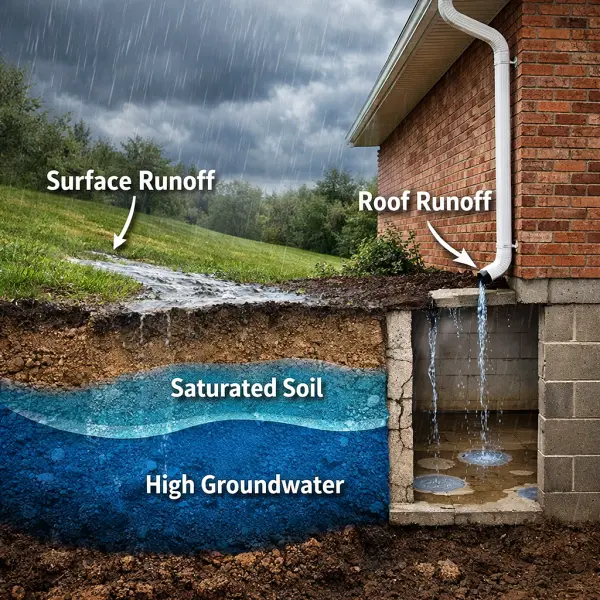
While surface runoff patterns can influence how water moves across a property, they are rarely the only factor involved in foundation moisture conditions. In many situations, surface flow interacts with deeper soil behavior and subsurface water dynamics.
For example, if soil near the foundation is already saturated from prior storms, even moderate rainfall can generate additional runoff. When saturated soil (soil that has reached its moisture capacity) cannot absorb incoming water, excess runoff may accumulate more quickly near the home.
Groundwater conditions can also affect how surface drainage behaves. In areas with high seasonal groundwater levels, subsurface moisture may rise toward foundation depth. In these cases, surface runoff becomes one contributing factor layered on top of existing moisture in the soil.
Roof runoff further adds to this interaction. Concentrated discharge from gutters and downspouts can introduce additional water into areas already influenced by yard slope or slow-draining soil (see: downspout discharge issues). When these elements overlap, roof drainage, surface slope, soil saturation, and groundwater, moisture exposure near the foundation can increase.
Because exterior drainage operates as an interconnected system, evaluating only one component may not provide a complete understanding of the issue. Surface runoff, grading conditions, roof discharge, and subsurface moisture often work together to shape how water behaves around a home.
Recognizing this broader context helps prevent oversimplified conclusions and supports a more accurate assessment of potential contributing factors.
Key Takeaways
- Surface runoff occurs when rainwater flows across the ground instead of soaking into the soil.
- Yard drainage determines how this water moves across a property and whether it flows toward or away from the home.
- Poor drainage patterns can allow water to collect near the foundation or repeatedly flow toward basement walls.
- Improving yard drainage can help redirect runoff and reduce moisture exposure around the home.
Where To Go Next
If you want to explore other exterior drainage factors:
If surface runoff may already be affecting the home:
If recurring runoff or drainage issues continue:
If you want to understand foundation water problems where you live:
Frequently Asked Questions About Surface Runoff and Yard Drainage
Can surface runoff alone cause basement water problems?
In some situations, yes. If water consistently flows toward the foundation during storms, repeated soil saturation may increase moisture exposure along below-grade walls. However, surface runoff is often one of several contributing factors. Soil type, roof drainage, and groundwater conditions may also influence how water affects a foundation.
How can I tell where runoff is coming from?
Observing the yard during or shortly after heavy rain can provide useful insight. Flow lines in grass, erosion patterns, or areas where water consistently pools may reveal the direction runoff is traveling. In some cases, runoff may originate from higher ground or neighboring properties rather than from the immediate yard surface.
Can neighbor drainage affect my foundation?
Yes, in some situations. Water does not always stay within property lines, and runoff from neighboring yards can influence how water moves across adjacent lots. If nearby grading directs water toward your property, or if runoff collects near shared boundaries, additional moisture may accumulate around the foundation. Local topography, drainage patterns, and soil conditions all play a role in how neighboring runoff affects a home.
Why does water pool after every storm?
Repeated pooling often occurs when water cannot drain away efficiently. Common causes include low areas in the yard, compacted or saturated soil, poor grading, or runoff being concentrated by roofs, driveways, patios, or other hard surfaces. While temporary puddles after heavy rain are common, water that consistently remains in the same location may indicate a drainage pattern that deserves closer evaluation.
Can landscaping changes affect surface drainage?
Yes. Adding berms (raised mounds of soil designed to redirect water), flower beds, edging materials, or other landscape features can subtly alter how water flows across a property. Even small changes in elevation or soil buildup may redirect runoff toward areas where it was not originally intended to collect.
Home › Exterior Water Problems › Surface Runoff and Yard Drainage