
Soil Compaction and Foundation Drainage
Soil around a home does more than support the landscape. The amount of space between soil particles influences how easily water can enter the ground, move through it, and drain away from a foundation.
When soil becomes compacted, those spaces can be reduced. This can change how the ground accepts rainfall and may contribute to increased surface runoff, slower infiltration, or uneven moisture conditions around a home.
Understanding soil compaction helps explain why two areas with similar soil may respond very differently to the same amount of water.
What Is Soil Compaction?
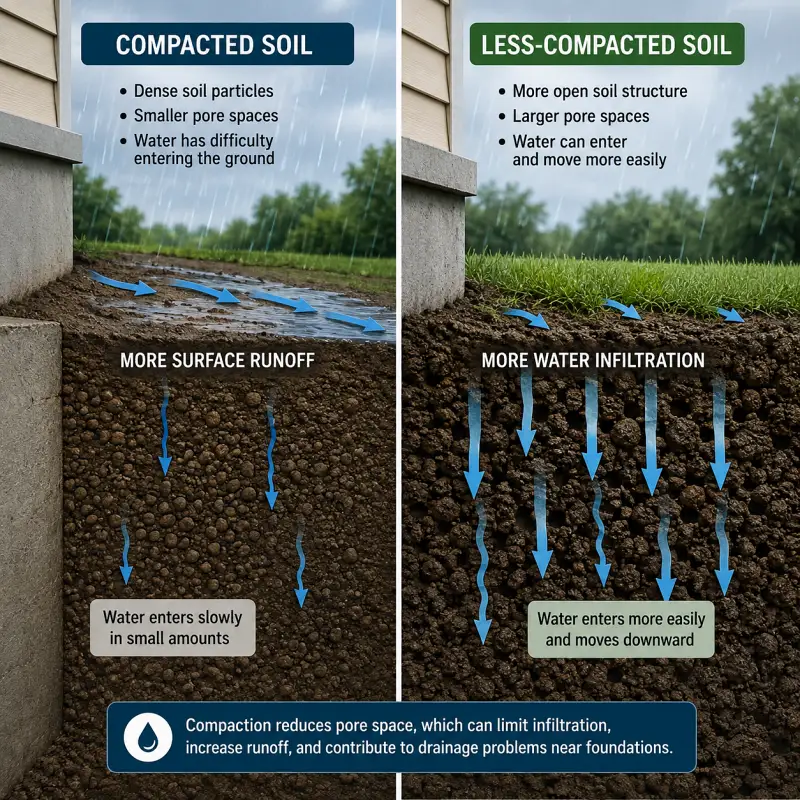
Soil compaction occurs when soil particles are pressed more closely together, reducing the pore spaces between them. These spaces normally hold air and water and provide pathways for moisture to move through the ground.
Compaction can occur naturally, but it is also commonly associated with construction, grading, heavy equipment, repeated foot or vehicle traffic, and other activities that place pressure on the soil.
Compacted soil is not automatically a drainage problem. Its effect depends on the soil type, degree and depth of compaction, surrounding soil layers, grading, rainfall, and other site conditions.
Around a foundation, those differences matter because compaction can influence whether water enters the soil, remains near the surface, or moves elsewhere across the property.
Why Soil Becomes Compacted Around a Home
Soil can become compacted whenever repeated pressure pushes its particles closer together. Around homes, this commonly happens during construction when heavy equipment travels across the site or soil is moved, placed, and graded.
Compaction can also develop later from repeated vehicle or foot traffic, landscaping work, equipment use, or activity concentrated in the same areas of a property. Some soils are also naturally denser than others.
Around foundations, intentionally compacted soil may be part of normal site preparation or construction. The important question is not simply whether soil is compacted, but how that compaction affects water movement in combination with the soil type, grading, and surrounding ground conditions.
“Compacted soil is not automatically a drainage problem. What matters is how the soil’s density, composition, and surrounding conditions influence where water can enter and move through the ground.”
— Foundation Water Guide Editorial Team
How Compaction Changes Water Movement
Compaction changes the size and arrangement of pore spaces within soil. Because those spaces provide pathways for water, changing them can affect how quickly rainfall enters the ground, how much remains at the surface, and where moisture moves next.
The effect is not identical in every soil. Soil type, depth of compaction, existing moisture, grading, and underlying layers all influence the outcome. For a broader explanation, see How Water Moves Through Different Soil Types.
Reduced Water Infiltration
When soil particles are pressed closer together, the pathways available for water to enter and move through the ground can become smaller or less connected.
As a result, compacted surface soil may accept rainfall more slowly than nearby less-compacted ground. If water arrives faster than the soil can absorb it, moisture can begin accumulating at the surface.
This effect can vary significantly by soil type. Compacted clay, for example, may behave very differently from compacted sandy or coarse soil.
Increased Surface Runoff
When water cannot enter the ground quickly enough, more of it may travel across the surface as runoff.
Where that water goes depends heavily on the surrounding grade. If the ground slopes away from the home, runoff may continue away from the foundation. If the grade is flat, uneven, or slopes toward the structure, water may collect in low areas or move toward the home.
This is why soil compaction and poor grading around the foundation can sometimes create a combined drainage problem.
Slower Drainage and Persistent Wet Areas
Compaction can also contribute to uneven moisture patterns. Water may move through one area relatively easily but slow when it encounters a denser layer or another soil with different drainage characteristics.
Under some conditions, this can contribute to persistent wet areas or moisture collecting above or alongside less-permeable soil layers.
However, a wet area does not prove that compaction is responsible. High groundwater, poor grading, soil type, surface runoff, irrigation, and other conditions can produce similar symptoms.
Compacted Soil vs. Looser Soil
Compacted and looser soil can respond differently to rainfall because the amount and arrangement of pore space affects how easily water enters and moves through the ground. These are general tendencies rather than a way to diagnose conditions at a specific property.
| Ground condition | Compacted soil | Looser soil | Why it may matter |
|---|---|---|---|
| Pore space | Generally reduced | Generally greater | Influences pathways available for air and water |
| Water infiltration | May be slower | May allow faster entry | Affects how quickly rainfall enters the ground |
| Surface runoff | May increase when infiltration is limited | May be reduced when water can enter readily | Influences where rainfall travels across the property |
| Water movement | Can be slower or redirected | May move more freely through connected pore spaces | Can create different moisture patterns |
| Settlement | Typically less susceptible to additional compression when adequately compacted | Loose or disturbed soil may consolidate over time | Can contribute to changing ground elevations |
| Foundation drainage | May encourage surface flow under some conditions | May allow more infiltration near the foundation | Neither condition is automatically better; grading and soil type also matter |
Signs Soil Compaction May Be Affecting Drainage
Soil compaction is difficult to identify from appearance alone, but certain drainage patterns may suggest that water is having difficulty entering or moving through the ground.
Homeowners may notice:
- Water pooling on the ground after rainfall
- Runoff flowing across areas that remain relatively hard or bare
- Soil that stays wet at the surface while nearby areas drain more quickly
- Erosion channels where repeated runoff follows the same path
- Sparse vegetation or difficulty establishing plants in heavily traveled areas
- Water repeatedly collecting in low spots near the foundation
- Noticeably different drainage between adjacent areas of the yard
These signs do not confirm that soil compaction is the cause. Poor grading, soil type, heavy rainfall, surface runoff, groundwater, and other conditions can create similar patterns.
The more useful clue is often a repeating pattern, especially when water consistently pools or runs off one area differently from the surrounding ground.
How Compaction Interacts With Grading and Soil Type
Compaction is only one factor controlling how water behaves around a foundation. The same degree of compaction can produce very different drainage patterns depending on the type of soil, the slope of the ground, and whether the soil was naturally occurring or placed during construction.
Looking at these conditions together provides a more useful picture than treating compaction as an isolated problem.
Compaction and Soil Type
Different soils respond differently when compacted. Fine-grained soils such as clay and silt generally contain smaller pore spaces, while sandy and coarse soils typically contain larger pathways for water.
Compaction can reduce or alter those pathways, but the resulting drainage behavior still depends heavily on the underlying soil composition. This is why two compacted areas may respond differently to the same rainfall.
Compaction and Grading
Grading determines where surface water tends to travel, while compaction can influence how much of that water enters the ground along the way.
When compacted soil limits infiltration, the slope of the property becomes especially important. Ground that slopes away from the foundation may help carry runoff away, while flat areas or poor grading around the foundation may allow water to collect or move toward the home.
In other words, compaction can affect how much water stays on the surface; grading helps determine where that surface water goes.
Compaction and Fill Soil
Fill soil is commonly placed and compacted during construction to establish grades, replace excavated material, or prepare areas around a foundation.
How that fill behaves depends on its composition, how it was placed, and the degree of compaction. It may also behave differently from the native soil beside or beneath it, creating transitions where water movement changes.
Our Fill Soil vs. Native Soil Around Foundations guide explains these differences in more detail.
Can Compacted Soil Contribute to Foundation Water Problems?
Yes. Compacted soil can contribute to foundation water problems when it changes how water enters, drains through, or moves across the ground around a home.
If infiltration is limited, more rainfall may remain at the surface and travel as runoff. Depending on the grading, that water may collect near the foundation or repeatedly saturate certain areas. Compacted layers can also interact with other soil layers and create uneven moisture conditions below the surface.
Over time, persistent moisture may contribute to conditions associated with water pooling near the foundation, basement or crawl-space moisture, and changes in moisture-sensitive soils.
However, compaction alone does not mean a foundation water problem will develop. Soil type, grading, rainfall, groundwater, drainage systems, foundation design, and other site conditions all influence what ultimately happens.
When Compacted Soil Conditions May Need Closer Evaluation
Compacted soil may deserve closer attention when drainage problems are persistent, concentrated near the foundation, or accompanied by other changes around the home.
A closer evaluation may be useful when you notice:
- Water repeatedly pooling near the foundation after rainfall
- Runoff consistently moving toward the home
- Areas that remain wet significantly longer than surrounding ground
- Recurring erosion caused by surface water following the same path
- Drainage patterns that changed after construction, grading, or landscaping
- Basement or crawl-space moisture appearing along with exterior drainage problems
- New or changing signs of foundation movement
A professional can evaluate the soil, grading, drainage pathways, and foundation together rather than assuming compaction is responsible based on surface observations alone.
Key Takeaways
- Compaction reduces pore space, changing how water enters and moves through soil.
- Compacted soil can increase runoff and uneven moisture.
- Soil type, grading, and surrounding conditions determine how much compaction matters.
- Compaction affects infiltration; grading influences where runoff goes.
- Recurring pooling or wet areas may warrant closer evaluation.
Where To Go Next
To understand related soil conditions:
If water is collecting or moving toward the foundation:
If you’re seeing signs of foundation movement:
For local conditions:
Frequently Asked Questions About Soil Compaction and Foundation Drainage
What causes soil to become compacted?
Soil can become compacted from construction equipment, grading, vehicle or foot traffic, landscaping activity, and other repeated pressure. Some soils may also be naturally dense.
Does compacted soil absorb less water?
Compacted soil often allows water to enter more slowly because the pore spaces between soil particles have been reduced. The effect varies with soil type, moisture conditions, and the depth and degree of compaction.
Can compacted soil cause water to pool near a foundation?
It can contribute to pooling when rainfall enters the ground more slowly than it arrives. Whether water collects near the foundation also depends on grading, soil type, drainage pathways, and other site conditions.
Is clay soil always compacted?
No. Clay describes soil composition, while compaction describes how densely soil particles are packed together. Clay can be compacted or relatively undisturbed, just as other soil types can.
Can soil compaction contribute to foundation problems?
Home › Soil & Ground Conditions › Soil Compaction and Foundation Drainage