
Does Homeowners Insurance Cover Basement Water?
Basement water problems can be confusing because the cause is not always obvious. In some homes, water appears after heavy rain. In others, it may develop gradually through damp walls, floor seepage, or recurring moisture near the foundation.
Because different water sources create different types of damage, insurance questions often depend on how the water entered the basement and what caused the problem in the first place.
Understanding the source of basement water can help homeowners better evaluate why some situations may be covered while others may fall outside a standard policy.
Basement Water Situations and Insurance Considerations
| Water Source | Insurance Questions Often Focus On |
|---|---|
| Sudden plumbing failure | Whether the event was accidental and unexpected |
| Appliance or water heater leak | How the water entered the basement |
| Roof runoff or drainage issues | Whether exterior water conditions contributed |
| Groundwater or soil saturation | The source of moisture around the foundation |
| Repeated seepage over time | Whether the issue developed gradually |
“When evaluating basement water events, the source of the water is often just as important as the damage it causes. Understanding how the water entered the basement can help homeowners ask better questions about coverage.”
— Foundation Water Guide Editorial Team
Why Insurance Coverage Often Depends on the Source of the Water
Not all basement water problems begin the same way.
Some water issues are associated with a sudden plumbing failure or an unexpected appliance leak. Others are related to conditions outside the home, such as roof runoff, poor drainage, saturated soil, or groundwater pressure near the foundation.
Because of this, insurance discussions often focus on the cause of the water, not just the fact that water entered the basement. Understanding how water enters a foundation can help explain why basement water situations are often treated differently.
Sudden Interior Water Events
Some basement water problems begin with an interior issue such as a burst pipe, failed water heater, or other sudden plumbing-related event.
In many cases, homeowners first try to determine whether the water came from inside the home or from conditions outside the foundation.
Exterior Drainage Problems
Water may also enter a basement because of drainage conditions around the home. For example, roof runoff, poor grading, or yard drainage problems can allow water to collect near the foundation.
Issues such as downspout discharge problems, poor grading around the foundation, and surface runoff and yard drainage may all contribute to basement moisture.
Groundwater and Soil Pressure
In some homes, water pressure in the surrounding soil can force moisture toward basement walls or up through the slab.
These conditions are often associated with surface water vs groundwater, seasonal saturation, or changing soil conditions around the home.
Ongoing Seepage or Repeated Moisture
Some homeowners experience recurring dampness rather than one obvious flooding event. Water may appear repeatedly at the wall-floor joint, through basement walls, or as a musty damp environment over time.
When moisture is recurring, it may help to review related issues such as water in the basement, wet basement walls, or musty smell or damp basement conditions.
Does Insurance Cover Water Damage in a Basement?
Coverage often depends on where the water came from and whether the event was sudden or ongoing.
Homeowners usually begin by asking whether the water resulted from:
- an interior plumbing problem
- roof or drainage issues outside the home
- groundwater or soil-related moisture around the foundation
- repeated seepage over time
Because policies vary, this page is intended only as an educational overview of why basement water claims are often evaluated based on the source of the problem rather than the location of the damage alone.
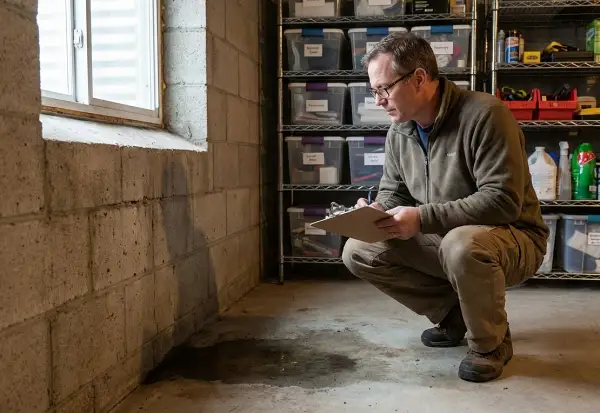
When Basement Water May Point to a Larger Foundation Drainage Issue
If basement water appears after rainfall, during seasonal saturation, or alongside damp walls, musty odors, or seepage through the floor, the issue may be related to broader drainage conditions around the home.
In these situations, water may be influenced by:
- roof runoff collecting near the foundation
- poor grading that directs water toward the house
- saturated soil around basement walls
- moisture moving upward through the slab
These patterns are often easier to understand when homeowners review broader foundation water risk factors and learn whether the issue may be part of a larger foundation water problem.
Frequently Asked Questions About Homeowners Insurance and Basement Water
Does homeowners insurance always cover basement water damage?
Why does the source of the water matter?
Can drainage problems contribute to basement water?
Is groundwater the same as a plumbing leak?
What should homeowners do after discovering water in a basement?
Home › Foundation Water Problem Questions › Does Homeowners Insurance Cover Basement Water?